Feeds:
Posts
Comments

By Sue Shekut, Owner, Working Well Massage, Licensed Massage Therapist, Certified Wellness Coach, ACSM Personal Trainer

At an early age I had to turn away from the processed foods I so loved growing up to the healthier whole grain, fruit and veggie and meats diet that doctors and other health care providers now embrace. In college, I tried eating as a vegetarian, reading “Diet for a Small Planet” and trying hummus, falafel and garbanzo bean curry for the first time. I felt better, my skin looked better and once I realized that eating an entire jar of peanut butter, no matter how organic, was a bad diet move, I lost some of my teenage belly fat.
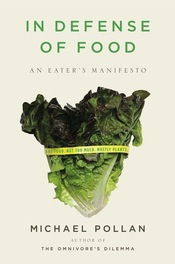
In Defense of Food

Now there’s a new book that talks about the American diet in a hopeful new way: Michael Pollan’s In Defense of Food here. Read an excerpt from his blog about the book:

Most of what we’re consuming today is not food, and how we’re consuming it — in the car, in front of the TV, and increasingly alone — is not really eating. Instead of food, we’re consuming “edible foodlike substances” — no longer the products of nature but of food science. Many of them come packaged with health claims that should be our first clue they are anything but healthy. In the so-called Western diet, food has been replaced by nutrients, and common sense by confusion. The result is what Michael Pollan calls the American paradox: The more we worry about nutrition, the less healthy we seem to become.

But if real food — the sort of food our great grandmothers would recognize as food — stands in need of defense, from whom does it need defending? From the food industry on one side and nutritional science on the other. Both stand to gain much from widespread confusion about what to eat, a question that for most of human history people have been able to answer without expert help. Yet the professionalization of eating has failed to make Americans healthier. Thirty years of official nutritional advice has only made us sicker and fatter while ruining countless numbers of meals.

Pollan proposes a new (and very old) answer to the question of what we should eat that comes down to seven simple but liberating words: Eat food. Not too much. Mostly plants. By urging us to once again eat food, he challenges the prevailing nutrient-by-nutrient approach — what he calls nutritionism — and proposes an alternative way of eating that is informed by the traditions and ecology of real, well-grown, unprocessed food. Our personal health, he argues, cannot be divorced from the health of the food chains of which we are part.

In Defense of Food shows us how, despite the daunting dietary landscape Americans confront in the modern supermarket, we can escape the Western diet and, by doing so, most of the chronic diseases that diet causes. We can relearn which foods are healthy, develop simple ways to moderate our appetites, and return eating to its proper context — out of the car and back to the table. Michael Pollan’s bracing and eloquent manifesto shows us how we can start making thoughtful food choices that will enrich our lives, enlarge our sense of what it means to be healthy, and bring pleasure back to eating.

Pollan’s last book, The Omnivore’s Dilemma, launched a national conversation about the American way of eating; now In Defense of Food shows us how to change it, one meal at a time.

Order Pollan’s book from Amazon here for about $15.00.

Reblog this post [with Zemanta]
Outdoor practice in Beijing's Temple of Heaven.
Image via Wikipedia

By Sue Shekut, Owner, Working Well Massage, Licensed Massage Therapist, Certified Wellness Coach, ACSM Personal Trainer

Unfortunately, Wii Fit does not have any Tai Chi training. At least,  not yet. Some of my clients are clammering for a tai chi module for Wii Fit, or even a separate Wii game with Tai Chi. At this time, however, if you want to learn Tai Chi, you’ll have to do it the “old fashioned way,” with a video or DVD.

What is Tai Chi Anyway?

According to the Mayoclinic: “Tai chi, also called tai chi chuan, is a noncompetitive, self-paced system of gentle physical exercise and stretching. To do tai chi, you perform a series of postures or movements in a slow, graceful manner. Each posture flows into the next without pause, ensuring that your body is in constant motion.

Tai chi has many different styles, such as yang and wu. Each style may have its own subtle emphasis on various tai chi principles and methods. There are also variations within each style. Some may focus on health maintenance, while others focus on the martial arts aspect of tai chi.

The result of all this variation is that there are more than 100 possible movements and positions with tai chi, many of which are named for animals or nature. Regardless of the variation, all forms of tai chi include rhythmic patterns of movement that are coordinated with breathing to help you achieve a sense of inner calm. The concentration required for tai chi forces you to live in the present moment, putting aside distressing thoughts.”

Read the entire article about Tai Chi from the Mayoclinic here.

David Carradine‘s AM & PM Tai Chi Workout for Beginners (1999)

One of the highest rankings videos for Tai Chi on Amazon is the David Carradine Tai Chi Workout.

While David Carradine is no longer with us, his Tai Chi routines are preserved on DVD and have great rewview. Plus who wouldn’t want to learn a martial art from an old friend, aka Kung Fu from the old television show of theh same name.

Here’s What Amazon Reviewers Say About David’s AM & PM Tai Chi Workout DVD:

• Both the Chi Engery Workout and this one include Arnold Tayam as the instructor. David Carradine does all the talking and the other students and the instructor follow along.

There are two 1-hour workouts on this DVD. The AM is really called Tai Chi for the Mind and can be done either in the AM or the PM. You work on your Chi Engergy similar to David’s other DVD called Chi Energy Workout. You start out with stretching to warm up your muscles, then you move on to the stances, Tai Chi Ball movements, and The 8 Moves of Chi Kung. You end your practice with Dan Tien Ball Rotation. It is a wonderful way to get in touch with your internal energies and is a very gentle workout for your body.

The PM workout is really called Tai Chi for the Body. Again, you could do this workout any time of day. You start out with stretching, move on to individual stances, and then it is put together in Combination and The Complete Form. I am still working on the individual stances and have begun working on the Combination, which ties all the stances together. I will wait to use the Complete Form segment until I feel comfortable with the movements.

You also get a wonderful meditation with David Carradine. I love his voice and even though it is a still picture on the TV during the mediation, it is okay since your eyes are closed. I lay down during the mediation, but you can also sit in a cross-legged position, or in a chair.

• I bought this DVD because I need to regain some agility and lose some weight. I limbered up after about two weeks. The weight loss will take longer, but I’m in no hurry. It is a good program for someone who has poor coordination and zero athletic ability, and hates to exercise.

• The tape is easier to follow than I expected. Following David Carradine’s voice is very soothing. My doctors have recommended Tai Chi for my arthritis, to help movement but also for the breathing and relaxing capabilities. Don’t get me wrong Tai Chi is difficult to learn because itself is very complex, but the tape is easier to follow than others I have seen.
Read more Amazon reviews here. Order the DVD from Amazon here.

Or go online and learn Tai Chi for free using this online program by Al Simon, here.

Check out this article on Wii Fit Plus and Tai Chi. No,  Wii has not added a Tai Chi module as of yet. But this article does show some Tai Chi moves and suggestions for using Wii Fit Plus to make movements similar to Tai Chi.

Enhanced by Zemanta

By Sue Shekut, Owner, Working Well Massage, Licensed Massage Therapist, Certified Wellness Coach, ACSM Personal Trainer

We all struggle with procrastination at times.   I struggle with focus when I am distracted or overwhelmed. Knowing this about myself helps me better prioritize my day and stay on task.  Interestingly, I came across a post linking ADHD to procrastination from the Associated Press. The author, Bruce Ziebarth, offers his tips for dealing with procrastination as an ADHD sufferer. I am sharing a snippet of the article here. If it interests you, click to link below to read the entire article at assocatedcontent.com.

Link Between Adult ADHD and Procrastination

Bruce Ziebarth

by Bruce Ziebarth

Many people procrastinate. People procrastinate for a variety of reasons; sometimes we just do not feel like doing something, sometimes there is something we want to do more, and sometimes we are just being lazy. No matter who you are, you have probably fought with procrastination. For people with Adult ADHD, procrastination is more than an annoying fact.

Adult ADHD is not a simple condition like cancer or diabetes. Adult ADHD is made up of symptoms from many different categories. A person receives an Adult ADHD diagnosis by showing several of the symptoms including trouble with organization, paying attention, finishing a task, etc. These symptoms must also rise to the level of interfering with daily living. Adult ADHD’s broad range of symptoms makes it difficult to address everyone’s needs. However, whether you have Adult ADHD or not, the strategies outlined here will help you identify why you procrastinate and help avoid future procrastination.

Read Bruce Ziebarth entire article on ADHD and Procrastination here.

Reblog this post [with Zemanta]
Pilsen and Pollution
Image by Señor Codo via Flickr

Bu Sue Shekut, Owner, Working Well Massage, Licensed Massage Therapist, Certified Wellness Coach, ACSM Personal Trainer

Normally, I am a big advocate of getting outdoors and getting some fresh air. but not today. The National Weather Service has issued an Air Quality Alert for Chicago today, warning people that outdoor activities like brisk walking and running could make them sick.

According to Pamela Jones of  CBS News:  The problem is tiny particles and they could put the health of people in Illinois, Indiana and Wisconsin at risk. Each particle is less than 2.5 millionths of a meter in diameter. By comparison, a human hair is about 80 to 100 millionths of a meter across, said Brian Urbaszewski, director of environmental health programs for the Respiratory Health Association of Greater Chicago.

But why are pollution levels suddenly higher?

Every day, dangerous fine particulate matter is pumped into the air by cars, trucks, coal-fired power plants, and factories. But on most days, we have wind or rain that moves the pollution away and spreads it out, so it doesn’t stay concentrated at unhealthy levels, Urbaszewksi said.

“What’s happening now is we have a high-pressure system, which basically means that the air is sinking so that all the population is being compressed into the ground and concentrated, and we don’t have any winds today,” Urbaszewski said. “So we’re being forced, essentially, to breathe what we produced.”

“It is pretty rare. Normally we hear about air pollution action days in the summer, but in the winter time there can be higher levels of particulate matter in the air, and the cold weather can cause that,” said Katie Lorenz of the American Lung Association.
Such tiny particles in the air could pose a lot of problems, especially for those with illnesses like asthma or allergies. Doctors say people shouldn’t ignore the symptoms.

Dr. Lindsey Buswell-Cleary of Michigan Avenue Immediate Care says to see the doctor “if you’re having trouble breathing, if you feel like your chest is tight, you can’t fully take a deep breath or you’re having a cough that’s just persistent.”

The Illinois EPA suggests that people try to cut down on pollution during these action days, by carpooling or taking public transportation. And if you have to drive, try running errands in the evening.

Read the entire article here.

For more information, click the links below.

National Weather Service: Air Quality Alert

Partners for Clean Air

Reblog this post [with Zemanta]

By Sue Shekut, Owner, Working Well Massage, Licensed Massage Therapist, Certified Wellness Coach, ACSM Personal Trainer

Once again, Life-Sized Business has a great post I want to share about creating a workplace wellness program. If you are an employee that has a wellness program at work, ask yourself if your HR staff or management has followed the advice from this post.  you are an HR staff person or manager, read on for Elizabeth Cogswell Baskin’s advice on what makes a workplace wellness program more effective. And remember, wellness programs are only as effective if the employees make good use of them!

5 Tips: How to Increase Employee Engagement with Workplace Wellness Programs

The key to a successful workplace wellness program is employee engagement. The reverse is also true. That is, one way to increase employee engagement is a successful wellness program.

Yesterday we were in a client’s break room, waiting for a meeting room to open up , and I noticed several flyers on the bulletin board about various wellness offerings. I was surprised by my initial reaction, which was, “Who would sign up for those?”

Why did they strike me as loser offerings? Because they seemed preachy and goody-goody and completely devoid of anything fun. One sounded like the school nurse was going to take you through a lecture on the five food groups. I’m not suggesting that wellness should be a barrel of laughs, but a good program creates energy and involvement. The more employees you can get to participate, the stronger your program will be.

An effective wellness program will do more than just increase productivity because people feel better and have more energy. It also gives co-workers a chance to do something together that’s unrelated to their usual work roles. It equals the playing field, so to speak, in a way that lets junior employees spend some time on an equal footing with those who rank above them in the company hierarchy. It will also build relationships between people in different departments, which helps smooth the way to better teamwork and increased collaboration.

So how do you create a wellness program with plenty of employee engagement? Here are five tips:

1. Ask the employees what they want. Particularly in a small company, you can solicit input from the group. You can do a survey, if you want, but it might be easier just to ask people about their wellness concerns. Are they looking for ways to find time for exercise? Do they really wish they could quit smoking? Are they trying to eat healthier?

2. Get their help in constructing the program. Give some influential employees ownership of developing the program. If the group wants a yoga class at lunch, let an employee track down a good yoga instructor willing to do a class in the conference room. If they’re interested in a buddy-system diet, let an employee research South Beach vs. The Zone vs. WeightWatchers.

3. Make sure management joins in. The top level people in the company need to suit up and show up. If you give the impression that the boss is too busy for exercise, for example, employees might interpret the fitness program as something meant only for those who aren’t as serious about their work. Besides making it clear that you’re committed to wellness, it adds extra motivation for participation, at least by those employees who want more chances to rub shoulders with the boss.

4. Add an element of competition. Put together a contest with some level of cash prize, or a free day off, or something employees will see as worth their while. Look for a way to compete that doesn’t automatically give an advantage to the fittest among the group. For instance, instead of a contest to see who can bench press the most weight, compete on who can complete three workouts a week for the most weeks.

5. Create a collaborative goal. If your group tends to get a little too competitive, choose a goal they work towards together. Maybe after the employees collectively walk or run 10,000 miles, the company donates $1,000 to a worthy cause. Or let the collaborative goal benefit the employees more directly. After they lose so many pounds as a group, you’ll hire a massage therapist to give chair massages on Friday afternoon.

Read the Entire blog post at Life-Sized Business blog here.

Reblog this post [with Zemanta]
Margarine in a tub
Image via Wikipedia

By Sue Shekut, Owner, Working Well Massage, Licensed Massage Therapists, Certified Wellness Coach, ACSM Personal Trainer

Even though my blood pressure is low to normal, I personally tend to avoid margarine and butter, opting for olive or canola oil when I cook with oil at all.  However, in the winter, I do indulge in a small sliver of butter on toast when I am working long hours doing massage or exercising and burning off calories quickly. But to me, a “sliver” of butter is about an 8th of a restaurant sized pad of butter, which is what most people would use! Fruit is the only sugar my body can tolerate.  Most people find that as they eliminate the corn sweetened foods and trans fat foods, real food, vegetables, fruits and whole grains taste much better than they thought.

Health Information World has a great article on reducing high blood pressure by implementing simple changes in your diet.  According to their Medical Conditions blog, Trans Fats and High Fructose Corn Sweeteners are the Frankenfoods of today.

The excerpt below is from their article,  “Simple Steps To Follow To Prevent High Blood Pressure.”

As an important point, two specific processed foods are now obviously linked to obesity and raised blood pressure. They are hydrogenated, or trans-, fats and high fructose sweeteners. These freaks can justly be called ‘Frankenstein Foods’ as examples of science gone wrong.

Trans-fats undergo a process that turns liquid oil into solid fat. We know this substance most commonly as margarine. The features of many of those margarines are no coincidence ; the chemical structure of hydrogenated fat is analogous to plastic. Unnecessary to say, trans-fats don’t happen naturally.

Ironically, margarine and other hydrogenated fats were once promoted as healthy choices to saturated fats. But we know now that natural fats contain trace minerals, amino acids and other nutrients essential to good health. Its hydrogenated fats that are the monsters.

Consumers need to read food labels carefully and treat hydrogenated fats with caution. And if you have raised blood pressure you should avoid them like the plague. Naturally, with extensive coverage of the health dangers of trans-fats this advice may appear old hat. A number of progressive shops and food producers have even taken the first steps to ban trans-fats in their products.

Another known cause of high blood pressure is high fructose syrups. These sweeteners were similarly promoted as healthy choices to the feared cane sugar. Food producers have pulled the wool over the publics eye by stressing the association of the name ‘fructose’ with fruit. Fruit contains fructose but it is in no fashion the same substance as the high fructose syrups, most frequently corn syrup, used in the food industry.

Read the entire article, “Simple Steps To Follow To Prevent High Blood Pressure” here.

Reblog this post [with Zemanta]
A typical TV Dinner.
Image via Wikipedia

By Sue Shekut, Owner, Working Well Massage, Licensed Massage Therapist, Certified Wellness Coach, ACSM Personal Trainer

Does eating certain foods make you sick? Obviously foods that are spoiled or have bacteria from sitting unrefrigerated too long can make you ill. However, what about foods that taste good and seem to be ok to eat? Like table salt, fast food and so forth. Recently I had a dear friend find out that his high blood pressure was preventing him from obtaining a lucrative government job. So we went on a grocery shopping mission to find foods he could eat that were healthier and less salty than the packaged and processed foods he accustomed to eating. It truly amazes me how small portions of frozen dinners often contain more fat, salt and calories than a huge pile of steamed veggies and meat!

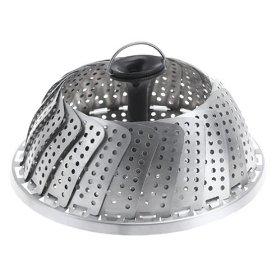
One of the simplest healthy eating devices I introduced my friend to was the vegetable steamer. Yes, the metal steamer that you can insert in a pot with a little water and steam your veggies for dinner or lunch. Steaming is one of the best ways to cook vegetables. It leaves more of the vegetable’s natural taste,  color and nutrients intact than any other method, and it requires no added fat. If you buy fresh produce like broccoli, and steam it instead of eating a tv dinner, you cut out a whole lot of unnecessary salt added to improve the taste of basically old frozen meat and veggies. You also cut out a lot of fat and other chemicals used to preserve the food and add flavor to what really is an unappetizing dish!

You can  buy a stainless steel veggie steamer from most stores including Target, Kmart, Bed Bath & Beyond or Amazon. The Trudeau Steamer runs about $17.00 at Amazon right now. Link here.

Trudeau Veggie Steamer

Read more on “How to Use a Veggie Steamer” here.

Watch a video on how to steam veggies here.

Reblog this post [with Zemanta]

By Sue Shekut, Owner, Working Well Massage, Licensed Massage Therapists, Certified Wellness Coach, ACSM Personal Trainer

So you are in a hurry and want to grab a quick bite. What’s your best bet calorie for dollar? Men’s Health magazine does such a  great job of explaining which fast food meal selections are better for you with their “Eat This Not That “column. They now made it into a  book.

A sample of the trade off between a few extra cents or bucks and the increase to your fat and calorie consumption from the Men’s Health article, “4 Must-Know Restaurant Secret’s,” By David Zinczenko, with Matt Goulding –  here.

Here’s exactly how expensive it really is whenever you go for the “bargain”:

  • 7-Eleven: Gulp to Double Gulp Coca-Cola Classic: 37 cents extra buys 450 more calories.
  • Cinnabon: Minibon to Classic Cinnabon: 48 more cents buys 370 more calories.
  • Movie theater: Small to medium unbuttered popcorn: 71 additional cents buys you 500 more calories.
  • Convenience store: Regular to “The Big One” Snickers: 33 more cents packs on 230 more calories.
  • McDonald’s: Quarter Pounder with Cheese to Medium Quarter Pounder with Cheese Extra Value Meal: An additional $1.41 gets you 660 more calories.
  • Subway: 6-inch to 12-inch Tuna Sub: $1.53 more buys 420 more calories.
  • Wendy’s: Classic Double with Cheese to Classic Double with Cheese Old Fashioned Combo Meal: $1.57 extra buys you 600 more calories.
  • Baskin Robbins: Chocolate Chip Ice Cream, Kids’ Scoop, to Double Scoop: For another $1.62, you’ve added 390 calories.

Want the Eat This, Not That info but don’t want to carry around a book. Men’s Health has a solution for you: the new Eat This, Not That iphone app. Check it out here.

Reblog this post [with Zemanta]
An orienteer about to "punch" at a c...
Image via Wikipedia

By Sue Shekut, Owner, Working Well Massage, Licensed Massage Therapist, Certified Wellness Coach, ACSM Personal Trainer

Some  of my clients are active outdoorsmen and women. They hike, they backpack, they climb mountains. Now you can join them in a fun activity called Orienteering. In Chicago, the Chicago Area Orienteering is an active group whose members combine mental exercise with physical exercise. (Information below is from the Chicago Area Orienteering website here.)

What is Orienteering?

Orienteering is a sport that gets you off the roads and into the forest preserves in the Chicago area. It has been popular in Europe for many years and is just starting to be popular here in the US.

For a nominal fee ($10) you are given a detailed 5-color map of the forest preserve that is made by our club. You copy one of the five offered courses onto your map and pick up a Punch Card and a Clue Sheet. The Clue Sheet tells you exactly what natural feature you’re to look for inside each of the 100m diameter circles you’ve drawn on your map. You report to the start table for a start time and then you’re off into the woods, trying to find each of the control features of your chosen course where you punch your card, and return to the finish line in as short a time period as possible.

It’s a fast treasure hunt! Sometimes a compass is nice to use, but usually you can navigate using the features marked on the map, just as you would a street map.

Who Can Participate in Orienteering?

Orienteering is often called the “thinking sport” because it involves map reading and decision-making in addition to a great workout. Orienteering is a sport for everyone, regardless of age or experience. The competitive athlete can experience the exhilaration of running through the woods at top speed, while the non-competitive orienteer can enjoy the forest at a more leisurely pace. If you love maps, exploring, and the great outdoors, try orienteering.

Sounds Like Fun. How Do I Try Orienteering?

Just show up at one of the events. The Chicago Area Orienteering group always offers a free beginner’s clinic that will teach you what you need to know.

Are There Good Books on Orienteering?

A good beginner’s book is Orienteering: The Sport of Navigating with Map and Compass by Steven Boga. You can sometimes find copies at outdoor outfitters such as REI, or Dick’s Sporting Goods. It is also available at Amazon.com. Other orienteering books can be found there, and at orienteering suppliers such as GO Orienteering. But really, there is no need to do any prior study.  Just come to a meet. The best way to learn is by doing.

When Does the Orienteering  Day Begin

Most local meets begin at 9:30 a.m. on respective Sundays with a Beginners’ Clinic for first-timers. Master maps and registration are available too, so orienteers can be ready to go by the time first starts are handed out at 10 a.m. Meet fees are a reasonable $10 per person (and only $7 for CAOC members). Make sure you bring a whistle for emergencies.

Read more at the Introduction to Orienteering Page here.

2010 Schedule of Local Orienteering Events here.

Upcoming Orienteering events in February and March 2010:

Saturday February 20, 2010: Snowgaine! event info here.
Mississippi Palisades State Park

March 21 Madnaess #3, Country Lane Woods

Reblog this post [with Zemanta]