Feeds:
Posts
Comments

Posts Tagged ‘Workplace Wellness’

By Sue Shekut, Owner, Working Well Massage, Licensed Massage Therapist, Certified Wellness Coach, ACSM Personal Trainer

Most people in the United States Spend 40+ hours at work. And work today typically consists of sitting long hours at a desk in front of  a computer, bent over in forward flexion, necks and shoulders straining to hold the weight of the body up. We’ve traded our active work life (toiling in the fields or doing manual labor) for a sedentary workstyle–which means our bodies don’t get much exercise while we work.  It’s no surprise that obesity and “lifestyle” related diseases are on the rise. Yet what can employers do to combat this trend when the very nature of work is to have employees crank out electronic “work” via computer? Many workplaces are getting creative because they need to get the word done, but realize the costs of not providing movement and nutrition sport for their staff.

Read more to learn how workplaces can integrate and have integrated wellness programs and incentives into the workday:

• Wellness Programs Get Creative from the Wall Street Journal

• Worksite Wellness Program Uses Financial Incentives and Creative Programming to Reduce Absenteeism and Its Related Costs from the US Department of Health and Human Service’s Agency for Healthcare Research and Quality website.

• Health Reform Prompts Employers to get Creative with Wellness from Corporate Wellness Magazine

• Wellness Programs Get Creative from Forbes

Enhanced by Zemanta

Read Full Post »

By Sue Shekut, Owner, Working Well Massage, Licensed Massage Therapist, Certified Wellness Coach, ACSM Personal Trainer

Gentle exercise from EverydayHealth.com

The American Heart Association’s Start! initiative calls on all Americans and their employers to create a culture of physical activity and health to live longer, heart-healthy lives through walking. It offers resources for employers to implement a walking program in the workplace and track employees’ progress in the program. One of Start’s key components, National Start! Walking Day aims to get Americans up and moving for 30 minutes on April 8, 2009. National Start! Walking Day will take place during National Workplace Wellness Week.

Why walk?

There are countless physical activities out there, but walking has the lowest dropout rate of them all! It’s the simplest positive change you can make to effectively improve your heart health. Research has shown that the benefits of walking and moderate physical activity for at least 30 minutes a day can help you:
  • Reduce the risk of coronary heart disease
  • Improve blood pressure and blood sugar levels
  • Improve blood lipid profile
  • Maintain body weight and lower the risk of obesity
  • Enhance mental well being
  • Reduce the risk of osteoporosis
  • Reduce the risk of breast and colon cancer
  • Reduce the risk of non-insulin dependent (type 2) diabetes

There really are so many benefits for such a simple activity!

How To Begin a Walking Program

The AHA offers these steps to begin a walking regimen:
Step 1: Remember that your safety is the most important thing! If you’re a male over 40 or a female over 50, you may want to work with your doctor to set up your exercise program.
Step 2: Get familiar with the American Heart Association’s recommendations for physical activity:

  • Aim for at least 30 minutes of moderate-to-vigorous physical activities, 5 days a week
  • Remember that physical activity can be accumulated throughout the day. Three 10-minute sessions is the same as one 30-minute session!
  • If you’re looking to lose weigh or maintain your current weight, aim for 60-90 minutes of moderate-to-vigorous physical activity each day

Step 3: Always measure the intensity of your exercise to know if you’re pushing yourself too hard or not hard enough. An easy way to do this is by taking the talk test:

  • You should be able to sing while working out at a light intensity level
  • If you’re exercising at a moderate intensity level, you should be able to carry on a conversation comfortably
  • If you become too winded or out of breath to carry on a conversation, the activity can be considered vigorous

You can also download this chart from the American College of Sports Medicine and Center for Disease Control and Prevention, which lists physical activities by their level of intensity. Happy trails!

Reblog this post [with Zemanta]

Read Full Post »

By Sue Shekut, Owner, Working Well Massage, Licensed Massage Therapist, Certified Wellness Coach, ACSM Personal Trainer

Worksite Wellness Programs Increases Productivity and Employee Retention

This coming week is National Workplace Wellness Week!  And no, it’s not just another Hallmark Holiday,  it’s a government resolution to promote workplace wellness.

History of Workplace Wellness Week

In 2008, the the U.S. House of Representatives passed a federal resolution creating National Workplace Wellness Week. The resolution, which was endorsed by the American Heart Association (AHA), Chamber of Commerce, Partnership for Prevention and many other groups, designated the first full week of April as “National Workplace Wellness Week.” During this week, private and public employers across the country are encouraged to invest in the health of their employees by creating worksite employee health promotion programs, or by sharing their worksite wellness experiences with other employers.

Workplace Wellness Statistics

The American Heart Association offers a handy fact sheet with some alarming statistics on workplace wellness:

· Health care costs in the United States doubled from 1990 to 2001 and are expected to double again by 2012

· Chronic illnesses affect more than a third of working-age Americans and the costs associated with chronic diseases account for approximately 75 percent of the nation’s annual health care costs

· Over 130 million Americans are employed across the United States and since a significant part of their day is spent at work, comprehensive, culturally sensitive health promotion within the workplace is essential to maintain and improve the nation’s health

· Nearly 60 percent of employers’ after-tax profits are spent on corporate health benefits. An estimated 25-30 percent of companies’ medical costs per year are spent on employees with excess health risk. That contrasts to three decades ago when only seven percent of corporate profits paid for health costs

· Addressing risk factors early can make a difference. For example, $5.6 billion in heart disease costs could be saved if one-tenth of Americans began a regular walking program

· Employer spending on health promotion and chronic disease prevention is a good business investment. Programs have achieved a rate of return on investment ranging from $3 to $15 for each dollar invested with savings realized between 12 and 18 months

National Workplace Wellness Week starts on April 5th and offers a new approach to some old stubborn problems that employers and employees face related to costs, health, productivity and morale, to mention a few. This information can help any company and can help them to take action to conquer their own health and wellness issues.

Get Well With Working Well Massage

One way to help employees reduce stress, increase productivity and computational skills and reduce muscle tension is to bring in Licensed Massage Therapists from Working Well Massage to give staff members a short chair massage.  Massage is an easy, cost effective way for employers to kick off or inject new energy into a workplace wellness initiative.

If your company already has a workplace massage program, tell us what you like about it! How has it benefited you?

if your company does not provide employees with massages, ask your Human Resources Department to look into it. You, and your fellow staff members, will be glad you did! For information on setting up a workplace wellness program including massage therapy, go to our website.

Reblog this post [with Zemanta]

Read Full Post »

By Sue Shekut, Owner, Working Well Massage, Licensed Massage Therapist, Certified Wellness Coach, ACSM Personal Trainer

Once again, Life-Sized Business has a great post I want to share about creating a workplace wellness program. If you are an employee that has a wellness program at work, ask yourself if your HR staff or management has followed the advice from this post.  you are an HR staff person or manager, read on for Elizabeth Cogswell Baskin’s advice on what makes a workplace wellness program more effective. And remember, wellness programs are only as effective if the employees make good use of them!

5 Tips: How to Increase Employee Engagement with Workplace Wellness Programs

The key to a successful workplace wellness program is employee engagement. The reverse is also true. That is, one way to increase employee engagement is a successful wellness program.

Yesterday we were in a client’s break room, waiting for a meeting room to open up , and I noticed several flyers on the bulletin board about various wellness offerings. I was surprised by my initial reaction, which was, “Who would sign up for those?”

Why did they strike me as loser offerings? Because they seemed preachy and goody-goody and completely devoid of anything fun. One sounded like the school nurse was going to take you through a lecture on the five food groups. I’m not suggesting that wellness should be a barrel of laughs, but a good program creates energy and involvement. The more employees you can get to participate, the stronger your program will be.

An effective wellness program will do more than just increase productivity because people feel better and have more energy. It also gives co-workers a chance to do something together that’s unrelated to their usual work roles. It equals the playing field, so to speak, in a way that lets junior employees spend some time on an equal footing with those who rank above them in the company hierarchy. It will also build relationships between people in different departments, which helps smooth the way to better teamwork and increased collaboration.

So how do you create a wellness program with plenty of employee engagement? Here are five tips:

1. Ask the employees what they want. Particularly in a small company, you can solicit input from the group. You can do a survey, if you want, but it might be easier just to ask people about their wellness concerns. Are they looking for ways to find time for exercise? Do they really wish they could quit smoking? Are they trying to eat healthier?

2. Get their help in constructing the program. Give some influential employees ownership of developing the program. If the group wants a yoga class at lunch, let an employee track down a good yoga instructor willing to do a class in the conference room. If they’re interested in a buddy-system diet, let an employee research South Beach vs. The Zone vs. WeightWatchers.

3. Make sure management joins in. The top level people in the company need to suit up and show up. If you give the impression that the boss is too busy for exercise, for example, employees might interpret the fitness program as something meant only for those who aren’t as serious about their work. Besides making it clear that you’re committed to wellness, it adds extra motivation for participation, at least by those employees who want more chances to rub shoulders with the boss.

4. Add an element of competition. Put together a contest with some level of cash prize, or a free day off, or something employees will see as worth their while. Look for a way to compete that doesn’t automatically give an advantage to the fittest among the group. For instance, instead of a contest to see who can bench press the most weight, compete on who can complete three workouts a week for the most weeks.

5. Create a collaborative goal. If your group tends to get a little too competitive, choose a goal they work towards together. Maybe after the employees collectively walk or run 10,000 miles, the company donates $1,000 to a worthy cause. Or let the collaborative goal benefit the employees more directly. After they lose so many pounds as a group, you’ll hire a massage therapist to give chair massages on Friday afternoon.

Read the Entire blog post at Life-Sized Business blog here.

Reblog this post [with Zemanta]

Read Full Post »

By Sue Shekut, Owner, Working Well Massage, Licensed Massage Therapist, Certified Wellness Coach, ACSM Personal Trainer

From time to time I come across a blog that is well written, has great info and coves areas of wellness that pertain to my readers. Recently I came across the blog, Life-Sized Business written by Elizabeth Cogswell Baskin.  I liked one of her posts so much I want to share it with you (with her permission and proper credit to her blog of course!) Enjoy!

Small Business Strategies: Starting a workplace wellness program might be easier than you think

By Elizabeth Baskin

What can you do in the new year to improve employee morale and productivity without spending a ton of money?
Easy answer: start some level of wellness program in your office. If you’ve ever considered doing something like that, this might be the perfect time.

Wellness programs allow you to give employees something they find meaningful without handing out big pay raises.
Many small companies froze salary increases last year. In others, employees watched people in their company lose their jobs, and were understandably meek about pushing for their own salary reviews. But don’t think that means they’re not thinking about what they give the company for what they get. A workplace wellness program can be a very good way to let employees know you value their contributions.

Of course, it’s also the beginning of a new year.
The perfect time for fresh starts, healthy new habits and lifestyle improvements. Your employees are probably already thinking about what they can do in 2010 to be healthier. A wellness program can help support them in their individual goals. It’s also a powerful way to bring new energy into the workplace.

How do you do it?
You don’t have to build a company gym or pay for an on-site spa chef (although you could). Think in terms of providing flexibility (time) or resources (access). You can pick one element of wellness, like fitness or stress management or healthy eating and focus your program around that area. Or you can put together a small smorgasbord of wellness offerings. Here are a few examples:

• Allow employees extra time for lunch two or three days a week so they can fit in a walk or a run.
At Tribe, we tell employees they can put up to three hours a week on their time sheets for exercise during the workday. We’ve found that whenever someone manages to fit in a workout or  yoga class during the day, they’re likely to come back to the office with a good idea or solution for something they’re working on. If nothing else, their energy level is higher that when they left.

• Use one of those empty offices for a meditation room.
Move the desk out and put a small couch or a comfortable armchair in there instead. Or just put out a few yoga mats or some big floor pillows.  Add a few meditation CDs and a CD player, and you’re good to go. If employees feel comfortable spending 20 minutes meditating in the middle of the day, alone or with a coworker, that can go a long way towards reducing stress levels.

• Put a bowl of fresh fruit in the break room, and stock it weekly.
When employees hit that pre-lunch or mid-afternoon slump, being able to skip the vending machine and grab an apple or banana instead can be a highly appreciated perk. Supporting wellness in the office can actually come down to some very simple (and inexpensive) changes.

The biggest thing employees are looking for in a wellness program is a way for the workplace to support them in living a good life.
As a business owner, you do that by providing meaningful work and fair compensation. But lately, many companies have been asking employees to work harder without the hope of a big, fat salary increase. Especially in this economic environment, one of the best things you can do for your employees is to provide the flexibility and resources for them to take care of their own health.

Read Elizabeth’s Live Sized Business blog here.

Workplace Massage
Of course, an easy and cost-effective way to show your staff you care about their health and well being AND give your company a productivity boast, is to offer workplace massage. Working Well Massage provides massage to corporate clients in and around the Chicago area. Contact us today for a customer proposal for your workplace.

Who is Elizabeth Cogswell Baskin and Why Should We Listen to Her?

Elizabeth Cogswell Baskin is the CEO and Creative Director of Tribe, Inc., a branding company working with national and global clients like UPS, Chick-fil-A and Coca-Cola Enterprises.

She also developed the Starter Cards deck titled “Start Your Own Company,” which takes the gigantic task of launching a business and breaks it down into 52 manageable steps, one step per card. (You can read a recent news story on the cards here.)

She is the author of “Hell Yes! Two Little Words for a Simpler, Happier, Life,” and of a book on women entrepreneurs titled “How to Run Your Business Like a Girl: Successful Strategies from Entrepreneurial Women Who Made It Happen.”

Reblog this post [with Zemanta]

Read Full Post »

By Sue Shekut, Licensed Massage Therapist, ACSM Personal Trainer, Certified Wellness Coach, Owner, Working Well Massage

I like to think of myself as not only a good massage therapist but also a good judge of massage therapists. I’ve had thousands of massages and given thousands of massages. As the owner of a wellness company, I interview many massage therapists and receive regular massage myself. Often, when clients travel or move out of town, they ask me how to find a good massage therapist.

It’s a question very similar to “how do I find a good dentist or a good doctor”. Since massage is a personal service, my first impulse is to say, ask your friends and coworkers who they go to and start there. But then, we’ve all had referrals to service people that our friends liked that were not a good fit for us. (One person may like a deep massage and you may like a lighter touch or vice versa. One person’s fantastic hair stylist may be great for that person but be unable to cut your style of hair well.)

Before you search out massage therapists, take a minute to think about what you want from a massage experience. Then when you call different therapists or massage centers, ask questions to make sure you get the massage therapist that best fits your needs.

Good questions to consider:

1. Are you going for stress relief or pain relief or both? Swedish massage or “relaxation massage” tends to be best for stress relief. Deep tissue or therapeutic massage tends to be best for pain relief. If you have a specific injury or chronic pain pattern, you will want a massage therapist with skill in relieving muscle pain, not just in relaxation therapy.

2. What’s your budget for massage?
Can you afford a weekly full hour (prices ranging from $65 to $120) or only mini-sessions (like the 15-20 minute $1 per minute chair massages offered at Whole Foods and similar places). If you have a chronic neck and shoulder pain, it’s often more cost effective to get weekly 20-minute massages than a one hour once a month.

3. Do you want someone you can go to regularly or just on a pamper yourself basis?
Spas tend to charge the most for massages and tend to be the place people go for pampering. However, some independent massage therapists may be able to offer you better prices and a really personalized pampering experience. Spas charge the most but they will give you the whole pamper yourself experience. However, if you want a regular massage your best bet is to find a good practitioner that is reasonably priced. If you can’t afford an hour regularly, try chair massage for 15-20 minutes if you want more frequent upper body massages.

4. How much do you care about the quality of the massage?
If you just want someone to pamper you and rub oil on your back while you relax and snooze away your stress, you don’t need someone with extensive experience or medical massage training. If you want someone to help you recover from an injury or deal with a chronic tension issue, you will likely want someone with a good deal of experience and skill working with similar conditions. Make sure you massage therapist meets minimal licensing and certifications standards if you want more than just relaxation massage!

5. Do you want the whole massage enchilada: the robe, slippers, the soothing music and spa environment? Or do you care more about the environment or more about the actual massage?

For the slippers and robe, go to a spa like Urban Oasis or Exhale in Chicago. For a great therapeutic massage, it’s more important to find a good practitioner. Use the locator services below and then speak with the therapist about his or her skill before you commit to the appointment.

Massage Locator Services
My top sources for great massage therapists are massage locator services (versus Google or any other search engine). Massage therapists that register with these services must meet minimum standards of training, normally 500 hours or more and have graduated from an accredited massage school.

One of the best is the Association of Bodywork and Massage Professionals massage practioner site here.

Massage Today also has a great service as well here.

Insider Pages is a review site that provides user comments about massage and spa services.

How Do I know if My Massage Therapist is Qualified?
In the State of Illinois, Licensed Massage Therapists are required by law to have at least 500 hours of training and graduate from an approved school. You can look up your therapists to see if he or she is licensed at this site. This site will also display a Y or N to indicate whether the massage therapist has ever undergone disciplinary action by the state of Illinois’s Department of Financial and Processional Regulation.

Other states vary in requirements. Some states do not require a license at all and allow municipalities to regulate massage. For example, in California, there is no state license. Hours of training required vary depending on the city. So some therapists in Northern California only have 100 hour of actual massage training! The Truth About California Massage Licensing here. However, at the other end of the spectrum is New York State, which requires 1000 hours of training. New York Licensing Requirements here

Still Unsure, Try a Sample Massage
Lastly, if you want to try a sample massage, your best bet is to try a chair massage at Whole Foods Gold Coast or Lincoln Park in Chicago. Or at a local health food store or mall. You can get a few minutes of massage, determine if the therapists fits your needs, then ask for his or her business card to set up a longer massage!

If you have questions about Chicago area massage therapists, feel free to contact Working Well Massage here!

Read Full Post »

By Sue Shekut, Licensed Massage Therapist, ACSM Personal Trainer, Certified Wellness Coach, Owner, Working Well Massage

I have had to eat a “healthy” diet for most of my adult life. As a young girl, I ate as much junk food as my peers and my body rebelled. By 20, I could not eat any white or processed sugar because I was hypoglycemic. I developed migrane headaches from chocolate (a former childhood love) and fermented foods like sharp cheeses and wines. White bread made me sick, so I had to switch to whole grain bread even before it was marketed as whole grain bread. Through the years my body let me know, anything overly processed, overly sugared, overly salted, or overly fat was going to give me stabbing pain in my head, my abdomen, or just plain make me sick and exhausted. I am the “canary in the coal mine” when it comes to food. But in many ways I am a lucky person. I haven’t been able to eat the typical American diet and I don’t have a lot of the typical American diseases. (such as obesity, high blood pressure, Type II diabetes)

I don’t tell you this to get accolades or say I am so great. No, my healthy diet was mainly by default in the beginning. I liked the junk food. I just couldn’t handle it. Later, as I read more and learned more, I ate healthy by design. Having grown up on Rice Krispy Treats, all things Nestle, Rice a Roni, Carnation Instant Breakfast, Skippy Peanut Butter, McDonald’s and Wonder Bread, I know what it’s like to try to wean off the processed foods and try to eat vegetables, fresh fruit, healthy grains, like brown rice, and be satisfied. In my case, I had a crash course in changing my diet. Still, it took a while to adjust to new tastes and learn how to be satisfied with less added sugar. But I can tell you IT CAN BE DONE! and your health and well being is worth it.

But How do you Know What’s Junk Food and What’s Healthy Food?
According to Margie King of the Philadelphia Nutrition Examiner, the NuVal nutritional scoring system may be the ticket to simpler healthy eating. The NuVal system will analyze more than 50,000 food items found in a typical grocery store and assign a value of 1 to 100 to each item. The higher the score, the more nutritious is the food.

The system is the brainchild of Dr. David Katz, an Associate Professor at the Yale University School of Public Health, and the Director and founder of Yale’s Prevention Research Center. Dr. Katz is an expert in nutrition and preventative medicine, the author of several books including The Flavor Point Diet, a syndicated health columnist for The New York Times and a medical contributor for ABC News.
Read more from Margie King of the Philadelphia Nutrition Examiner here

Dr. Katz says our taste buds are malleable and we are teaching them to crave salt and sugar. Eating added sugar in non-dessert items in everything from pasta sauce to breakfast cereal causes our taste buds to crave sugar much more than we normally would. In the video, he talks about how there is as much sodium in many breakfast cereals than your diet should be. It’s well worth the 4 minutes to watch Dr. Katz talk about how our diets are modified by the food supply and how we can retrain our taste buds to enjoy healthier less salty and less sugary foods.

Link to Dr. Katz’s video “Rehab Your Taste Buds: Getting Hooked on Wholesome Foods”

As American’s look to health care reform, there is a growing buzz about food system reform as well. Some say health care reform won’t work without reforming our nutritional system. The Nu Val system is one attempt to give us tools to reform our diets so we don’t NEED as much health care intervention. It’s Prevention versus Disease Treatment. And that sounds pretty sweet! Read Why Health Care Reform Requires Nutrition Reform by Margie King in the Philadelphia Nutrition Examiner

Read Full Post »

by Sue Shekut, Licensed Massage Therapist, ACSM Personal Trainer, Certified Wellness Coach, Owner, Working Well Massage

Through the years I’ve had a number of massage therapy clients say things like, “I know it has to hurt to be effective,” and “no pain no gain, right?” Actually, massage does not, and should not ,“hurt” to be effective. In fact, if the massage you are receiving is so painful you have to grit your teeth or hold your breath, it likely isn’t going to be very effective.

The idea that we have to experience pain in order to heal is a holdover from the 1980’s when people were “going for the burn” and many bodywork modalities were just starting to take root. Some massage therapy schools of thought held that people were experiencing deep emotional breakthroughs if they cried out or had an emotional “release” during a particularly intense bodywork session. This led to the idea that you HAD to have a deep emotional outburst or had to feel pain to have a really “good” bodywork experience.

Since then, somatic psychology and bodywork has matured. As have bodywork practitioners. Many realize that, especially for people that have already had a physical trauma such as a car accident or injury, the body has already been through deep trauma. Working too deep, giving too much pressure, or expecting clients to have radical transformation from a single session can be retraumatizing.

Some massage therapists still hold to the belief that trigger points need intense compression to release the knot. Sometimes this is true. But holding a trigger point for too long, or pressing too deeply into a sore muscle area can cause more pain and damage than healing. (Trigger points are areas of the muscles that have a cluster of muscular adhesions or “knots” that refer pain elsewhere when compressed.)

Good Pain Versus Bad Pain
Does that mean that massage should be painless? Well herein lies the rub (pun intended). Massage is not painless any more than working out is painless. There can be muscle soreness. When we first press on a sore or extremely tight muscle area, there may be tenderness or soreness. We call this “good pain” similar to the soreness you may experience when you lift weights or do a prolonged cardio session. However, if you are working out and you “pull” a muscle or sprain your ankle, that would be “bad pain.” That type of pain indicates an injury to the tissue and requires medical attention. Muscle soreness during an exercise or massage session is not abnormal and can indicate that healing is occurring.

What About Soreness?
When a tight muscle is massaged, at first you may notice the sensation of soreness or tenderness. Initially you become more aware of that muscle area and that may include an awareness of just how very tight and sore the muscle is. Then as the massage therapist continues to work with the muscle tissue, fresh blood flows into the muscle area as the therapist presses down (as in compressions or gliding strokes). This fresh blood helps “loosen” the muscle tissue and also helps bring nutrients and oxygen into the muscle. At this point, especially in a deep tissue massage, you will likely notice less soreness in the area. If the muscle gets more and more sore, the massage therapist may be overworking the area and it’s best if you tell him or her to stop massaging that area and to move elsewhere!

That all said, after a deep tissue massage, you may feel some muscle soreness a day or two afterwards, just as you may feel sore after a workout. In essence, a deep tissue massage is like having someone else give your body a workout. Soreness or bruising lasting longer than a day or so may indicate the massage was too intense. Let your massage therapist know if this happens so he or she knows to work with less pressure for your next massage. (If you go back to him or her at all!)

Read Full Post »

By Sue Shekut, Licensed Massage Therapist, ACSM Personal Trainer, Certified Wellness Coach, Owner, Working Well Massage

Are you shorter than average or do you simply want a better back support than your current chair or car seat offers? Do you have lumbar back pain or a back disorder that requires extra support for your back?

Why settle for uncomfortable car seats and office chairs when you can easily upgrade your seating setup with a foam cushion and backrest!

For about $100-$150 you can put together your own “ergo” seating. We’ve reviewed many of the products out there and found the best prices and reviews on Amazon. You may be able to find the same or similar products elsewhere, but you will pay about 10-30% more from other vendors.

To save you time, we pasted the links and pictures of the products in a few separate posts about backrests and seat cushions. Find the situation that describes your issue (you are taller than average, shorter than average, of wider girth than average, etc.) and read the associated post to find out about the product we think may help you best. This post describes backrests for people of shorter or medium height, about 5′ to 5′-6″.

We also included pertinent tips from the Amazon customer reviews so you don’t have to wade through them yourself. However, if you want to read all the reviews yourself, simply go to the Amazon product link and check out the customer reviews.

For medium height to shorter people that want a simple backrest with lumbar support:

Orthopedic Lowback Backrest Support By Obus Forme

On Amazon for $68.39

Orbus Lowback Backrest

According to the manufacturer:

• Patented, polycarbonate S-shaped frame that promotes correct spinal alignment and proper posture; guaranteed for life. Includes a patented, removable and adjustable lumbar pad that provides additional support to your lower back by filling in your lumbar curve.

• Portable and lightweight, turns any chair into an ergonomic seating system; use it in your home, office, vehicle, or anywhere else you sit.

• Polyurethane foam protects the frame.

• Hypoallergenic, brushed nylon cover can be removed and sponge washed.

Amazon Reviewers Say:

• Sounds cliché, but this backrest is worth its weight in gold to me. My back used to get so sore sitting in an office chair all day. Now that I have the backrest my back actually feels BETTER after having sat in my office chair for a while. It’s always good to get up and stretch now and then though. If the seat cushion of your chair is not firm enough, I recommend purchasing this backrest along with the Obus Forme seat cushion that helps to keep you in the proper position.

• If you’re a big person, you may want to consider the wide backrest version. I’m less than 125 pounds, and this particular (smaller) model is fine for me.

• It comes with a detachable pillow that can be placed wherever it’s most comfortable for lumbar support. It attaches with Velcro and could probably eventually fray the seat cover if it’s moved around a lot.

• It’s high back allows for complete back support.

Read Full Post »

By Sue Shekut, Licensed Massage Therapist, ACSM Personal Trainer, Certified Wellness Coach, Owner, Working Well Massage

Most office furniture is made for people of average height, say people from 5’ 5” to 6’ 2 “. For those of us that don’t fall within this height range (like me at 5’2” or a friend that is 6’-6”), finding a comfortable way to sit and work on your computer is a challenge. Luckily, there are a host of add on products we can use to modify our workstations to make them more comfortable and ergonomic.

Recently a client has been having pain in her neck and upper back due to sitting at a desk without a properly fit keyboard tray. She can’t raise her chair high enough to let her hands rest comfortably over the keyboard because the desk design won’t allow it. And the desk has a support bar along the bottom of the desktop that prevents her from installing a conventional, slide out keyboard tray.

We looked into various trays and offer those of you with similar limitations a few options to easily add a keyboard tray to your workstation.

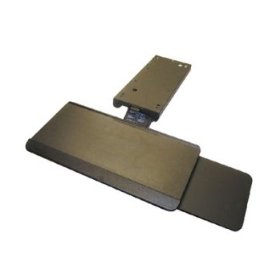
Waterloo Premium Arm, Keyboard Tray & Mouse Tray

Waterloo Keyboard and Mouse Tray

The advantage of this tray is that you don’t need to install rails and casters along the bottom of the tray. You can simply install one arm which sits in the center of the tray. In the case of the desk with the bar along the front underside of the desk, it looks like this arm can fit just under the bar and then the opening between the stabilizer arm and the actual trial itself may give a=enough room to accommodate the desk support bar. This keyboard tray has 7 positive reviews on Amazon and reviewers found to easy to install. Retails for $126.30 on Amazon. View more at the link here.

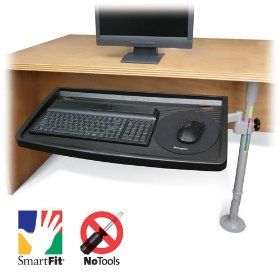
Kensington SnapLock Keyboard Tray with SmartFit

Kensington SnapLock Keyboard Tray

In this case, the tray is mounted on a metal pole that allows you to adjust the tray 6 inches in height, +/- 15 degrees in tilt and rotates 360 degrees. I did not find any customer reviews but the design gives those of you with desks without space for brackets and rails another potion for a keyboard tray. This tray extender retails for $117.83 at Amazon but is available via other online shopping services as well (for likely more). Link to this tray here.

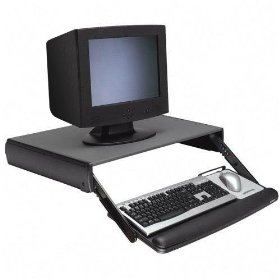
3M Desktop Adjustable Keyboard Drawer

3M Adjustable Keyboard Monitor Stand and Drawer

A top of the desk option, the desktop design is height and tilt adjustable up to 3 1/4″ below desk level and wide platform keeps mouse and keyboard at same level for added comfort. Includes gel-filled wrist rest and full size mousing area. No installation required. Lifetime warranty included.

Pros: holds heavy monitors and installs without having to attach anything to the actual desk. 4 adjustment levels for the keyboard tray. The tray can also be inclined at any angle that is comfortable and locked into position or not.

Cons: if your monitor is too light or if you do not place the monitor in the center of the stand the keyboard will wobble when you type. If you place the monitor too far forward the whole assembly, plus monitor could fall into your lap. (Sounds like proper placement is essential in this case!)

Retails for $132 at Amazon (or you can pay a hefty $209.99 for the same product at ergoguys.com)

Amazon link

Ergoguys link. This let’s you pay more for the same product from a company with the Ergo name in it.

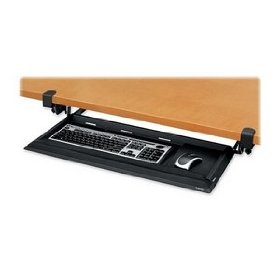
Fellowes Designer Suites Desk Ready Keyboard Drawer
Fellowes Keyboard Drawer
According to Fellowes:
• Attaches to virtually any work surface without tools or complex instructions.
• The patented clamp easily attaches unit to desktop (5/8 1-5/8 W) without surface damage and adjusts tray to one of three height positions below desktop for personal comfort: 2-1/2, 3-1/8,and 3-3/4
• Tray adjustment tilts to 3, 6, or 9 degrees to suit personal preference, and separate tray and mouse platforms allow you to switch mouse position to right or left side of keyboard tray
• Sturdy, impact-resistant tray fits standard and ergonomic keyboards, and the ball-bearing glide tracks ensure smooth drawer movement
• Includes soothing memory foam wrist rest for keyboard tray and provides convenient cable management for keyboard and mouse cord
From users of the tray: The suspension mechanism causes it to need almost 34 inches side to side table top space to attach. The exterior width of the drawer itself is 28 inches. The mouse tray is a little small.

This tray retails for $76.52 at Amazon.

Amazon Link here.

Read Full Post »

Older Posts »