Feeds:
Posts
Comments

Posts Tagged ‘Strength training’

By Sue Shekut, Owner, Working Well Massage, Licensed Massage Therapist, Certified Wellness Coach, ACSM Personal Trainer

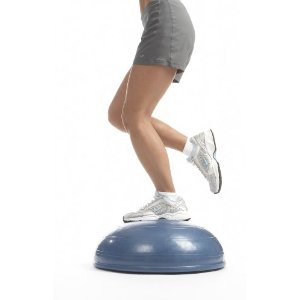
Dr. Bonny Flaster responded to my training query about getting ready for the Warrier Dash this fall. Her advice is spot on: combine strength training with balance training using a Bosu Balance Trainer. Her advice is here.

Bosu Balance Trainer

According to the Amazon product description: The Bosu Balance trainer helps you strengthen and coordinate several major muscle groups, including the muscles you don’t see. The Bosu targets your core muscles–the muscles around your abdominal and back area–while you perform a host of different workouts, from squats and bicep curls to lateral shoulder raises and hip extensions. As a result, you not only gain strength, trim, and tone, but also improve your balance and coordination along the way. In addition, Bosu training helps strengthen the mind, with thoughtful movement that requires the participant to not only be physically involved, but also “here and present” with the mind fully engaged. By combining physical and mental focus, Bosu training will boost your performance across a wide continuum of activities, including sports, recreation, and daily tasks.

The Bosu balance trainer–which measures 55 cm and comes in blue–comes with a foot pump and an exercise manual.

The Bosu System is available from Amazon for about $70. Click here for link.

Wii Fit Balance Training

For those that are not quite ready for the Bosu system, you can also start working on balance and flexibility with the Wii Fit. Wii Fit does not provide the instability of a Bosu “ball” but it does give you some great practice on maintaining your balance and coordination. And it has a fantastic yoga module for flexibility.

Enhanced by Zemanta

Read Full Post »

By Sue Shekut, Owner, Working Well Massage, Licensed Massage Therapist, Certified Wellness Coach, ACSM Personal Trainer

The American College of Sports Medicine tracks trends for the fitness industry and published their findings to show you what to expect in fitness in the coming year at the gym, in your doctor’s office and at work. Experienced fitness professionals topped the list while strength training, core work, special fitness programs for older adults, pilates and balance training also made the top ten. Dr. Walter Thompson, of the American College of Sports Medicine (ACSM) which conducted the poll, said that 1,540 ACSM-certified fitness professionals from all around the world took part in the online survey.

“We really wanted to look at trends,” Thompson, a professor of Exercise Science at Georgia State University, explained. “We instructed the respondents to ignore fads, like the devices you see on late-night TV infomercials.”

Fitness professionals and personal trainers captured the first and third spots in the survey, but according to Thompson, this increase is at expense of clients. Why? Because the increase in demand for personal trainers and fitness instructors has led to an influx of people entering the profession lacking the necessary training to avoid injuring clients. Thompson said, “There has to be some policing. People are getting hurt by trainers who just don’t have the qualifications.” Personal training was introduced about 10 years ago and was once a luxury for movie stars. Now most gyms provide personal trainers and some gyms are personal trainer-only gyms.

Children and obesity came in second in the poll. “For the first time in history the next generation of young people may not live as long as their parents or grandparents,” said ACSM representatives. Strength training  and core training were in the top five as well.

The stability ball  came in at number eight. (Note: The use of the stability ball did not even make the top 20 in an ACSM survey in 2007.)  Fitness professionals once thought this was a fad, according to the ACSM, but the ball has become into a versatile teaching tool for stability, balance and strength.

Balance training, which includes yoga, Pilates, tai chi and exercise balls, came in at number 10. (Two years ago it was not even in the top 20.)

The emphasis on comprehensive health promotion at the workplace was number 12. “The notion of wellness coaching (number 13) was also a surprise. Last year it was at the bottom.” said Thompson, adding that nutrition as well as exercise and wellness training points to a more holistic approach to fitness in general.

Thompson and his team don’t predict the future, but they believe that the trends they track to inform the fitness industry are also useful in educating the public. For example,  physician referrals to exercise professionals is a growing trend. “Exercise is medicine,” Thompson concludes. “We’re bridging the gap between fitness professionals and physicians.”

Read the full article  here.
Enhanced by Zemanta

Read Full Post »

There is no case of my sore feet that Sarah ca...
Image by colorblindPICASO via Flickr

By Sue Shekut, Owner, Working Well Massage, Licensed Massage Therapist, Wellness Coach, ACSM Personal Trainer

The internet is full of great exercise videos. The news publishes reports daily about the benefits of exercise. Yet I hear the same refrain from people all the time: I don’t have time to exercise. I have great sympathy for those with no time to workout. And I offer you this: maybe it’s not that you don’t have time. Maybe it’s more a question of changing our thinking about exercise rather than finding time to exercise.

In the U.S., we tend to compartmentalize exercise. We think we can only exercise if we go to special places and wear special clothes. We think “we have to sweat to be doing any good.” But these are all myths.

Exercise myths include:

• Exercise is something we only do at the gym.

• Exercise is something you need a personal trainer to do.

• Exercise requires long hours of sweat and exertion to be effective.

• Exercise is something we have to set aside large chunks of time to accomplish.

These belief’s only keep us from doing what we need to do. Before The Industrial Revolution, people got “exercise” doing daily chores and work. Farmers and farm hands got “exercise” toiling in the fields, herding cattle, riding horses around the ranch, milking cows, etc. Before “labor-saving devices” like dishwashers, washers and dryers and the infamous automobile, people got “exercise” every day without needing gyms or “workouts.” Of course, people didn’t live as long. 40-45  was the average life expectancy. But since then we’ve made great progress in modern medicine, diet and education. People don’t HAVE to labor to earn a living. And labor-oriented jobs have been leaving the U.S. for years. So how do we get our daily exercise dose?

Flash forward to the typical American life in 2010. Male or female, the typical American works 50-60 hours, drives or takes a train or bus to work, averaging 1 hour commute each way. With a few small children at home, by the time mom or dad gets done helping kids with homework, preparing dinner, and putting the kids to bed, the day is done and it’s time for a little TV time. There is little time to “work out.”

So, think about putting a little labor back into your life. You don’t have to go to the gym to ‘work out.” If you can find the time and need the focus of the gym to squeeze in some cardio or strength training, go for it. But if going to the gym means taking precious time away from the family, incorporate your kids into your workout. use yoga tapes or the Wii Fit at home. Make it a family fun time.

Ways to Put a Little “Labor” Back  Into Your Life

• If you normally try to park as close as possible to the store or work, park  farther away. The extra walk will do you good!

• Hang your laundry on a clothesline outdoors to dry (also saves energy and money).

• Plant a garden and spend time weeding, watering and enjoying your garden a few minutes every day.

• If you take public trans, get of or on the bus/train/etc. a few blocks earlier.

• At work, do some mid-day squats at your desk. Simply stand up then start to sit down. But don’t let yourself sit. As you feel the chair under your posterior, slowly stand back up again. Then “sit” again, without resting on the chair. Lather, Rinse and repeat 10 times.

• Take a walk around the block after dinner. Even a 15-min walk helps you feel better, teaches your kids the benefits of exercise and allows you to spend quality time with your family.

• Whenever possible, at work, take the stairs. If you can, take two 10 minute breaks each day to walk up and down a few flights of stairs. Don’t run, take your time so you don’t get sweaty! Your form is more important than trying to race up the stairs.

• In parking garages, take the stairs, too, versus the elevator.

• If you live in a home with stairs and you are doing housework, putting away laundry, etc., make more trips up and down the stairs.

• If you don’t have kids, get a dog. You are more likely to make walking the dog part of your daily routine than if you were to take yourself for a daily walk!

• If you are single and live alone, get to know your neighbors. Help out the sick and elderly by volunteering to do their chores. It will give you exercise and make you feel good about yourself!

• Buy a set of dumbbells (even Target sells them!) and do basic resistance training at home in front of the television. (Versus sitting on the coach with a bag of chips!)

• Take your kids to a water park, a forest preserve or a park on the weekends. Climb the stairs of a few slides with your kids. At a forest preserve or park, paddle boat or canoe with them. Take nature walks.

• Ride your bike to work or around the neighborhood after work, before dinner.

Related articles:

How to Get a total Body Workout without going to the gym here.

Reasons why you don’t exercise here.

The best exercises for lazy people here.

Enhanced by Zemanta

Read Full Post »