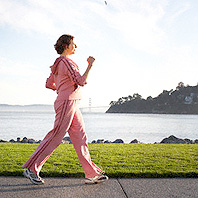
Gentle exercise from EverydayHealth.com
The American Heart Association’s Start! initiative calls on all Americans and their employers to create a culture of physical activity and health to live longer, heart-healthy lives through walking. It offers resources for employers to implement a walking program in the workplace and track employees’ progress in the program. One of Start’s key components, National Start! Walking Day aims to get Americans up and moving for 30 minutes on April 8, 2009. National Start! Walking Day will take place during National Workplace Wellness Week.
Why walk?
- Reduce the risk of coronary heart disease
- Improve blood pressure and blood sugar levels
- Improve blood lipid profile
- Maintain body weight and lower the risk of obesity
- Enhance mental well being
- Reduce the risk of osteoporosis
- Reduce the risk of breast and colon cancer
- Reduce the risk of non-insulin dependent (type 2) diabetes
There really are so many benefits for such a simple activity!
How To Begin a Walking Program
The AHA offers these steps to begin a walking regimen:
Step 1: Remember that your safety is the most important thing! If you’re a male over 40 or a female over 50, you may want to work with your doctor to set up your exercise program.
Step 2: Get familiar with the American Heart Association’s recommendations for physical activity:
- Aim for at least 30 minutes of moderate-to-vigorous physical activities, 5 days a week
- Remember that physical activity can be accumulated throughout the day. Three 10-minute sessions is the same as one 30-minute session!
- If you’re looking to lose weigh or maintain your current weight, aim for 60-90 minutes of moderate-to-vigorous physical activity each day
Step 3: Always measure the intensity of your exercise to know if you’re pushing yourself too hard or not hard enough. An easy way to do this is by taking the talk test:
- You should be able to sing while working out at a light intensity level
- If you’re exercising at a moderate intensity level, you should be able to carry on a conversation comfortably
- If you become too winded or out of breath to carry on a conversation, the activity can be considered vigorous
You can also download this chart from the American College of Sports Medicine and Center for Disease Control and Prevention, which lists physical activities by their level of intensity. Happy trails!
Related articles by Zemanta
- The Hidden Benefits of Exercise (online.wsj.com)
- READING: If you’re not fit in your 50s, your projected life span “is eight years shorter than if you are fit,” WOW! (calacanis.com)
- Risk of death increases with every hour spent in front of a television: study (nationalpost.com)
- You Can’t Exercise Away TV’s Toll on the Heart (nlm.nih.gov)
- Being Active an Hour a Day Puts Brakes on Weight Gain (nlm.nih.gov)
- How to grow old gracefully (msnbc.msn.com)
![Reblog this post [with Zemanta]](https://i0.wp.com/img.zemanta.com/reblog_b.png)

 Working Well Resources' Blog