Do scenes of nature on your computer screen or television give you the same stress relief that you get looking out a window at a scenic view? Sadly, no. Read the excerpt from Newswise.com below for the sad truth about the effects of “faux” nature.
Scenes of Nature Trump Technology in Reducing Low-level Stress
A new study that measured individuals’ heart recovery rate from minor stress when exposed to a natural scene through a window, the same scene shown on a high-definition plasma screen, or a blank wall. The heart rate of people who looked at the scene through the window dropped more quickly than the others. In fact, the high-definition plasma screen had no more effect than the blank wall.
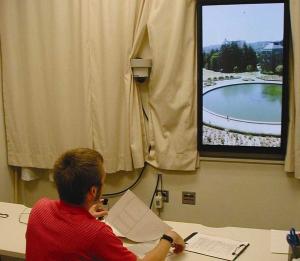
Student viewing computer scene of nature (Credit: Image courtesy of University of Washington)
Research done through the Human Interaction with Nature and Technological Systems Lab at the University of Washington showed that when people spent more time looking at the natural scene their heart rates tended to decrease more. That was not the case with the plasma screen.
The study, funded by the National Science Foundation, is published in the current issue of the Journal of Environmental Psychology.
“Technology is good and it can help our lives, but let’s not be fooled into thinking we can live without nature,” said Peter Kahn, a UW associate professor of psychology who led the research team.
“We are losing direct experiences with nature. Instead, more and more we’re experiencing nature represented technologically through television and other media. Children grow up watching Discovery Channel and Animal Planet. That’s probably better than nothing. But as a species we need interaction with actual nature for our physical and psychological well-being.”
Part of this loss comes from what the researchers call environmental generational amnesia. This is the idea that across generations the amount of environmental degradation increases, but each generation views conditions it grew up with as largely non-degraded and normal. Children growing up today in the cities with the worst air pollution often, for example, don’t believe that their communities are particularly polluted.
“This problem of environmental generational amnesia is particularly important for children coming of age with current technologies,” said Rachel Severson, a co-author of the study and a UW psychology doctoral student. “Children may not realize they are not getting the benefits of actual nature when interacting with what we’re calling technological nature.”
The researchers found that participants with the plasma screen actually looked at it just as often as did those who had the window. However, the window held the students’ attention significantly longer than the plasma screen did. When participants spent more time looking at the window, their heart rates decreased faster than on tasks when they spent less time looking at the window. This was not true with the plasma screen.
“I was surprised by this,” said Kahn. “I thought the plasma screen would come somewhere between the glass window and the blank wall. This study is important because it shows the importance of nature in human lives and at least one limitation of technological nature.
“In the years ahead, technological nature will get more sophisticated and compelling. But if it continues to replace our interaction with actual nature, it will come at a cost. To thrive as a species, we still need to interact with nature by encountering an animal in the wild, walking along the ocean’s edge or sleeping under the enormity of the night sky.”
Co-authors of the study are Batya Friedman, Jennifer Hagman, Erika Feldman and Anna Stolyar of the UW, Brian Gill of Seattle Pacific University, Nathan Freier of Rensselaer Polytechnic Institute and Sybil Carrere of California State University, San Bernardino. Freier and Carrere were both at the UW when they worked on the study.
Read the full article here.

 Working Well Resources' Blog