By Sue Shekut, Owner, Working Well Massage, Licensed Massage Therapist, Certified Wellness Coach, ACSM Personal Trainer
Are you looking for a really big challenge, fitness wise? Wanted to climb Mount Ranier and didn’t make it this year? Or not able to run the Chicago Marathon but still want a heavy duty fitness goal? You are in luck. The people behind Men’s Health magazine have put together a rigorous obstacle source race called the URBANATHLON™. And it’s coming to Chicago on October 10-16-10.
What’s so cool about the URBANATHLON™? It’s all set up in downtown Chicago lakefront areas and consists of fitness challenges for men and woman that want to do more than run on pavement for 26 plus miles. Not to bash the Marathon, but some people want more than a running race. They want a climbing, jumping, sprinting and crawling race.
For example, the first challenge is:
Obstacle Course 1: Navy Pier
Violation of the rules of this obstacle course will result in a do-over.
Section 1
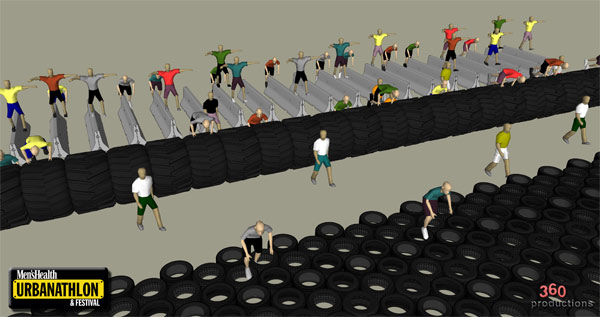
- Get up on and move across the “JERSEY CONCRETE BARRIERS” as you would a balance beam
- You must get from one end to the other without falling off
Section 2
- Get up and over the “MONSTER TRUCK TIRE” obstacle
- You are not permitted to go around the obstacle
Section 3
- Move through the “TIRE” portion of the obstacle stutter-step style, touching the ground inside of each consecutive tire
- Do not skip a tire or run on top of the tires
For a full list of obstacles on the course click here.
For the obstacle course map click here.
And if you don’t want to race but want to participate, you can watch. For a list of where to watch the race, click here.
Registration Cost
Solo: $110.00
Relay: $180.00
Ipods Banned From the Race
iPods/portable media devices are strictly prohibited because of the unique urban makeup of this event. The obstacles involve jumping, crawling and climbing and thus lend themselves to headphone cord snags and dropped devices that result in back-ups and run-ins. This rule has been set to protect all involved parties from injury.
Please Note: Race staff will be aggressively enforcing this rule on race day.
What are the Rules?
For a complete list of rules to compete in the URBANATHLON™, click here.
Total Course Distance
9.75 miles, including obstacles.

Race Start Time
Wave One will begin at 7:45AM sharp, with each successive wave following according to the wave start plan.
Minimum Age of Race Participants
All racers must be 18 years of age or older to participate in this event.
If I can’t Make the Race in Chicago in 2010, Where Else Can I Race the Course?
This year, the URBANATHLON™ will be held in Chicago only. We are looking to bring the race to other cities in the future.
Charity
 Join the Men’s Health Mission, to raise funds for the Challenged Athletes Foundation® so people with physical disabilities can pursue an active lifestyle. Signing up for the Mission will provide you with:
• A fundraising kit
• A dedicated fundraising web page
• A CAF T-shirt
Your hard work will be rewarded with valuable incentive prizes: technical apparel, high-tech bikes, adventure trips, sports watches, digital cameras and more.
Click here to join the Men’s Health Mission.
Where to Pick Up Your Race Packet
Hard Rock Hotel
230 North Michigan Avenue
Chicago, IL 60601
Enter via the Michigan Avenue entrance, take stairs on left to the 2nd floor, Gibson Room
race Packet Pickup Dates and Times
10.14.10, 11:30 AM–8:00 PM
10.15.10, 11:30 AM–10:00 PM
Please Note: There will be NO packet pickup on the morning of the race.
Related articles by Zemanta
- The most grueling week in sports! (chicagonow.com)
- Runners get dirty at Soldier Hollow for charity ()


 Working Well Resources' Blog