Feeds:
Posts
Comments

Archive for the ‘Workplace Wellness’ Category

Stretching throughout the workday is essential for good health.

By Sue Shekut, Owner, Working Well Massage, Licensed Massage Therapist, Certified Wellness Coach, ASCM Personal Trainer

If you’re reading this, it’s likely that you’ve been sitting at a computer for an extended period of time.  Did you know that sitting still for a long time can cause serious health damage? OSHA says that maintaining static postures, such as viewing the monitor, for a prolonged period of time without taking a break can fatigue the muscles of the neck and shoulder that support the head. Additionally, OSHA recommends that repetitive tasks or jobs that require long periods of static posture incorporate several, short rest breaks (micro breaks or rest pauses). During these breaks you should stand, stretch, and move around. This provides rest and allows the muscles enough time to recover. Read the excerpt from Susan Seliger”s article “Stretching Exercises at Your Desk: 12 Simple Tips” at WebMD for a few of the stretches you can easily perform in your workplace to keep limber throughout the day.

Stretching Exercises You Can Do at Your Desk

  1. Just stand up and sit down — no hands
    • You might have gotten a gold star in preschool for sitting still, but it just goes to show you (best sellers notwithstanding) that not all of us learned everything we need to know in kindergarten. “If you stand up and sit down (over and over) — without using your hands — it can be a challenge,” says Smith. It’s like doing mini-squats!
  2. Substitute exercise for sitting — while you work
    • Get rid of your desk chair and substitute an exercise ball, suggests Smith. “I used it for a while when I was having low-back problems; it was great,” Smith says. “All day you are engaging all the muscles in the back, legs, butt, everything, to stay balanced.”
  3. Shrug your shoulders — to release the neck and shoulders
    • Inhale deeply and shrug your shoulders, lifting them high up to your ears. Hold. Release and drop. Repeat three times.
    • Shake your head slowly, yes and no.
  4. Loosen the hands with air circles
    • Clench both fists, stretching both hands out in front of you.
    • Make circles in the air, first in one direction, to the count of ten.
    • Then reverse the circles.
    • Shake out the hands.
  5. Point your fingers — good for hands, wrist, and forearms
    • Stretch your left hand out in front of you, pointing fingers toward the floor. Use your right hand to increase the stretch, pushing your fingers down and toward the body. Be gentle.
    • Do the same with the other hand.
    • Now stretch your left hand out straight in front, wrist bent, with fingers pointing skyward. Use your right hand to increase the stretch, pulling the fingers back toward your body.
    • Do the same on the other side.
  6. Release the upper body with a torso twist
    • Inhale and as you exhale, turn to the right and grab the back of your chair with your right hand, and grab the arm of the chair with your left.
    • With eyes level, use your grasp on the chair to help twist your torso around as far to the back of the room as possible. Hold the twist and let your eyes continue the stretch — see how far around the room you can peer.
    • Slowly come back to facing forward.
    • Repeat on the other side.
  7. Do leg extensions — work the abs and legs
    • Grab the seat of your chair to brace yourself and extend your legs straight out in front of you so they are parallel to the floor.
    • Flex and point your toes five times. Release.
    • Repeat.
  8. Stretch your back with a “big hug”
    • Hug your body, placing the right hand on your left shoulder and the left hand on your right shoulder.
    • Breathe in and out, releasing the area between your shoulder blades.
  9. Cross your arms — for the shoulders and upper back
    • Extend one arm out straight in front of you. With the other hand, grab the elbow of the outstretched arm and pull it across your chest, stretching your shoulder and upper back muscles.
    • Hold. Release.
    • Stretch out the other arm in front of you — repeat.
  10. Stretch your back and shoulders with a “leg hug”
    • Sit on the edge of your chair (if it has wheels, wedge the chair against the desk or wall to make sure it does not roll). Put your feet together, flat on the floor.
    • Lean over, chest to knees, letting your arms dangle loosely to the floor. Release your neck.
    • Now bring your hands behind your legs, right hand grasping left wrist, forearm (or elbow if you can reach that far), left hand grasping the right. Feel the stretch in your back, shoulders and neck. Hold.
    • Release your hands to the floor again.
    • Repeat three times or as often as it feels good.
  11. Look up to release upper body
    • Sit up tall in your chair, or stand up. Stretch your arms overhead and interlock your fingers.
    • Turn the palms to the ceiling as you lift your chin up, tilt your head back, and gaze up at the ceiling, too.
    • Inhale, exhale, release.
  12. Substitute walks for email — and don’t eat at your desk
    • Instead of emailing a colleague “and copying 25 people who don’t want to be copied anyway,” Smith says, “walk over to the colleague you really want to talk to.”

    Read the rest of the article at WebMD.

    Reblog this post [with Zemanta]

Read Full Post »

By Sue Shekut, Owner, Working Well Massage, Licensed Massage Therapist, Certified Wellness Coach, ACSM Personal Trainer

One of our most popular posts is our post about NASA’s Top Ten plants to help clean your air here. You might already think that having a small plant at your desk is a pleasant aesthetic choice, but now you know that it actually will help keep you healthy as well!

“Indoor plants can reduce fatigue, coughs, sore throats and other cold related illnesses by more than 30%,” explains Dr Tove Fjeld of Norway’s University of Agriculture. NASA scientists have also found that plants in the office combat air humidity problems and absorb the pollution from computers, carpets and perfume.

A hearty desk plant can help improve the health of your office.

Megan Cohen at Planet Green has some suggestions for even the worst gardeners:

Spider Plant
Spider plants are happy with watering just once a week, and do well in moderately cool places, which is good news if you’re in an office where air conditioning is just part of the daily deal. They do best when they’re near a window so that they can get some natural light, but don’t put them right in the path of very strong sun or the leaves will freak out and start turning brown. Spider plants like it mellow.

Jade Plant
Jade plants can keep growing for decades, which definitely tells you something about how tough they are. Much like the parrot on the shoulder of a pirate, there’s a chance that your jade plant might outlive you, but chances are, it’ll just be a cool, laid-back partner in crime and will keep most of your secrets.

Peace Lily
These elegant white flowers only need watering about twice a week and have an exotic look that belies how easy they are to handle. Most flowers need a lot of sunlight to fully bloom, but peace lilies still put on a show in low-to-middling lighting conditions, which makes them optimal for bringing a little eye candy to a dingy cubicle.

Photo courtesy of Wikipedia.

Reblog this post [with Zemanta]

Read Full Post »

By Sue Shekut, Owner, Working Well Massage, Licensed Massage Therapist, Certified Wellness Coach, ACSM Personal Trainer

Gentle exercise from EverydayHealth.com

The American Heart Association’s Start! initiative calls on all Americans and their employers to create a culture of physical activity and health to live longer, heart-healthy lives through walking. It offers resources for employers to implement a walking program in the workplace and track employees’ progress in the program. One of Start’s key components, National Start! Walking Day aims to get Americans up and moving for 30 minutes on April 8, 2009. National Start! Walking Day will take place during National Workplace Wellness Week.

Why walk?

There are countless physical activities out there, but walking has the lowest dropout rate of them all! It’s the simplest positive change you can make to effectively improve your heart health. Research has shown that the benefits of walking and moderate physical activity for at least 30 minutes a day can help you:
  • Reduce the risk of coronary heart disease
  • Improve blood pressure and blood sugar levels
  • Improve blood lipid profile
  • Maintain body weight and lower the risk of obesity
  • Enhance mental well being
  • Reduce the risk of osteoporosis
  • Reduce the risk of breast and colon cancer
  • Reduce the risk of non-insulin dependent (type 2) diabetes

There really are so many benefits for such a simple activity!

How To Begin a Walking Program

The AHA offers these steps to begin a walking regimen:
Step 1: Remember that your safety is the most important thing! If you’re a male over 40 or a female over 50, you may want to work with your doctor to set up your exercise program.
Step 2: Get familiar with the American Heart Association’s recommendations for physical activity:

  • Aim for at least 30 minutes of moderate-to-vigorous physical activities, 5 days a week
  • Remember that physical activity can be accumulated throughout the day. Three 10-minute sessions is the same as one 30-minute session!
  • If you’re looking to lose weigh or maintain your current weight, aim for 60-90 minutes of moderate-to-vigorous physical activity each day

Step 3: Always measure the intensity of your exercise to know if you’re pushing yourself too hard or not hard enough. An easy way to do this is by taking the talk test:

  • You should be able to sing while working out at a light intensity level
  • If you’re exercising at a moderate intensity level, you should be able to carry on a conversation comfortably
  • If you become too winded or out of breath to carry on a conversation, the activity can be considered vigorous

You can also download this chart from the American College of Sports Medicine and Center for Disease Control and Prevention, which lists physical activities by their level of intensity. Happy trails!

Reblog this post [with Zemanta]

Read Full Post »

By Sue Shekut, Owner, Working Well Massage, Licensed Massage Therapist, Certified Wellness Coach, ACSM Personal Trainer

Worksite Wellness Programs Increases Productivity and Employee Retention

This coming week is National Workplace Wellness Week!  And no, it’s not just another Hallmark Holiday,  it’s a government resolution to promote workplace wellness.

History of Workplace Wellness Week

In 2008, the the U.S. House of Representatives passed a federal resolution creating National Workplace Wellness Week. The resolution, which was endorsed by the American Heart Association (AHA), Chamber of Commerce, Partnership for Prevention and many other groups, designated the first full week of April as “National Workplace Wellness Week.” During this week, private and public employers across the country are encouraged to invest in the health of their employees by creating worksite employee health promotion programs, or by sharing their worksite wellness experiences with other employers.

Workplace Wellness Statistics

The American Heart Association offers a handy fact sheet with some alarming statistics on workplace wellness:

· Health care costs in the United States doubled from 1990 to 2001 and are expected to double again by 2012

· Chronic illnesses affect more than a third of working-age Americans and the costs associated with chronic diseases account for approximately 75 percent of the nation’s annual health care costs

· Over 130 million Americans are employed across the United States and since a significant part of their day is spent at work, comprehensive, culturally sensitive health promotion within the workplace is essential to maintain and improve the nation’s health

· Nearly 60 percent of employers’ after-tax profits are spent on corporate health benefits. An estimated 25-30 percent of companies’ medical costs per year are spent on employees with excess health risk. That contrasts to three decades ago when only seven percent of corporate profits paid for health costs

· Addressing risk factors early can make a difference. For example, $5.6 billion in heart disease costs could be saved if one-tenth of Americans began a regular walking program

· Employer spending on health promotion and chronic disease prevention is a good business investment. Programs have achieved a rate of return on investment ranging from $3 to $15 for each dollar invested with savings realized between 12 and 18 months

National Workplace Wellness Week starts on April 5th and offers a new approach to some old stubborn problems that employers and employees face related to costs, health, productivity and morale, to mention a few. This information can help any company and can help them to take action to conquer their own health and wellness issues.

Get Well With Working Well Massage

One way to help employees reduce stress, increase productivity and computational skills and reduce muscle tension is to bring in Licensed Massage Therapists from Working Well Massage to give staff members a short chair massage.  Massage is an easy, cost effective way for employers to kick off or inject new energy into a workplace wellness initiative.

If your company already has a workplace massage program, tell us what you like about it! How has it benefited you?

if your company does not provide employees with massages, ask your Human Resources Department to look into it. You, and your fellow staff members, will be glad you did! For information on setting up a workplace wellness program including massage therapy, go to our website.

Reblog this post [with Zemanta]

Read Full Post »

By Sue Shekut, Owner, Working Well Massage, Licensed Massage Therapist, Certified Wellness Coach, ACSM Personal Trainer

Do you ever find yourself rubbing and stretching your wrists after a long day at work? Do you frequently have shoulder and neck tension after a long day typing and mousing?    The United States Occupational Safety & Health Administration says the culprit could easily be improper keyboard height and/or distance. Proper keyboard placement can help prevent repetition injuries, awkward posture and stress.

Keyboards that are too high or too low can lead to awkward wrist, arm, and shoulder postures. For example, when keyboards are too low you may type with your wrists bent up. When keyboards are too high, you may need to raise your shoulders to elevate your arms. Performing typing tasks in awkward postures such as these can result in hand, wrist and shoulder discomfort.

Here are some possible height-related solutions the OSHA recommends:

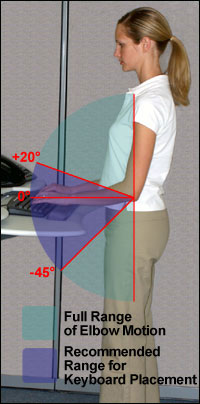
  • Image courtesy of OSHA

    Adjust the chair height and work surface height to maintain a neutral body posture (illustrated here). Elbows should be about the same height as the keyboard and hang comfortably to the side of the body. Shoulders should be relaxed, and wrists should not bend up or down or to either side during keyboard use.

  • Remove central pencil drawers from traditional desks if you can’t raise your chair high enough because of contact between the drawer and the top of the thighs. The work surface should generally be no more than 2 inches thick.
  • may be needed if the work surface or chair cannot be properly adjusted. The keyboard tray should:
    • Be adjustable in height and tilt,
    • Provide adequate leg and foot clearance, and
    • Have adequate space for multiple input devices (for example, a keyboard and pointer/mouse).
  • The keyboard’s vertical position should be maintained within the recommended range shown here. The tilt of the keyboard may need to be raised or lowered using the keyboard feet to maintain straight, neutral wrist postures while accommodating changes in arm angles.

    Image courtesy of OSHA

If your keyboard or mouse  is too close or too far away this may cause you to assume awkward postures such as reaching with the arms, leaning forward with the torso and extreme elbow angles. These awkward postures may lead to musculoskeletal disorders of the elbows, shoulders, hands, and wrists.

Keyboard too far away (courtesy OSHA)

Keyboard too close (courtesy OSHA)

Here are some possible distance-related solutions the OSHA recommends:

  • Place the keyboard directly in front of you at a distance that allows your elbows to stay close to your body with your forearms approximately parallel with the floor.
  • A keyboard tray may be useful if you have limited desk space or if your chair has armrests that interfere with adequate positioning.

Making these simple changes may make a world of difference for you in your workplace and your neck and shoulders. Give them a try and feel the difference!

Reblog this post [with Zemanta]

Read Full Post »

By Sue Shekut, Owner, Working Well Massage, Licensed Massage Therapist, Certified Wellness Coach, ACSM Personal Trainer

Deep breathing from Anxiety Therapy Online

Non smokers don’t get it. I’ve heard nonsmokers say, “Why don’t you just quit?” Or “How can any intelligent person smoke?” (Knowing what we know about smoking and health.) Smoking addiction isn’t a rational decision. People don’t get up in the morning and say, “Gee, I think I will fill my lungs with carcinogens.” Like any addiction, smoking is a habit and a physical dependence on a powerful chemical substance. The addiction to nicotine can override people’s intellectual beliefs about health. If you’ve ever had the stomach flu or persistent diarrhea, you know what it’s like to have an overwhelming urge you can’t control. Being addicted to smoking is a similar situation. It gives people strong urges that are very difficult to deny or control.

Read more from the American Cancer Society about nicotine withdrawal:

Nicotine withdrawal symptoms can lead quitters back to smoking

When smokers try to cut back or quit, the lack of nicotine leads to withdrawal symptoms. Withdrawal is both physical and mental. Physically, the body reacts to the absence of nicotine. Mentally, the smoker is faced with giving up a habit, which calls for a major change in behavior. Both the physical and mental factors must be addressed for the quitting process to work.

Those who have smoked regularly for a few weeks or longer, and suddenly stop using tobacco or greatly reduce the amount smoked, will have withdrawal symptoms. Symptoms usually start within a few hours of the last cigarette and peak about 2 to 3 days later when most of the nicotine and its by-products are out of the body. Withdrawal symptoms can last for a few days to up to several weeks. They will get better every day that you stay smoke-free.

Withdrawal symptoms can include any of the following:

  • dizziness (which may only last 1 to 2 days after quitting)
  • depression
  • feelings of frustration, impatience, and anger
  • anxiety
  • irritability
  • sleep disturbances, including having trouble falling asleep and staying asleep, and having bad dreams or even nightmares
  • trouble concentrating
  • restlessness or boredom
  • headaches
  • tiredness
  • increased appetite
  • weight gain
  • constipation and gas
  • cough, dry mouth, sore throat, and nasal drip
  • chest tightness

These symptoms can lead the smoker to start smoking cigarettes again to boost blood levels of nicotine back to a level where there are no symptoms. (For information on coping with withdrawal, see the section, “How to quit.”)

Smoking also makes your body get rid of some drugs faster than usual. When you quit smoking, it may change the way your body handles medicines. Ask your doctor if any medicines you take regularly need to be checked or changed after you quit.

Dealing with withdrawal

Withdrawal from nicotine has 2 parts — the physical and the mental. The physical symptoms, while annoying, are not life-threatening. Nicotine replacement and other medicines can help reduce many of these physical symptoms. Most smokers find that the bigger challenge is the mental part of quitting.

If you have been smoking for any length of time, smoking has become linked with nearly everything you do — waking up in the morning, eating, reading, watching TV, and drinking coffee, for example. It will take time to “un-link” smoking from these activities. This is why, even if you are using a nicotine replacement, you may still have strong urges to smoke.

Rationalizations are sneaky

One way to overcome these urges or cravings is to notice and identify rationalizations as they come up. A rationalization is a mistaken thought that seems to make sense to you at the time, but the thought is not based on reality. If you choose to believe in such a thought, it can serve as a way to justify smoking. If you have tried to quit before, you will probably recognize many of these common rationalizations:

  • I’ll just have one to get through this rough spot.
  • Today is not a good day. I’ll quit tomorrow.
  • It’s my only vice.
  • How bad is smoking, really? Uncle Harry smoked all his life and he lived to be over 90.
  • Air pollution is probably just as bad.
  • You’ve got to die of something.
  • Life is no fun without smoking.

You probably can add more to the list. As you go through the first few days without smoking, write down any rationalizations as they come up and recognize them for what they are: messages that can trick you into going back to smoking. Look out for them, because they always show up when you’re trying to quit. After you write down the idea, let it go from your mind. Be ready with a distraction, a plan of action, and other ways to re-direct your thoughts to something else.

Use the ideas below to help you stay committed to quitting.

Avoid temptation: Stay away from people and places where you are tempted to smoke. Later on you will be able to handle these with more confidence.

Change your habits: Switch to juices or water instead of alcohol or coffee. Take a different route to work. Take a brisk walk instead of a coffee break.

Alternatives: Use substitutes you can put in your mouth such as sugarless gum or hard candy, raw vegetables such as carrot sticks, or sunflower seeds. Some people chew on a coffee stirrer or a straw.

Activities:
Do something to reduce your stress. Exercise or do hobbies that keep your hands busy, such as needlework or woodworking, which can help distract you from the urge to smoke. Take a hot bath, exercise, or read a book.

Deep breathing: When you were smoking, you breathed deeply as you inhaled the smoke. When the urge strikes now, breathe deeply and picture your lungs filling with fresh, clean air. Remind yourself of your reasons for quitting and the benefits you’ll gain as an ex-smoker.

Delay: If you feel that you are about to light up, delay. Tell yourself you must wait at least 10 minutes. Often this simple trick will allow you to move beyond the strong urge to smoke.

Reward yourself

What you’re doing is not easy, so you deserve a reward. Put the money you would have spent on tobacco in a jar every day and then buy yourself a weekly treat. Buy a magazine or book, go out to eat, develop a new hobby, or take a yoga class. Or save the money for a major purchase. You can also reward yourself in ways that don’t cost money: visit a park, go to the library, and check local news listings for museums, community centers, and colleges that have free classes, exhibits, films, and other things to do.

Read more at the American Cancer Society’s website here.

Notice that many of the strategies for handing nicotine withdrawal are the same strategies people use for stress management!

Reblog this post [with Zemanta]

Read Full Post »

Unlit filtered cigarettes
Image via Wikipedia

By Sue Shekut, Owner, Working Well Massage, Licensed Massage Therapist, Certified Wellness Coach, ACSM Personal Trainer

Coping with stress can be tough. Some people turn to cigarettes as a way to cope with stress. In the long run, smoking doesn’t help your body ward off stress…it creates new health and social problems that lead to more stress. Quitting smoking is also tough but the rewards are numerous.  I was once a heavy smoker myself and quitting was one of the toughest things I’ve ever done. Quitting smoking also freed me from a crippling dependence not only on nicotine but on the habit of ingesting smoke with the result of having my clothes and hair smell like smoke and having yellow fingers and skin that was aging more rapidly than normal.

The American Cancer Society has great information on smoking cessation. In the next few posts we will share some tips o quitting smoking with you.

Why is it so hard to quit smoking?

Mark Twain said, “Quitting smoking is easy. I’ve done it a thousand times.” Maybe you’ve tried to quit, too. Why is quitting and staying quit hard for so many people? The answer is nicotine.

Nicotine

Nicotine is a drug found naturally in tobacco. It is as addictive as heroin or cocaine. Over time, a person becomes physically and emotionally addicted to (dependent on) nicotine. Studies have shown that smokers must deal with both the physical and psychological (mental) dependence to quit and stay quit.

How nicotine gets in, where it goes, and how long it stays

When you inhale smoke, nicotine is carried deep into your lungs. There it is quickly absorbed into the bloodstream and carried throughout your body. Nicotine affects many parts of the body, including your heart and blood vessels, your hormones, the way your body uses food (your metabolism), and your brain. Nicotine can be found in breast milk and even in mucus from the cervix of a female smoker. During pregnancy, nicotine freely crosses the placenta and has been found in amniotic fluid and the umbilical cord blood of newborn infants.

Different factors affect how long it takes the body to remove nicotine and its by-products. In most cases, regular smokers will still have nicotine or its by-products, such as cotinine, in their bodies for about 3 to 4 days after stopping.

How nicotine hooks smokers

Nicotine causes pleasant feelings that make the smoker want to smoke more. It also acts as a kind of depressant by interfering with the flow of information between nerve cells. Smokers tend to increase the number of cigarettes they smoke as the nervous system adapts to nicotine. This, in turn, increases the amount of nicotine in the smoker’s blood. In fact, nicotine inhaled in cigarette smoke reaches the brain faster than drugs that enter the body through a vein (intravenously or IV).

After a while, the smoker develops a tolerance to the drug. Tolerance means that it takes more nicotine to get the same effect that the smoker used to get from smaller amounts. This leads to an increase in smoking over time. The smoker reaches a certain nicotine level and then keeps smoking to maintain this level of nicotine.

Read more at the American Cancer Society website here.

Reblog this post [with Zemanta]

Read Full Post »

By Sue Shekut, Owner, Working Well Massage, Licensed Massage Therapist, Certified Wellness Coach, ACSM Personal Trainer

We all struggle with procrastination at times.   I struggle with focus when I am distracted or overwhelmed. Knowing this about myself helps me better prioritize my day and stay on task.  Interestingly, I came across a post linking ADHD to procrastination from the Associated Press. The author, Bruce Ziebarth, offers his tips for dealing with procrastination as an ADHD sufferer. I am sharing a snippet of the article here. If it interests you, click to link below to read the entire article at assocatedcontent.com.

Link Between Adult ADHD and Procrastination

Bruce Ziebarth

by Bruce Ziebarth

Many people procrastinate. People procrastinate for a variety of reasons; sometimes we just do not feel like doing something, sometimes there is something we want to do more, and sometimes we are just being lazy. No matter who you are, you have probably fought with procrastination. For people with Adult ADHD, procrastination is more than an annoying fact.

Adult ADHD is not a simple condition like cancer or diabetes. Adult ADHD is made up of symptoms from many different categories. A person receives an Adult ADHD diagnosis by showing several of the symptoms including trouble with organization, paying attention, finishing a task, etc. These symptoms must also rise to the level of interfering with daily living. Adult ADHD’s broad range of symptoms makes it difficult to address everyone’s needs. However, whether you have Adult ADHD or not, the strategies outlined here will help you identify why you procrastinate and help avoid future procrastination.

Read Bruce Ziebarth entire article on ADHD and Procrastination here.

Reblog this post [with Zemanta]

Read Full Post »

By Sue Shekut, Owner, Working Well Massage, Licensed Massage Therapist, Certified Wellness Coach, ACSM Personal Trainer

Once again, Life-Sized Business has a great post I want to share about creating a workplace wellness program. If you are an employee that has a wellness program at work, ask yourself if your HR staff or management has followed the advice from this post.  you are an HR staff person or manager, read on for Elizabeth Cogswell Baskin’s advice on what makes a workplace wellness program more effective. And remember, wellness programs are only as effective if the employees make good use of them!

5 Tips: How to Increase Employee Engagement with Workplace Wellness Programs

The key to a successful workplace wellness program is employee engagement. The reverse is also true. That is, one way to increase employee engagement is a successful wellness program.

Yesterday we were in a client’s break room, waiting for a meeting room to open up , and I noticed several flyers on the bulletin board about various wellness offerings. I was surprised by my initial reaction, which was, “Who would sign up for those?”

Why did they strike me as loser offerings? Because they seemed preachy and goody-goody and completely devoid of anything fun. One sounded like the school nurse was going to take you through a lecture on the five food groups. I’m not suggesting that wellness should be a barrel of laughs, but a good program creates energy and involvement. The more employees you can get to participate, the stronger your program will be.

An effective wellness program will do more than just increase productivity because people feel better and have more energy. It also gives co-workers a chance to do something together that’s unrelated to their usual work roles. It equals the playing field, so to speak, in a way that lets junior employees spend some time on an equal footing with those who rank above them in the company hierarchy. It will also build relationships between people in different departments, which helps smooth the way to better teamwork and increased collaboration.

So how do you create a wellness program with plenty of employee engagement? Here are five tips:

1. Ask the employees what they want. Particularly in a small company, you can solicit input from the group. You can do a survey, if you want, but it might be easier just to ask people about their wellness concerns. Are they looking for ways to find time for exercise? Do they really wish they could quit smoking? Are they trying to eat healthier?

2. Get their help in constructing the program. Give some influential employees ownership of developing the program. If the group wants a yoga class at lunch, let an employee track down a good yoga instructor willing to do a class in the conference room. If they’re interested in a buddy-system diet, let an employee research South Beach vs. The Zone vs. WeightWatchers.

3. Make sure management joins in. The top level people in the company need to suit up and show up. If you give the impression that the boss is too busy for exercise, for example, employees might interpret the fitness program as something meant only for those who aren’t as serious about their work. Besides making it clear that you’re committed to wellness, it adds extra motivation for participation, at least by those employees who want more chances to rub shoulders with the boss.

4. Add an element of competition. Put together a contest with some level of cash prize, or a free day off, or something employees will see as worth their while. Look for a way to compete that doesn’t automatically give an advantage to the fittest among the group. For instance, instead of a contest to see who can bench press the most weight, compete on who can complete three workouts a week for the most weeks.

5. Create a collaborative goal. If your group tends to get a little too competitive, choose a goal they work towards together. Maybe after the employees collectively walk or run 10,000 miles, the company donates $1,000 to a worthy cause. Or let the collaborative goal benefit the employees more directly. After they lose so many pounds as a group, you’ll hire a massage therapist to give chair massages on Friday afternoon.

Read the Entire blog post at Life-Sized Business blog here.

Reblog this post [with Zemanta]

Read Full Post »

« Newer Posts - Older Posts »