Feeds:
Posts
Comments

Archive for the ‘Workplace Wellness’ Category

By Sue Shekut, Owner, Working Well Massage, Licensed Massage Therapist, Certified Wellness Coach, ACSM Personal Trainer

Proper ergonomics for computer work. Image by Wikipedia

Want new info on making your office at home or work more ergonomics? Check out Ergonomics Info here.

The site provides tips on ergonomic consideration for desktop computer users, laptop computer users and ideal monitor, chair and desk position to help those that work more than 2 hours a day on computers. For computer ergonomic tips, click here.  The site also includes chair reviews, keyboard and mouse reviews. The site also has a great graphic that shows proper seating positioning at a computer workstation. Go to this link and then scroll to the bottom of the page to see the graphic!

Enhanced by Zemanta

Read Full Post »

By Sue Shekut, Owner, Working Well Massage, Licensed Massage Therapist, Certified Wellness Coach, ACSM Personal Trainer

Most people in the United States Spend 40+ hours at work. And work today typically consists of sitting long hours at a desk in front of  a computer, bent over in forward flexion, necks and shoulders straining to hold the weight of the body up. We’ve traded our active work life (toiling in the fields or doing manual labor) for a sedentary workstyle–which means our bodies don’t get much exercise while we work.  It’s no surprise that obesity and “lifestyle” related diseases are on the rise. Yet what can employers do to combat this trend when the very nature of work is to have employees crank out electronic “work” via computer? Many workplaces are getting creative because they need to get the word done, but realize the costs of not providing movement and nutrition sport for their staff.

Read more to learn how workplaces can integrate and have integrated wellness programs and incentives into the workday:

• Wellness Programs Get Creative from the Wall Street Journal

• Worksite Wellness Program Uses Financial Incentives and Creative Programming to Reduce Absenteeism and Its Related Costs from the US Department of Health and Human Service’s Agency for Healthcare Research and Quality website.

• Health Reform Prompts Employers to get Creative with Wellness from Corporate Wellness Magazine

• Wellness Programs Get Creative from Forbes

Enhanced by Zemanta

Read Full Post »

By Sue Shekut, Owner, Working Well Massage, Licensed Massage Therapist, Certified Wellness Coach, ACSM Personal Trainer

Over the 4th of July weekend, I went “on vacation”..only 30 miles from home! I went to the Itasca Westin off the 290 and Thorndale and had a very relaxing time with my family. (Note: for business travelers that like to stay fit on the road, the Itasca Westin is a wonderful “home-away-from-home,” too.)

Itasca Westin-All lit up and ready to book your visit!

First off, the Westin is located in a large industrial park with multiple ponds, water fountains and hiking/walking trails.

Looks like Florida! But it's Itasca, Illinois

The Westin is adjacent to a super nice health club that sports a large swimming pool, ample sized hot tub, raquetball courts, tennis and basketball (indoor and outdoor) courts, cardio equipment and strength training gear. Oh and boxing equipment!

Pool inside Northwest Athletic Club adjacent to Westin in Itasca, IL

The Westin rooms are all lovely and spacious with super comfy Heavenly beds.

A whole lot of relaxing goes on in these Heavenly beds!

This hotel turned out to be a great place for our mini-family reunion. And late at night, walking along the trees, ponds and water fountains, we felt safe and secure, much safer than walking along the Chicago Lakefront!

No it's not Close Encounters! It's a view of the fountain behind the Westin at night!

Sure, Itasca is no Lake Geneva, there are  no speed boats, no long motorcycle runs and no ice cream parlous. But for a quiet romantic get away or just a place to relax and “get away from it all” for just a few days, Itasca is worth visiting.

Walking paths abound around the Westin with bridges over waterways and swans and ducks

Several weddings took place at the Westin while we were there but somehow we managed to get rest and enjoy the beautiful flowers left over from the night before!

The Banquet for an Indian Wedding took place in the main hall so we got to see the lovely decorations!

The hotel staff let me father take some of the flowers from the weddings for our family party. Recycling versus throwing them out!

"Recycled" flowers in our suite!

And if you just want to walk the grounds without staying at the hotel, that’s fine! As far as we could tell, walking around at about 11pm at night, there is no curfew for night walks. During the day, you can see the ducks and other birds swimming and enjoying the ponds and waterfalls. And there is ample parking-no city of Chicago meters to feed. Check it out the next time you want to go for a walk in the  (industrial) “park.”

Note: Neither Working Well Massage nor myself, Sue Shekut, has any affiliation with the Westin. The latest AMTA-IL Annual Conference was held there and I’ve done a few chair massage events there in the past. As a guest of the hotel,  I found that some of the font desk staff were really not nice. Others were very helpful . That’s the case in many hotels–staff responsiveness varies.  I found the policy of charging $9.99 per day for Wifi access excessive (what hotel charges for Wifi these days?!). Rooms do not come with microwaves or mini-fridges standard–you have to order them and there is a limited supply. But location wise the hotel is a nice place to go for a short get-a-way. Just pack a cooler with ice and enjoy the health club pool and hotel grounds.

Enhanced by Zemanta

Read Full Post »
Recently I received an email from William Hopper at HealthTechTopia . He called my attention to one of their posts, “25 Online Health Informatics Resource Collections” in which they list 25 online health informatics resource collections  that provide useful sites filled with statistics and data, articles and projects about health. The post lists 10 sites for health care statistics, 7 sites which provide  tools and resources and 8 useful website links such as  World Health Organization and Center for Public Health Informatics.

If you want stats or biometrics, check out their post, 25 Blogs on Biometrics. If you are looking for a experts in health care field, check out 17 Informatics Experts Worth Listening To.
If you simply want to learn more about your own health, you may want to check out their post on  33 Essential Tips to Take Control of Your Medical Records,
25 Free & Freemium Web Apps to Track Your Body’s Statistics, and
The Definitive Guide to CDC.gov: 10 Resources Everyone Should Bookmark.

For Biometric info from the US Government check out this site, Biometrics.gov

Enhanced by Zemanta

Read Full Post »

By Sue Shekut, Owner, Working Well Massage, Licensed Massage Therapist, Certified Wellness Coach, ACSM Personal Trainer

Massage therapists see many people with neck and shoulder pain. In the U.S., a large proportion of people either work at a computer all day. A pain pattern I see commonly from those that place their keyboards far away from the edge of the desk and set papers in front of them on the desk before the keyboard. Then they lean far over the paper to type. This can result in tight and painful muscles in the middle of the back.

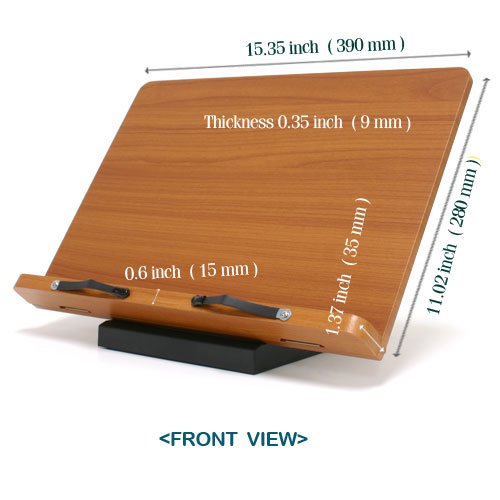
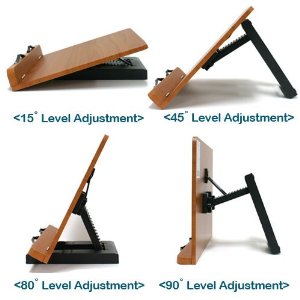
An easy and inexpensive fix for this is to buy a document holder and use it to stand your papers or books upright, at a slight angle so that you can see your documents and still have your keyboard closer to you as you type. I’ve provided a list of the best document stands I could find on Amazon below.

Jasmine Book Stand (Bookstand / Bookstands / Holder / Cookbook / Music)

$29.99 at Amazon click here.

Amazon reviewers say:

• This book stand is so amazing! As a graduate student, it has made all the difference in the world with my reading and research. It makes it much easier to take notes; it can accommodate quite thick books; it is very sturdy; and, it is a great size. My reading and note taking are happening with greater ease and speed. This is a wonderful product! C roberts

• I have degenerative disc disease in my cervical spine and I can hold my head in only one direction for longer than 5 minutes–straight ahead. I am a student and have a lot of reading to do. This bookstand has saved me a lot of pain and discomfort, allowing me to maintain good posture while I study. I highly recommend this product to anyone with neck pain.  j hunter

• I purchased this stand to hold thick textbooks, and it is exactly what I wanted. As an added benefit, I also use it to hold my computer tablet. Now I’m considering getting another one.  Sydney

• I’m a nursing student, and I got this stand because I was getting neck aches from studying so much. This stand put a prompt end to that! It is sturdy, easy to use, and it works well at my computer desk for my online class. I can easily set my book at a 45 degree angle to my computer screen and a bit to the side, and I can see the screen, the textbook, and have my binder open in front of my screen to follow along during a lecture. It is lightweight and stores fairly flat, too. I love it!  R H May

• I use this bookstand in front of my computer at work to hold file folders while I type letters and reports, etc. It’s excellent for this. Some of the files can be a little thick and heavy; this book stand holds up. It’s made much better than the one I had before that was made from plastic and had bent under the weight of the files over time. I don’t see that happening with this stand. I do wish the tray was slightly deeper to hold even thicker files (or books), but overall I’m very happy with it. In spite of its strength, it is very light weight, but a little bulky if you plan to carry it around with you a lot. I would definitely recommend this book stand to my family and friends.  SS

• This is a steal for $30. The best part is the smooth surface finish and the solid feel of the assembly. The main hinge assembly is made of black plastic, but it is very rigid and the screws are metal. Another great feature is that the stand folds up flat so that you can put it in a backpack or a large notebook bag. I went to the library today and whipped it out onto a desk. The clips that hold the pages in place are nice too: firm enough to keep the pages down but not too strong so as to be a nuisance when turning pages. I’m definitely recommending this to all my friends who are students or who are serious readers.  Mpay

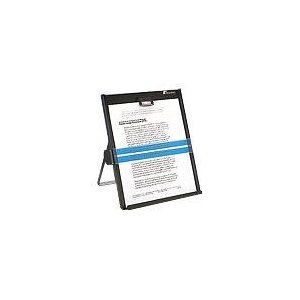
Fellowes Kopy-Aid Black Letter Copyholder (11053)

$24.88 at Amazon, click here.

I like this stand because its affordable and because it’s metal, it is most likely easier to write on if you need to take notes.

Amazon reviewers say:

• Top of the line document holder. I use the Fellowes Kopy-Aid both at home and work. I’d be lost without it. I do accounting and bookkeeping entries and nothing beats the moveable magnetic line guide. I highly recommend the Fellowes Kopy-Aid. J. Ferrero “MontanaJoe”

• I purchased this after my plastic on broke for the second time. It is very stable and won’t be likely to break or turn over like the ones I have used previously. I like the way the magnetic line guide fits at the side. Easy to use on one sheet or 20 semi-rumpled sheets. Patricia Adcock

• This item was pretty sturdy and help avoid a stiff neck when copying something. It was delivered on time and in good condition. The price is right. Edgardo P. Yamsuan

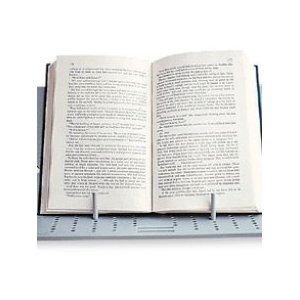
Portabook Message Board and Multifunctional Book and Laptop Stand (Light Gray)

Price on Amazon $12.99 click here.

Amazon reviewers say:

• This is the 4th or 5th Portabook I’ve purchased. I recommend them to massage clients and give them to friends and family. The Portabook is lightweight and easy to pack into a backpack along with laptop. It holds books, papers and lap taps easily. A set of coated rubber bands holds large books or a laptop keyboard in place. Using the Portabook relieves neck and shoulder pain caused by looking down at papers and books. It can also be used to hold a laptop at an angle that is easier to viewing the screen. However, it’s best to plug-in an extended keyboard in this setup or you ave to type with your arms up to your shoulders!

We only broke one Portabook after 2 years of constant use. For such an inexpensive and lightweight product 2 years of use is pretty good. I highly recommend the Portabook if you want an easy way to hold books and papers at an angle while you read. Wellness Woman

Roberts 732310000 Book Holder

$35.25 at Amazon click here.

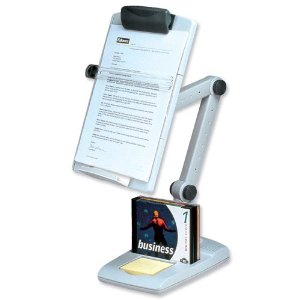
Fellowes Flex Arm Weighted Base Copyholder Platinum/Graphite

$26.23 at Amazon, click here.

I am leery of this stand but it does offer the flexibility of allowing you to position your document where its easiest for you to view. the down side is that the stand takes up a lot of room and that these types of arms tend to be flimsy and break often as noted by Amazon reviewers.

Enhanced by Zemanta

Read Full Post »


The Artculating Easel in use with an iPad


By Sue Shekut, Owner, Working Well Massage, Licensed Massage Therapist, Certified Wellness Coach, ACSM Personal Trainer

This past weekend I did what I tell other people not to do. I spent the bulk of the weekend at my desk and computer, studying, writing a paper and reading  a textbook. In all, I likely logged 20 hours sitting in my chair, typing, reading and researching. I did use my Port-A-Book to hold my textbook but even with good ergonomics, sitting for that long take sits toll. The result: I got a lot of work done, but I also felt exhausted, my back and neck hurt and I felt my immune system wearing out. I missed my weekly, long forest preserve hike and overall, I missed my weekend. I don’t do this often and I don’t advise spending the weekend working or computing, especially if that is what you do all week at work.

Now research shows that you do on your weekend can effect how well you feel and how productive you are during your workweek.  A study conducted by German researchers on emergency medical service (EMS) workers showed that weekend time spent socializing with friends and family tended to reduce workers’ burnout and increase their general well-being. Kind of a no brainer, don’t you think?  But  many people who work long hours during the week in office jobs that come home to a weekend of more work done in front of their computers. Why do we work so hard? For some, it’s a matter of managers giving workers too many tasks to complete in too little time. But if your manager is one of those people who doesn’t believe you should have time off from work on the weekend, you may want to share the results of this study with him or her. AND, if you are the one that drives yourself to work during the weekend, you may want to read more about this study yourself. And then, give yourself some time off! You will be glad you did.

Researchers at the Technical University of Braunschweig studied the effect of nonwork hassles, time spent in social activity and time spent reflecting positively about work on 87 EMS workers. Nonwork hassles were defined as conflicts with family members or spouse, car trouble, excessive housework  or similar irritation. Social activity was defined as spending time with people one enjoys and positive reflection about work was defined as thinking about the benefits or successes of one’s work. It appears it was easier to study EMS workers (paramedics in U.S. terminology) because they would have a difficult time “bringing their work home with them.” Thus,  the weekend experience for an EMS worker would not include work tasks. (Contrast this with U.S. office workers than can do their work anywhere a Blackberry, laptop or iPhone can be powered up.)

Non work hassles correlated with poor general well-being post-weekend and lower performance in daily work tasks post-weekend. So fighting with your spouse tends to make you feel less healthy and perform more poorly at work the next week). Workers engaged in more social activity on the weekend reported higher levels of general health and well-being as well as better task performance post-weekend.  A high amount of non work hassles tended to associate with lower pursuit of learning post weekend.  Higher positive work reflection on the weekend led to higher pursuit of learning post weekend. Exhaustion was significantly related to task performance (those more exhausted did less well on task performance). The study recommended that workers try to spend more time in positive social activities during weekends and free time.  Employers and organizations could use this study as support for considering reductions in workload and allowing for breaks or comp time after periods of intensive work activity.

I, for one, will be taking time off from the computer and my textbooks for next few days for Thanksgiving activities with my family and friends. And I will be giving my back and neck a much-needed break. And maybe even get  some hiking or swimming in!

Happy Thanksgiving to all of you!

Source:

Fritz, C., and Sonnentag, S. (2005) Recovery, Health, and Job Performance: Effects of Weekend Experiences. Journal of Occupational Health Psychology, 10(3), 187-199

Enhanced by Zemanta

Read Full Post »

By Sue Shekut, Owner, Working Well Massage, Licensed Massage Therapist, Certified Wellness Coach, ACSM Personal Trainer
Recently I heard about a great blog that provides posts about the latest research on Industrial/Organizational science, The IOATWORK blog.

Human Resource professionals, as well as those of you interested in reducing stress in your workplace, might learn a lot from articles in this blog. As a massage therapist and wellness coach, I see the effects of workplace stress first-hand. And I can do something about relieving the effects of stress for my clients. But I can’t eliminate the causes of stress. That’s the job of management and Industrial/Organizational psychologists. If you want to know more about what’s going on in the field of research, what’s been shown to work and what does not as far as reducing workplace stress, providing better work/life balance for employees or how to keep yourself from burning out, you would do well to check out this blog! (And of course there are a lot of other great non-wellness related posts in the blog as well.

Who Created the IOATWORK blog and Who May Benefit From Reading It?

The blog editor, Alison Mallard, Ph.D. explains why the blog was created and the audience they intend to serve:

Many consider Industrial/Organizational psychology as the science behind Human Resources, Organizational Development, Organizational Effectiveness, and Organizational Behavior.

I/O AT WORK helps to bridge the gap between I/O research and its application in the HR world (and beyond) by making it easier for practitioners to access and stay on top of recent published research.

So, instead of spending hours scanning multiple journals, we do much of the work for you.  With this site and a few minutes a week, you can stay informed about new research by scrolling through the new reviews posted each week.  Or you can search reviews by topic or journal.

Wellness-related  Blog Posts from IOATWORK blog (links included)

Your Lunchbox is Your Friend

Keeping it Safe for Daylight Saving Time

Heavy Workloads: Much More Than Just a Nuisance

If You Want to Prevent Exhaustion … Don’t Worry, Be Happy!

With Age Comes Wisdom…And Better Job Attitudes

Managing Grief in the Workplace

Oh give me a BREAK! (Why breaks are important)

When Helping Hurts: The Dark Side of Organizational Citizenship Behaviors

When Mental Detachment from Work is a Must

Play Hard, Rest Hard and Maximize Your Performance

The Organizational Benefits of Work Life Balance

Home Sweet Home…At Work?

Work-Family Conflict: White vs Blue Collar

Related articles

Enhanced by Zemanta

Read Full Post »

Some Kills
Image via Wikipedia

By Sue Shekut, Owner, Working Well Massage, Licensed Massage Therapist, Certified Wellness Coach, ACSM Personal Trainer

Today we have a guest post from Libery Kontranowski, a freelance writer and former pharmaceutical representative. Liberty has first hand experience representing a major smoking cessation product, Zyban.  Many of my friends and some clients have had good luck with Zyban and quitting smoking. So if you are a smoker or have someone in your life that still smokes, read on. (I am not affiliated with Liberty, Zyban or eDrugstore.md. I simply want to give my readers access to new information about smoking cessation!)

Note: Zyban does not work for everyone. If you try Zyban or similar products and have any adverse side effects, mood swings or feel depressed, contact your doctor immediately.

Quitting Smoking: Meds, Methods and Madness, Oh My!

By: Liberty Kontranowski

Quitting smoking is one of the hardest tasks to ever accomplish. But now that smoking is being banned in municipalities and public spaces, it’s a great time to kick the habit for good.

While you already know that smoking is dangerous to you and those around you (and even to those who visit your home, whether you light up in their presence or not), it’s important to realize that smoking is an addiction. Certain properties in nicotine have addictive qualities, and to be truthful, they are not all bad. Nicotine can help people focus, make them more alert and can soothe frazzled nerves. It’s the other stuff that cigarettes are made up of – the cancer-causing carcinogens – that are so harmful. In short, if nicotine could be bottled or manufactured without the rest of a cigarette’s components, we might all find ourselves racing out to buy some. Of course, that is not the case, so to prolong the health of your lungs, make quitting a priority.

In my previous life as a pharmaceutical sales rep, I had the pleasure of selling Zyban (buproprion). I say “pleasure” because on more than one occasion, I had physicians call me into patient rooms to give details about the medication right to the patient themselves. At first, it  was intimidating, but once I saw the genuine look of hope and relief wash over the patients’ faces, I knew I was making a difference.

Unlike nicotine patches, medications such as Zyban and Chantix do not deliver nicotine into the body, and quitters are allowed to smoke in the beginning of treatment. Once the medication reaches a steady state in the body, cravings are reduced little by little, to the point of none at all. This seems to be a particularly intriguing way to quit, since the quitter does not have to initially give up their cigarettes completely. As they find their cravings reduced, they feel a great sense of accomplishment and therefore tend to stick out the program – and are more successful in their effort to quit.

As an interesting side note, Zyban is actually a renamed version of Wellbutrin, an anti-depressant. In clinical studies for Wellbutrin, subjects reported the “side-effect” of fewer cravings for cigarettes, and thus the manufacturing company pursued FDA approval to repackage Wellbutrin with a support program and release it as Zyban for smoking cessation. What a great side-effect!

Now, while medications are wonderful choices for a lot of people, some folks try to avoid that road, or they save it for a last-ditch effort. That said, there are other ways a smoker can attempt to quit:

Cold Turkey – This is simply quitting altogether without cutting back, using medications, etc. If you’re a very strong-willed person, or if you’ve recently been diagnosed with an illness or disease that is directly affected by your smoking, this might be the quit choice for you.

Nicotine Replacement Therapy – Nicotine patches are often used in a step-down method, whereby they deliver a certain amount of nicotine to the body, gradually lessening the amounts until the body no longer craves it. Those using nicotine replacement therapies (also including gums, lozenges, sprays and inhalers) are urged NOT to smoke while using these devices, as this will both defeat the purpose of the step-down treatment and may overdose the quitter’s body with nicotine.

Behavioral Modification – A key factor to the success of any smoking cessation method is simply a change in habit, also known as behavior modification. If a smoker lights up first thing in the morning, they should distract themselves with a shower, cup of coffee or breakfast instead. If a cigarette is part of the daily ride to work, the quitter should take a different route to work, drive with the windows open or take public transportation. Any change in the routine will help offset the quitter’s auto-response to light up a cigarette.

If the hand-to-mouth motion is what the quitter misses most, chewing gum, gnawing on the end of a pen, or drinking a glass of water may suffice. Type an email, write a letter, cook a meal or take a walk to keep the hands occupied.

While quitting smoking is not easy, there are plenty of resources to help a person be successful. There are many websites and support groups available for quitters, and online discussion boards can be a great place to share your successes and downfalls, as well as get and give inspiration.

Best of luck to you on your smoking cessation goals. Your lungs (and family and friends and co-workers) will thank you, for sure!

Liberty Kontranowski is a freelance writer and blogger with hundreds of health, sex and lifestyle articles published online and print. She is a frequent contributor to eDrugstore.md, the top-rated online medications facilitator.

Enhanced by Zemanta

Read Full Post »

Common shot of iPad showing only users lap. Image from Flickr.

By Sue Shekut, Owner,  Working Well Massage, Licensed Massage Therapist,  Wellness Coach, ACSM Personal Trainer

I’ve been noticing iPad advertisements all over town. I see iPads on billboards, ads on my computer and on television. Notice how the ads don’t show people sitting and using the iPad. They show people’s laps and legs and then a close up the iPad. Hmm, why hide the necks and shoulders of iPad users? My guess, because sitting hunched over a small but relatively heavy iPad makes people look pretty uncomfortable.

Ned Batchelder has a great post on the ergonomic issues of the new iPad here. Ned shows a video of someone using the iPad to make slides that shows just how awkward it is to use the iPad for data creation. Commenters say that hey, the iPad isn’t designed to be a data creation device but a data consumption device.  Do we really need separate devices for each use?

Don’t get me wrong, I am a huge Apple fan. I’ve been using Macs since they first came out (Does anyone remember the old SE30’s with the 9″ monochrome monitor. That’s where I started. And interestingly enough that’s about the time I started needing to see a chiropractor, too.) But as slick as Apple’s touch screen iPod’s and iPad s are and are, they really cause a world of hurt for users’ necks and shoulders.

Whats Wrong With iPad?

1. iPad/iPod devices are small and relatively lightweight. So at first glance you may think, hey, it won’t hurt me, it’s a device under 1 pound. But that one pound gets pretty heavy if you hold it up over time.

Try this exercise. Hold a 1 pound weight up in front of your body for 5 minutes. Bet you can’t do it. The 60 seconds may be pretty easy. But as the clock ticks, the weight gets heavier and heavier. Now think about holding that weight for an hour. Two hours.  Even try holding just a real apple for ten minutes in front of you. (An edible apple I mean.) After a while your arm gets too heavy. It’s not so much the weight of the apple or the device that gets you. It’s the weight of holding your arm in front of you for long periods.

A Woman Named Rachel "holding" the Apple logo. Image from Flickr, luckmontague's photostream.

Even though the woman above is not holding any weights, just keeping her arm up will make her arm and shoulders fatigue. quickly. It’s unlikely you anyone would use their iPad in this position, but it gives you an idea of how heavy your arm can be.

2. The “iDevices” are small and to see the screen you have to bend over them. Your neck has to crane to position your eyes over the keypad. I watched a client use her new iPad yesterday. Even though she was sitting in a comfy overstuffed chair, with her legs up, resting the iPad on my knees, she still had to lean far forward and look down at the device.   Thanks Apple for keeping massage therapists, physical therapists, chiropractors and orthopedic docs busy for years to come!

Even Steven Jobs will need  a neck and shoulder massage after using the iPad!  Notice in the photo below that he is holding the iPad in his hands away from his lap unlike ads for the iPad where we see people holding the iPad on their laps. It’s a trade off in whether his neck gets tired faster from craning forward or his arms and shoulders from holding the iPad closer to his face.

Even Steve Jobs Looks Uncomfortable Using the iPad Image from curiouslee at Flickr.

3. The touch screen is “cool” but it requires you to move your arm in front of your body at an awkward angle. using a keyboard already causes users to tighten their pectoral (chest) muscles a great deal. Tighter pectoral muscles often leads to muscle tension in muscles in the upper back and neck. Why? These back muscles have to compensate for the pec muscles literally pulling your body forward.

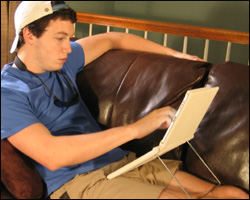
Notice how the young man pictured below is leaning far forward over his keyboard? He is engaging his pectoral muscles and the muscles in the back of his neck and upper back are straining to hold him upright. I feel safe to say he may have some neck and shoulder pain from this position. You may think your posture is much better than his But then thick about how you sit if you work on a iPad or iPod!

Image from NatBat at Flickr

I don’t doubt that the new iPad will necessitate a whole slew of new products designed to hold your iPad at a more ergonomic position. Until these come out, I recommend you use the good old Porta Book to hold your iPad at a comfortable viewing angle. The Posta Book is inexpensive, about $20, and lightweight. And it’s available here.

Or if you have a common house cat, you can make use of your pet as an iPad holder. One man did in the pic below!

Image from Flickr.

More articles on iPad ergonomics

The ErgoLab’s Apple iPad Part Deux: Don’t Shoot The Messenger
Donald Clack Plan B, iPAD: ergonomic disaster – end of story

The ErgoLab: The Apple iPad; this Apple has a few worms.

Business Inside SAI: Apple Still Hasn’t Fixed The Big Problem With The iPad: It Looks Really Uncomfortable To Use

Reblog this post [with Zemanta]

Read Full Post »

04.26.09 [#116] Feet Week - At Rest
Image by Jeezny via Flickr

By Sue Shekut, Owner, Working Well Massage, Licensed Massage Therapist, Certified Wellness Coach, ACSM Personal Trainer

Some of you may wonder why I haven’t posted much over the past week. It’s simple–I caught a touch of the flu and have needed to rest.

As a massage therapist, wellness coach, and small business owner, I work a lot of hours. And in my work, I come in contact with many people every day. Some of my clients see me when they are sick or are getting over an illness but are still contagious. Being self employed, I don’t get paid sick time.  Therefore, I do all I can to avoid catching colds and flues. However, there are still times when my immune system can’t handle the fight and an infection or flu bug gets me. Luckily, living healthy keeps me well most of the time and helps me get over most illnesses relatively quickly. In those times when I do get sick, one of the principle methods I use to get over an illness is one you can’t buy in a store: it’s rest.

The definition of rest, according to education.yahoo.com here is:

  1. Cessation of work, exertion, or activity.
  2. Peace, ease, or refreshment resulting from sleep or the cessation of an activity.
  3. Sleep or quiet relaxation.
  4. The repose of death: eternal rest.
  5. Relief or freedom from disquiet or disturbance.
  6. Mental or emotional tranquillity.
  7. Termination or absence of motion.

Looking through this list, how many times the past week have you been able to achieve the definitions cited in point 1, 2, 3 or 5 above? When I think of rest, I don’t only think of sleep. I also think of relaxing, having quiet time to contemplate my navel or meditate or watch clouds pass overhead. Resting to me is a time to let the worldly concerns go and just relax my mind and body. Which is tough to do in today’s fast paced culture. But rest is ever more important in today’s world. Most people do not even get the required 7-8 hours of sleep. Then they spend the day working on computers, meeting with other people, traveling and commuting, going to the gym or home to spend time with family. In all the hours we spend working and meeting outside obligations, rest is often confined to the hours of sleep we can sandwich into  the rest of our lives. But studies show that rest is an important tool in our wellness arsenal. Napping is a common event in many cultures (just not in the U.S.!). Read more from my post on Daytime Naps here. And meditation is an effective way to rest our minds as well.

NASA is currently doing a study on how bed rest effects human subjects in space travel. Read more about the study here.

While I rest, read more great articles on rest:

• The vital importance of rest here.

• Give your immune system a  rest here.

• The effects of sleep deprivation on brain and behavior here.

Reblog this post [with Zemanta]

Read Full Post »

« Newer Posts - Older Posts »