Feeds:
Posts
Comments

Archive for the ‘Nutrition’ Category

lakefront joggers

Image by reallyboring via Flickr

By Sue Shekut, Owner, Working Well Massage, Licensed Massage Therapist, Certified Wellness Coach, ACSM Personal Trainer

Recently I came across a nutritionist’s website that I really like. The nutritionist, Jennier Vimbor, has banded together with fitness experts to create a combo nutrition education and exercise club called NCS..gotta run!! This club incorporates nutrition and exercise into a weekly meeting format. Our Nutritionists, weekly speakers and guests will demonstrate how to balance your nutritional needs with your fitness needs. Each member receives individualized recommendations from Nutritionists/Dietitians, Trainers and others in order to continue to move forward to reach your goals.

Here is what you receive if you join the NSC…Gotta Run Club:

1. Every week you will keep a food & activity journal, then submit the information prior to each meeting.

2. A Registered Dietitian (RD) will evaluate your intake/output and provide personalized recommendations.

3. Each week we’ll start off or end with a different 15 – 30 minute clinic regarding nutrition information, correct shoe fit, stretching, rehydrating, Pilates & Yoga, and Massage Therapy.

4. Get out there and run or walk at your pace for 15 – 60 minutes along Chicago’s beautiful Lakefront Trail., depending on your goals. Pacers will be out there with us in order to provide consistency, advice and encouragement.

5. Safety is of great importance. No member will walk/run alone. There’s a match for everyone.

6. Return to suite to pick up your belongs.

7. Q&A with our Healthcare Professionals, if interested.

8. Enjoy complimentary snacks & beverages.

Schedule

6-Week Sessions
Session A is Closed
Session B: Mon, Jun 6 – Jul 18
Session C: Mon, Aug 1 – Sep 12
Session D: October 18th – November 22nd

When: Every Monday, 6 – 8 pm
(doors open at 5:45 pm)

Where: the Fine Arts Building
410 South Michigan Avenue, Suite #306, Chicago, IL 60605

Cost: $150 ($25 per session for the whole package)

Registration: Sign up for NCS…Gotta Run!! Club  here.

NCS Founder: NCS…Gotta Run Club was created by Jennifer Vimbor, MS, RD, LDN, CDN in 2003 to promote optimal nutrition, health & wellness. Her website is the ChicagoNutritionist here.

Jennifer received her Master’s Degree (MS) from Columbia University in New York City. She is a Registered Dietitian (RD), Licensed Dietitian-Nutritionist (LDN) and Certified Dietitian-Nutritionist (CDN), as well as certified in Food afety from the National Restaurant Association Educational Foundation.

NCS philosophy: nutrition plays a significant role in your life. You really are what you eat. The foods you choose influence your healthy and well-being. Foods are selected for many reasons (pleasure, emotions, traditions, and associations as well as nourishment). The challenge is to find a balanced regimen that works for your lifestyle.

Enhanced by Zemanta

Read Full Post »

By Sue Shekut, Owner, Working Well Massage, Licensed Massage Therapist, Certified Wellness Coach, ACSM Personal Trainer


]

Nutrition+exercise=Good Health

Today I came across an article about a gym that offers cooking classes and teaches basic nutrition to its members. Sadly for Chicagoans, the gym isn’t located in Chicago, but in Pittsburgh, PA. But maybe some enterprising Chicago gym owner/Entrepreneur will like the idea and start one here in the city of restaurants! Hint hint.”An article by Debbie Black in the FOR THE PITTSBURGH TRIBUNE-REVIEW describes the fitness/nutrition experience of My Fitness  Kitchen here:

With over 23 years of experience working in the fitness industry, the owner of My Fitness Kitchen, Mark Rullo is an exercise physiologist, a certified strength and conditioning specialist, a medical exercise specialist and certified golf fitness instructor.

Gym members can learn to cook from nutritional recipes and are trained in a healthy lifestyle starting with calories, cooking and eating. My Fitness Kitchen recommends supportive nutrition, stressing the need for oxygen to work muscles, concern for muscles, and relaxation and recuperation.

Read the entire article here.

Enhanced by Zemanta

Read Full Post »

CORONADO, Calif. (Nov. 22, 2007) Storekeeper 1...
CORONADO, Calif. Storekeeper 1st Class Andy Zhang enjoys Thanksgiving dinner with his son. Image via Wikipedia

By Sue Shekut, Owner, Working Well Massage, Licensed Massage Therapist, Certified Wellness Coach, ACSM Personal Trainer

Thanksgiving is traditionally a time to give thanks and count our blessings. It can also be a time to overeat and overindulge. Here a few tips to help keep you from feeling like you lost control of your healthy eating habits on this feastful holiday:

1. Eat small portions of each food item you want to sample.

2. Don’t deprive yourself of dessert or you may overeat something else. If you want a slice of  pie, have one. Just cut a half  a slice, let that digest an hour or so before you think about having more!

3. Make sure you drink plenty of water. Dehydration can make you want to consume more food. And drinking water fills your stomach so you don’t have as much room for food.

4. If you drink alcohol, remember it is dehydrating. Trade off between one glass of water for every beer or glass of wine (or mixed drink if you are hitting harder stuff.)

5. Remember that this holiday is really about spending time with friends and family. Focus on the social interactions and the food becomes less of an issue.

6. If you are struggling with overeating or overindulging, do the dishes! It helps out the hostess/host and gives you something to do with your hands besides munch!

A Heartfelt Thank You

And thank you for reading my blog. It’s been a great year for Working Well Massage, am exceptionally happy year for me and a wonderful year for the many people in my life that have benefited from massage therapy, wellness coaching, personal training, better ergonomics, outdoor exercising, and good nutrition! I am grateful to have the opportunity to meet so many interesting and positively motivated people as I travel around and find interesting stories for  my blog. It’s the people I meet and work with that make my life interesting and fulfilling. A heartfelt thank you to all of you I’ve come in contact with this year, on the blog and in real life!

Enhanced by Zemanta

Read Full Post »

By Sue Shekut, Owner, Working Well Massage, Licensed Massage Therapist, Certified Wellness Coach, ACSM Personal Trainer

There is a good article in this months’ Men’s Health Magazine about fat phobia and America’s obesity problem, titled “I Hate Fat People.”  The author, Richard Connif, did a thorough job of explaining how BMI numbers have been revised and how this affects our perception of our fatness in his article about fat phobia and prejudice. He also did a great job explaining the controversy between those that celebrate their fatness (and contend that fat doesn’t mean unfit and that thin isn’t necessarily more healthy or fit) and those that believe that obesity is a ticking time bomb of health problems that tend to manifest later in life no matter how fit an obese person is. But he also notes that obesity tends to cause health problems later in life as the extra weight takes its toll on the pancreas (contributing to Type II diabetes), heart disease, and I would also add, joint issues and back pain.

But what’s the cause of our obesity? I have read articles that explain that we as human beings are biologically predisposed to crave fat and sugary foods as well as protean to stave off hunger. For the majority of time humans have been on this planet, we were living in food scarcity. But in the last 100 years, and especially the last 30-40 years, we’ve been afforded an abundance of food in most developed nations. Walk the aisles of any grocery store and you’ll find more food than our ancestors likely ate in a lifetime. Advertisers, trying to sell their companies products, cater to our inborn cravings for fat and sugar and salt and load our prepared foods with it. Like literally giving candy to a baby, food manufacturers and retailers tempt us with sweets and treats and we, creatures of our biological nature, snatch them up, and eat as much as we want or can afford. Over time, as we add in the more sedentary lifestyle most of us now enjoy, due to car travel, television and long work hours and commutes. Add this all up and it’s a simple math equation. Too much fat, sugar and calories coupled with low activity levels and our bodies do what they are supposed to do: protect us from starvation and store fat.

There may be more to this picture than all that. Some believe that obesity isn’t a sign of lack of self-discipline or solely our biological drives. It may be caused by an addiction: Compulsive overeating. An article in WebMD by Elizabeth Lee talks about former FDA Commissioner David Kessler, MD ‘s book,  The End of Overeating. In the book, Kessler, a Harvard-trained pediatrician and medical school professor at the University of California, San Francisco, described Hyperpalatable foods. He defines these foods as those high in fat, sugar, and salt that stimulate the senses to provide a physiological reward that causes many people to eat more to repeat the experience. Kessler explains that when a person eats a high sugar, high fat food they like this stimulates the body to produce endorphins, the brain chemicals that tell us we are experiencing something pleasurable. (Similar to runners high but less calorie burning!) Since our brains feel so good from the ingestion of endorphin producing sugar and fatty food, we want more. Eating more momentarily calms our nervous systems and  makes us feel good. Eating these foods also stimulates our brings to produce more dopamine. This in turn signals us to eat more of that feel good food. Visual cues lead us to seek more of the feel good food-pictures of food on TV ads, the signs of fast food restaurants, the packaging of our favorite candy bars in vending machines and at the checkout line. We eat without thinking and don’t realize why it’s so hard to control our cravings and eating habits. Once we get “hooked” on these feel good foods, we may develop a tolerance. And then we need food with more fat and sugar to bring us the same high, Kind of sounds like cocaine addiction, doesn’t it? Well, chemically, to our brains there are a lot of similarities. Read the full WebMD article here.

Not everyone is susceptible to the hyperpalatable foods. But for those that are, similar to people who are more susceptible to becoming alcoholic or addicted to other substances, there is help. One of the self-help groups that many people with compulsive overeating issues can turn to is a group called “Overeaters Anonymous.” Link here to take  short test to see if you may be considered a compulsive overeater.

More about OA from their website:

What is OA?

Overeaters Anonymous is a Fellowship of individuals who, through shared experience, strength and hope, are recovering from compulsive overeating. We welcome everyone who wants to stop eating compulsively.

There are no dues or fees for members; we are self-supporting through our own contributions, neither soliciting nor accepting outside donations. OA is not affiliated with any public or private organization, political movement, ideology or religious doctrine; we take no position on outside issues.

Our primary purpose is to abstain from compulsive overeating and to carry this message of recovery to those who still suffer.

Who belongs to OA?

In Overeaters Anonymous, you’ll find members who are extremely overweight, even morbidly obese; moderately overweight; average weight; underweight; still maintaining periodic control over their eating behavior; or totally unable to control their compulsive eating.

OA members experience many different patterns of food behaviors. These “symptoms” are as varied as our membership. Among them are:

  • obsession with body weight, size and shape
  • eating binges or grazing
  • preoccupation with reducing diets
  • starving
  • laxative or diuretic abuse
  • excessive exercise
  • inducing vomiting after eating
  • chewing and spitting out food
  • use of diet pills, shots and other medical interventions to control weight
  • inability to stop eating certain foods after taking the first bite
  • fantasies about food
  • vulnerability to quick-weight-loss schemes
  • constant preoccupation with food
  • using food as a reward or comfort

Where can I find OA?

Go to Find a Meeting on this Web site and follow the instructions to find a meeting in your area. Or you can contact the World Service Office at (505) 891-2664 or email for further assistance. You can also look for Overeaters Anonymous in your local telephone directory and in your local newspaper’s social or community calendar section.

Enhanced by Zemanta

Read Full Post »

By Sue Shekut, Owner, Working Well Massage, Licensed Massage Therapist, Certified Wellness Coach, ACSM Personal Trainer

The answer: Change your life!  What do I mean by that? Change the way you relate to food and exercise.


Healthy people exercising

Today I was reading this article on Yahoo Health about women that lose a significant amount of fat and transformed into healthier leaner people. And they kept the fat off over a period of years. If you read through their stories you will find a common theme: They switched from eating processed foods to “clean” foods like salads, brown rice, fish, vegetables. And they added regular exercise to their daily routines. They didn’t become professional bodybuilders, they did not subsist on a peanut and a celery stalk a day. They just eat healthier food in smaller more frequent portions. And they added activity to their daily lives One woman follows the simple guidelines of the ACSM: She added 30-60 min of cardio or strength training each day. Another woman said she makes sure she works out even on busy days at least 15 minutes.


If you read fitness magazines, blogs or know anything about fat loss and physical fitness, this story won’t be a big surprise to you. I think it’s important to remind ourselves that there are no quick fixes for fitness. But is losing fat, getting in shape and then STAYING in shape so easy? For most people, it’s not. It takes a few key qualities:

1. Perseverance-We don’t skip brushing our teeth every day to catch up on weekends and brush for 2 hours. Why would working out for 2 hours once a week be better than working out for 20-30 minutes 5 days a week? It isn’t. Our bodies work best in increments. We eat several times during the day, we sleep each night. We wash up each day (hopefully). Our 2010 lifestyles may make it tough to fit in movement when most people work in offices or in jobs that involved sitting for hours on end.  Adding in movement a little bit each day is easier than trying to pack in a mega workout once in a while. It takes perseverance (to persist in a state, enterprise, or undertaking in spite of counterinfluences, opposition, or discouragement). Taking stairs instead of the elevator, parking farther away from the store, walking when you can versus driving. Working out while spending time with your family and children also makes it easier to incorporate daily activity into your routine.  What’s important is that you add some exercise activity each day or at least 5 days a week. Don’t have time to go to a gym? It’s easy to make a home gym or workout to videos, Wii Fit or other cardio program. Whether you run swim, hike, bike or do yoga, it’s important is that you keep it up on a regular basis.

2. Discipline as in Self discipline-Fast food, junk food and high calorie, high fat food are all around us. It’s tough to get out of bed and go for a run or come home from a long day and fit in that 30 minutes of cardio or strength training. Making it a regular nonnegotiable part of your routine can help. And when you feel the urge to overeat or skip your daily workout, it takes a bit of self-discipline to pass up those french fries or push yourself to work out even when you’d rather sleep! But the rewards are feeling better, being healthier, having a clearer mind, being less stressed out and of course, being fit!

3. Prioritization-like that word? I did NOT make it up. It means making the most of your time and resources. And in this case, I say it means making sure that fitness and healthy eating are a priority. I use this analogy. If your child (if you don’t have a child, think about your niece, nephew or another child you care about) needed to eat, rest or get some exercise, would you let other priorities get in the way of taking care of the child?  (Hopefully not!) Yet adults often neglect our own needs for health and fitness because “we are too tired, too busy or too unmotivated.” Yet if we have to walk the dog or feed a child healthy food, somehow we find the inner strength, time and resources. So it’s not a matter of not having time or energy to take care of ourselves. It’s really about priorities. Learn to make your own health and wellness a priority. It benefits you and it also provides a good role model for children in your life!

4.  Focus (directed attention, concentration)-Focusing on how we look is rarely motivating. For some, working out to get the body they want or fit into a particular outfit may help motivate them to work out and eat right. It doesn’t work for me and many of my clients though. For me, I have to focus on how I feel. I feel better when I work out and eat right. How I look may change for the better but it’s not my  main focus. My focus is in feeling good, having more energy. sleeping well, not having stomach aches or feeling sluggish. No matter what your prime motivator/s is/are, use them to give you strength when you need a push to work out or eat right!

5. Fun-Wellness needs to be fun to be sustainable.  If you hate running, how motivated will you be to get up and run in the morning? But if tennis is fun for you, you will be more likely to play tennis than run. Wii Fit tries to make exercise fun for adults and children by integrating games in with the movement exercises. healthy food doesn’t have to be drab and boring. take a cooking class that specializes in healthy eating: Indian food, Middle Eastern Food , Chinese Stir Fry and even some Italian dishes can be low-fat and healthy.  Learn to add healthy spice to your food and “healthy” becomes fun and tasty! Make learning new fitness routines fun by trying them out with family and friends.

Enhanced by Zemanta

Read Full Post »

By Sue Shekut, Owner, Working Well Massage, Licensed Massage Therapist, Certified Wellness Coach, ACSM Personal Trainer

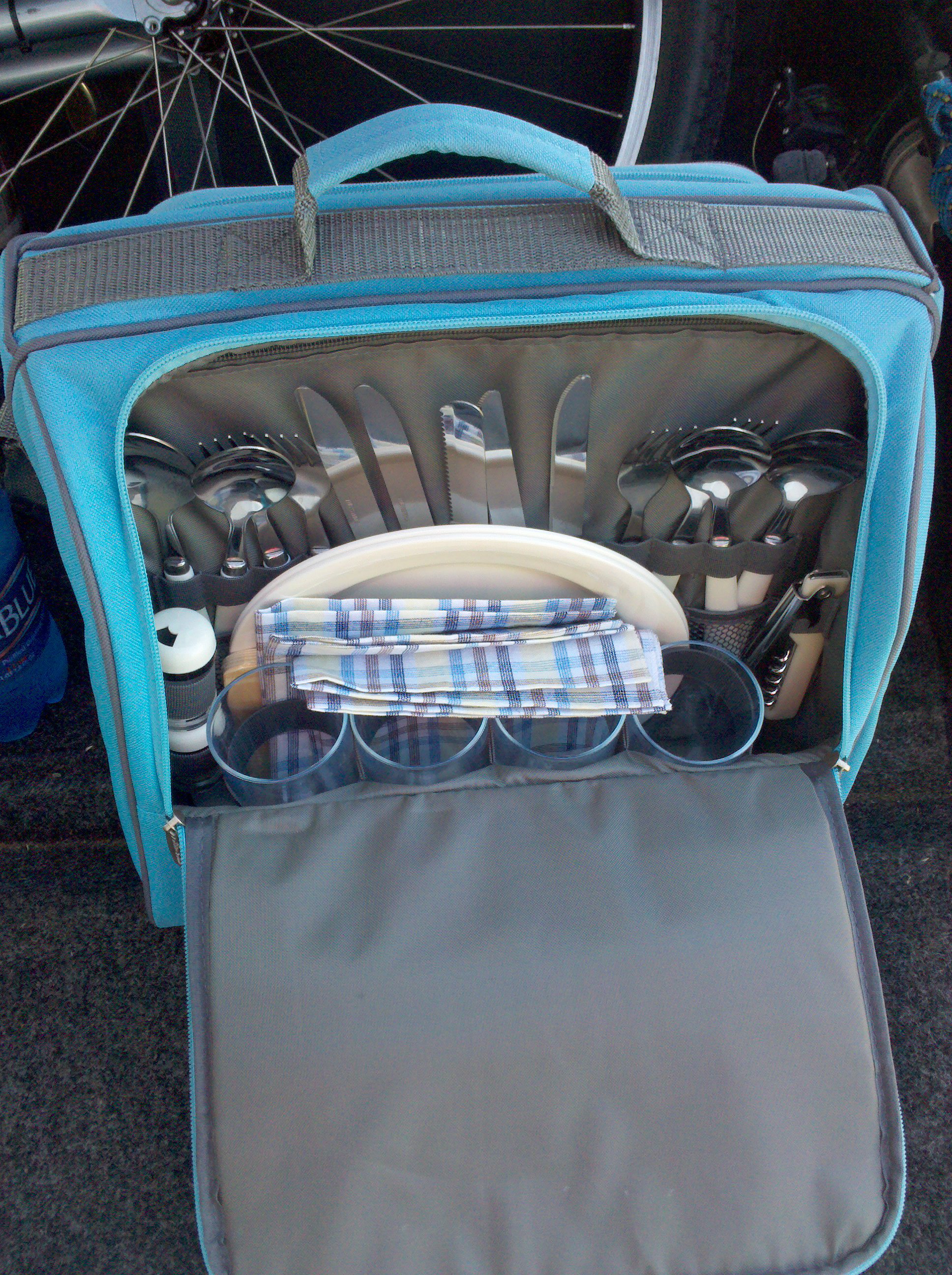
As you all know, I am a big believer in eating healthy and exercising outdoors when possible. And I am not afraid to travel to seek out new places to enjoy the great outdoors. However, when traveling or even for short day hikes, it’s a challenge to find healthy food nearby.  For that reason I recently invested in a fantastic product that I can take (and have taken) with me to ensure my partner and I eat healthy when away from home. What is it? It’s a cooler with a mess kit attached. Well, not really a mess kit, more of an upscale picnic set. There are a few different versions of this tote but I liked the Picnic Time Solano 412-44 Blue w/Grey Fully-insulated Picnic Cooler Tote best.

Plates, glasses, silverware, even salt and pepper shakers for the road. Image by Sue Shekut

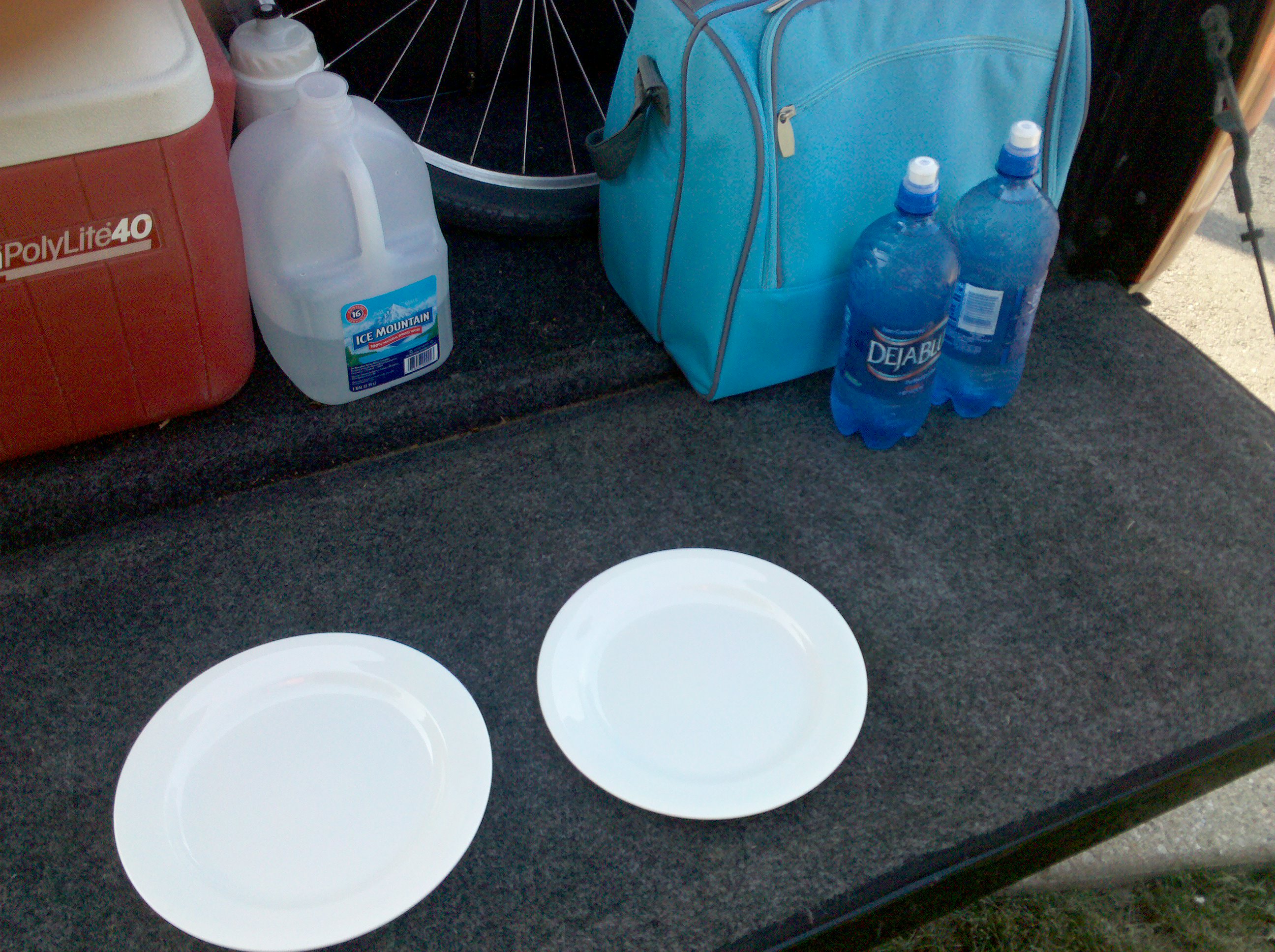
Before a day hike or a long trip, I pack up the cooler section of this pack with a few cool packs or ice in a plastic baggie. Then I can slip in some fresh sandwiches, fruit or even tuna fish salad or any healthy snack or meal that requires refrigeration.  We set out on our hike and I may take a tortilla and some lunch meat along for a mid day snack. By placing the meat next to the water pack in my camelback, I can keep it cool enough until I eat it a few hours later. The pack in the car keeps the rest of the food cold so we have food when we return from a long day’s hike. Then we can sit in the car and lay out plates, silverware and even cloth napkins for a small feast!  We used this pack on our recent trip to Door County and enjoyed a nice meal on the tailgate of my boyfriends truck.

Blue Picnic Pack and plates for our lunch on the road. Image by Sue Shekut

A Perfect Picnic Stop-Tailgating in the Back of a Gas Station Near Woods. Image by Sue Shekut

You can get this pack or similar packs on Amazon. (I found  a similar picnic pack at REI but it does not include the cooler.)  Order from Amazon here: NEW Picnic Time Solano 412-44 Blue w/Grey Fully-insulated Picnic Cooler Tote High Quality Pretty Cost $49.95.

* Durable polyester canvas construction, an adjustable shoulder strap
* Fully-insulated food/drink compartment with 18-can capacity
* Includes deluxe picnicware for four
* Comes with linens, cutting board, cheese knife and corkscrew
* Perfect for concerts, picnics, days at the park or beach

Product Dimensions: 14.5 x 9.5 x 13.5 inches
Shipping Weight: 3 pounds

Enhanced by Zemanta

Read Full Post »

By Sue Shekut, Owner, Working Well Massage, Licensed Massage Therapist, Certified Wellness Coach, ACSM Personal Trainer

So called “sports” drink advertising campaigns taut the benefits of drinking energy drinks for improved performance, concentration, and mood. However, like most marketing campaigns, as the old adage goes, if it seems to good to be true (energy in a bottle! Lose 30 pounds in 1 week!) it likely is too good to be true.
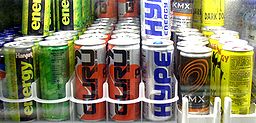
In his recent article, “The Downside of Energy Drinks – Negative Performance and Psychological Effects” published in ACSM’s Active Voice newsletter, Conrad Woolsey, Ph.D., CHES states that Energy drinks may actually cause long term energy depletion. Dr. Woolsey has published a number of studies regarding energy drink use and it’s effect on the nervous system and health in general. His findings are that that Energy Drinks can inhibit peak performance and that regular Energy Drink use will result in drinkers feeling tired, anxious, and depressed more of the time rather than energized and calm.

Caffeine Overdose?

According to Dr. Woolsey, of the over 500 brands of energy drinks now available, several contain 3-4 times the amount of caffeine (300+ mg/8 oz.) as standard energy drinks (80 mg/8 oz.) such as Red Bull.

Drinks like Spike and Redline also contain other herbal stimulants such as evodamine and yohimbine which are more powerful and dangerous than caffeine.

Energy Drinks: A New Addiction?

According to Dr. Woolsey, energy drinks work, much like drugs of addiction, “ by causing a large release and/or prolonged action of pleasure-reward neurotransmitters (dopamine/serotonin) and stress hormones (nor-adrenaline/adrenaline), which in turn provides a short term high followed by a low.”

In his research Dr. Woolsey found that “using energy drinks can raise pleasure-reward thresholds and damage neurotransmitter receptor sites. This results in more drug craving and/or thrill-seeking to satisfy homeostatic brain deficiencies and increases the chances of developing anxiety and depressive disorders.”

Prior research has shown that significant brain modeling occurs in adolescents all the way up to age 20. Young people under age 25 are also at risk for developing addictive personality traits and behaviors due to incomplete development of the memory (hippocampus), stress, and pleasure-reward systems of the brain with regular use of energy drinks.

In a randomly assigned double-blind placebo controlled study where Dr. Woolsey and his collagues tested energy drinks on a dynamic performance skill, they found performance improvements only when they examined a one-dimensional variables such as reaction time. But reaction time alone is not the only variable needed to coordinate multi-dimensional skills. In the study, performers perceived they were doing better, but actually made significantly more errors, due to being hyper-focused and/or over-aroused. Technical skills require precise timing and coordination and according to Dr. Wollesey’s studies, Energy Drinks can and often do reduce performance. As a sport psychology consultant, Dr. Woolsey regularly works with elite athletes whose performances suffer from using energy drinks, particularly in high-pressure situations.

Energy the Natural, Non-Addictive Way

The best way to feel energized and alert is to get a good nights sleep of about 7-8 hours. There is no substitute for a good night’s sleep, for you or for your children. Pouring caffeine into a sleep deprived person does not make up for the lack of sleep.

Another natural way to perk yourself up include avoiding dehydration by simply drinking enough water to stay hydrated. (Hint: If you feel thirsty you are already dehydrated.)

Finally, to keep energy levels constant, maintain steady blood sugar levels (without spikes or lows) by eating small meals at regular intervals (versus starving yourself and then binging on sugar or energy drinks to get you going). Sounds suspiciously like that whole “eat right, exercise, get plenty of rest and fluids” advice we’ve all heard before. Try it yourself and see how you feel.

And save the cost of expensive energy drinks, along with the cost of possible medical bills for anxiety, depression and addiction!

Buy Bottled Sleep By Sue Shekut

Am I really selling bottles of sleep? Of course not. If I could bottle sleep and sell it, I’d be a billionaire. But really, no one can bottle sleep. And if they could, would you have to buy a separate bottle for REM sleep and good dreams? (I’ll have a bottle of 8 hours of Sleep with a side order of good dreams?)

To read the complete article by Dr. Woolsey in Active Voice, click here.

Who is Conrad Woolsey and Why Should We Listen to Him?

Conrad Wolsey, PhD, CHES

Conrad Woolsey, PhD, CHES, is an Assistant Professor of Health and Human Performance at Oklahoma State University and a sport psychology consultant. His research areas include brain chemistry, addiction, positive health behavior change, health psychology and performance in athletes. He has authored publications and several research presentations related to this commentary1 including one at ACSM’s Annual Meeting and World Congress on Exercise is Medicine™, held in Baltimore in June 2010. For further information, contact the author by e-mail via his institutional website.

Studies by Dr. Woolsey on Energy Drinks

Woolsey, C. (in press, due for publication in October, 2010). Energy drink cocktails: A dangerous combination for athletes and beyond. Journal of Alcohol and Drug Education, 54(3), December 2010

Woolsey, C., Waigandt, A., & Beck, N. (2010). Athlete energy drink use: Reported risk taking and consequences from the combined use of alcohol and energy drinks. Journal of Applied Sport Psychology, 22(1), 65-71. Doi:10.1080/10413200903403224

Woolsey, C. (2010, March 18). Energy drinks: The new gateway drug. AAHPERD National Convention and Exposition in Indianapolis, Indiana. AAHE RCB Oral Session – New Challenges in Drug Use/Abuse Prevention and Intervention.

Woolsey, C., Martens, M.P., Beck, N.C. (2009). Understanding athlete brain chemistry and addiction. American College of Sports Medicine, ACSM Central States Regional Conference, Columbia, MO. November 6, 2009. Oral Presentation – 45 min.

Woolsey, C. & Kensinger, W.S. (2009, November 6). Exercise & energy drink use: Juiced jolts or risky sips? ACSM’s Central States Regional Conference, Columbia, MO. Oral Presentation – 45 min.

Woolsey, C. (2010, March 5). The effects of energy drinks and alcohol on brain development and psychological health. Achieving Wellness Through Community. Sponsored by the Oklahoma Department of Mental Health and Substance Abuse Services. Norman, OK. Speaker- 60 minutes.

Enhanced by Zemanta

Read Full Post »

By Sue Shekut, Owner, Working Well Massage, Licensed Massage Therapist, Certified Wellness Coach, ACSM Personal Trainer

Image by Wikipedia

Whether I am working with a massage client, showing someone stretches as a personal trainer or working with a client as a wellness coach, there is one thing I’ve learned to do when explaining new behaviors: I have my clients try the new behavior/stretch/exercise in front of me. This allows me to see if they understood my instructions and can accomplish the new task without too much difficulty. It also gives my clients a “body memory” or an experience with the new activity that goes beyond simply watching someone else do it. By experiencing a new behavior in the best possible form or manner, my clients then have a better sense of how it feels to do something correctly.

If I can’t demonstrate of watch my client try a new behavior, for example, when I am wellness coaching (which is usually done via telephone), I have my clients repeat back to me what they think the new goal or behavior would be. For example, if I want someone to breath deeply, I can have them try it and then listen to see if they are breathing with too much or too little effort. That all said, it’s time to experiment with you and your taste buds.

Previous Vegetable Experiences Color Your Perception of Vegetables

When I ask you how many vegetables you eat each day or what your favorite vegetable is, what do you visualize? Last night my boyfriend and I were talking about vegetables and how as kids, our experience with veggies was pretty limited. Canned green beans or peas. Soggy reheated previously  frozen mixed vegetables. Overly salty V8 Juice. Tasteless iceberg lettuce smothered in corn syrup sweetened dressing.  Overall, veggies in our childhood tasted rather bland and, to use a childhood phrase, “yucky.”

If your experience with eating vegetables brings these memories to mind, do you have any desire to eat vegetables? Likely  not.  This is one problem with being told by media and the government agencies (and me!) to eat more vegetables.  Some people do eat fresh veggies and delight in salads with arugula and jicama, or nosh on fresh steamed broccoli with gomashio (ground up sesame seeds with a touch of salt. It adds a nutty favor to any dish.) I was lucky enough to meet health food friends in college and shop at one of the first Whole Foods in the Midwest in the 1990’s. But many of my clients and those in the suburbs or with little access to the variety of foods available in big cities, still think of veggies as the canned, frozen green plants best smothered in cheese or dressing.

Change is tough, I know. And habits are hard to break. It’s so easy to stop by Micky D’s or Wendy’s or BK. Prepackaged baby carrots and iceberg lettuce salads are easy to prepare. If you don’t know how to prepare vegetables so that they taste good, it may be slightly risky to break out of the mold and try a new dish. But it’s well worth it!

If you read my blog, you know I am a big fan of the veggie steamer. Steaming broccoli, cauliflower, carrots, zucchini and even spinach makes for a truly amazing burst of sweet veggie flavor. For people  accustomed to eating foods with corn syrup or sugar fresh veggies may seem too bland still. For those folks I recommend you try adding a touch of olive oil, ground up sesame seeds (gomashio) or even a tiny sliver of butter to steamed veggies to ease into eating more veggies. Butter is not great  for you considering it’s high saturated fat content. But in moderation, it’s better to eat a plate of steamed veggies with a sliver of butter than eat no veggies at all!

Veggie Taste Test

Try something for me, then let us know how it goes via the comments section.

1. Bur either  a can of green beans and a bag of fresh green beans or a package of frozen broccoli and a stalk of fresh broccoli. (Make sure the stalk feels hard and not soft. if the broccoli is too soft it won’t taste as good.)

2. Cook both the canned/frozen and the fresh veggies in separate pans.

3. Try a blind folded taste test with just yourself or with your family as well.

4. Taste each version of the vegetable. What do you notice? Which version do you like better?

5. If you have not had steamed veggies before, did you think they tasted better than the canned or frozen variety?

Does this taste test give you hope for being able to eat veggies more often? If so, then you are ready to move on to…brussal sprouts!

Veggie Resources

For a Nutritional Analysis of different versions of green beans click here.

For a Nutritional analysis of broccoli click  here. Includes a fairly healthy recipe for broccoli soup!

For a good recipe for garlic sauce for your steamed brocs, and an exhaustive  history of broccoli longer that may either delight or overwhelm you in its length, click here. (The recipe at the bottom o the history of broccoli page.)

Creative ideas on how to feed your kids more fruit and vegetables click here.

Note: I, Sue Shekut, am strongly affiliated with broccoli and fresh veggies. I admit it, I eat steamed broccoli about 3-4 time s a week. Sometimes more!

Enhanced by Zemanta

Read Full Post »

By Sue Shekut, Licensed Massage Therapist, ACSM Personal Trainer, Certified Wellness Coach, Owner, Working Well Massage

Grocery Store Aisle. Image at Wikipedia

For some time now, we’ve heard about “food deserts,” those areas of Chicago and other cities where there is little to no access to healthy food such as fruit and vegetables. In food deserts, access to food within walking distance of residents homes is often limited to convenience store sand gas stations. this means feeding a family requires a car ride or public transportation ride to a grocery store outside the neighborhood or a dinner of potato chips pop and candy. Public health officials and groups like Building a Healthier Chicago, are working on improving the options for “food desert” areas by helping plant community gardens, creating farmers markets and providing nutritional education. Now the home delivery grocery service, Peapod, provides a 2010 alternative for families needing healthy food in food deserts–Peapod brings the food to the neighborhood!  Read more about PeaPod new offerings in Chicago areas considered food deserts here.

A Food Desert in Your Own Home

But food deserts are not only found in low-income neighborhoods. You may have a food desert in your own home! How can this be? Well, if the majority if your food is frozen, sodium-laced dinners like TV dinners, if your shelves are stocked with many packaged products with high fructose corn sweeteners, high sodium, partially hydrogenated oils (aka trans fats) and if your refrigerator is full of corn sweetened soda pop and juices, you may be under nourishing yourself and your family.

When I was growing up, my mom was so proud that she could afford to feed her family the latest new convenience foods. As a mom and a nurse, she tried to give us what she thought was healthy food. In my childhood (lo so many years ago, but long after fire was invented), TV dinners were a hot new thang. Tang tasted odd, but the astronauts drank it, so it must be good. Canned vegetables meant we could eat veggies year round. (Versus in my mom’s day when she could only get veggies and fruit in season.) Hamburger Helper did help my working mom. Shake and Bake Chicken, Rice a Roni, all these were staples in our kitchen.  My mother and other working parents did the best they can to feed their children what they believed was healthy food.  At the time all theses products came out, my mother thought she as feeding us the very best there was to offer her family. Years later, after childhood and adult obesity has become a national health crisis, we learn that all that new and exciting packaged, astronaut-endorsed food was not so healthy for us. Yet old habits are hard to break. And high fat, high sodium, high sugary foods taste great and are addicting.

If the majority of food in your home is heavily processed and you have few or no fresh fruit or vegetables, you are living in your own food desert. Don’t despair though, help is one the way!

What can you do to change your home from a food desert to a food oasis?

Reduce your purchase and family consumption of processed foods. Processed foods are usually found in the center aisle of the grocery store. When you read the label, even if the box says “NO trans Fats”, if you see “partially hydrogenated oil” or any kind of fat that is hydrogenated at all, that food has trans fats in it. The FDA allows manufacturers to label a food Trans fat-free if a single servicing size has less than .5 grams of trans fats in it. So, if a servicing size is half a cookie, then the whole cookie could have 1 gram of trans fat. The labeling and serving size restriction is easy to circumvent by food manufacturers. Savvy shoppers know to read the label and look for the words “partially hydrogenated” versus the big “Trans Fat Free” label, which often is meaningless as you can see by my illustration.

Increase your purchase and consumption of fresh fruit and vegetables. This is difficult for many people because they lack the skills to cook and prepare fresh veggies. Fruit is easier to serve and prepare. Most fruit can be eaten by itself. Apples, pears, peaches, bananas, even watermelon needs little to no preparation beyond washing to outer skin. But small children (and even many adults) used to sugary foods, may have a hard time switching to the real thing: Fresh fruit. Try fruit bowls with multiple types of fruit.  Get in the habit of feeding your children or yourself at least a piece of fruit a day or twice a day. pack a banana for lunch or apple or pair. Fill a ziplock baggie with a serving of dried fruit like raisins and almonds or pecans.

An easy and super healthy way to prepare vegetables is by steaming them. Use a small stainless steel veggie steamer (which you can get a Target or Kmart or Bed Bath and Beyond for about $5.00) to cook your veggies without leaching out a lot of the valuable nutrients. brocoli, asparagus, zucchini, even spinich quick quickly in a vegetable steamer. If you or your family can’t stomach veggies alone, put a small, very very small amount of butter (a sliver not a pat of butter) or olive oil on the veggies to season them. (Over time reduce the amount of  butter or oil you use as you become more accustomed to the taste of fresh steamed veggies).

Eliminate soda pop from your diet and your family’s diet. I know this is a tough one for many people. But soda pop is simply sugary water. Highly sugary water at that. “Diet” sodas are not much better for you. The number one drink for hydration, health and great skin is, water. Not juice, not beer, not tonic water. Just plain water. If you or your family have a hard time drinking plain old water,  try adding a squeeze of lemon juice or lime juice for flavor.  If you must have some sweetener, stir in a bit of real sugar, not corn syrup-sweetened soda!

Try serving a meatless meal from time to time (especially, if your dinner menu tends to be meat and potatoes). Meatless does NOT have to be tasteless. A dinner of rice and beans is high in protean and can be favored with a variety of spices to increase the taste. Falafel, a Middle Eastern staple, is a fried pattie made of spices and garbanzo beans. That may not SOUND appetizing, but try it out before you pass it up!

Try baking snacks from scratch. Do it yourself, “Lara bars” are easy to make and super healthy. If you must have cookies or cakes, make them yourself at home instead of from a box or bought from a store. Sorry Sara Lee and Entenmann’s but there is no substitute for homemade. And by making goodies at home you teach your kids to cook, can control the ingredients, and can spend some quality time with your family. If you don’t have time to cook during the week, make it a regular family weekend event!

We want to hear from you!

Share your food desert transformation stories with us in the comment section!

Enhanced by Zemanta

Read Full Post »

By Sue Shekut, Owner, Working Well Massage, Licensed Massage Therapist, Certified Wellness Coach, ACSM Personal Trainer

Want to find out about Chicago area restaurants, the best food is, reviews, recipes  and more? Check out  the Tasting Table here. I can’t say that all of their recipes and recommendation are healthy, but reading about food options in your city can give you more options for healthy eating.

What is Tasting Table?

According to their website, it is a free daily email that brings the best of food and drink culture to adventurous eaters in major U.S. Cities. Each weekday, Tasting Table send their subscribers a delicious idea about dining, wine, cocktails, cooking or restaurant personalities. Tasting Table  feeds you only first-hand recommendations that they have tested thoroughly themselves—one bite at a time.

In their local editions in New York, Los Angeles, Chicago, San Francisco and Washington D.C., they’ll alert you to a must-try dish at a forgotten restaurant, a hot new bar, under-appreciated shops for cooks and neighborhood food stores.

The national edition, Tasting Table National,  keeps you up to date about the most interesting dining trends  and the best new wines, spirits and cocktails around the country. They’ll direct you to essential new websites, kitchen tools and ingredients. And if you like to travel Tasting Table will cover that, too, with weekly updates about where to eat on the road and how to plan your next food-driven vacation.

Twice a week, their other national edition, Tasting Table Chefs’ Recipes, serves up an exclusive recipe adapted and tested for you to cook at home. These recipes offer a behind-the-scenes bonus from the kitchens of America’s hottest new restaurants and a preview of recipes from the latest essential cookbooks.

Read this months offerings to find out what happened to Ukrainian Village eatery Dodo. Also read more about Joeys Shrimp House, Ruxbim and a slew of international restaurants.

Enhanced by Zemanta

Read Full Post »

« Newer Posts - Older Posts »