Feeds:
Posts
Comments

Archive for the ‘Mental health’ Category

By Sue Shekut, MA, Licensed Clinical Professional Counselor, Licensed Massage Therapist, and Owner of Working Well Massage

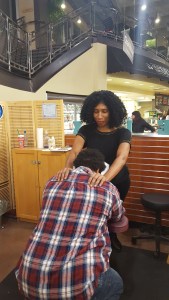
AARP published a list of health reminders in it’s December Bulletin, How to Stay Healthy in the New Year back in 2017. One tip is to spend time with a friend or loved on each day. Most of the other tips have to do with physical health or nutrition. So why the tip about socializing?

Photo from http://jesusgilhernandez.com

According to Psychology Today, socializing can boost your brain health and reduce the risk of dementia. According to Simplemost.com, in The 6 Health Benefits of Being Social, socializing can not only help you sleep better, but also help you avoid coming down with colds, reduce your vulnerability to depression and help you live longer. Lastly ValueOptions gives a deeper explanation of why socializing helps improve health and longevity in The Benefits of Social Interactions. ValueOptions post explains that feeling worthwhile leads to a long life.

I would clarify that spending time with people that are negative, critical and judgmental is not likely to improve your health.  So saying “socializing improves your health” is too general to be helpful advice.   If someone has a family member or friend that frequently shames them, violates their boundaries, is often needy, talks nonstop and doesn’t listen, (aka “Toxic people“), then spending time with those people won’t improve your health, and, can actually make you feel worse.

Therefore, I add a caveat to the advice above. Spending time with people that validate you, support and encourage you, that are honest and open with you, and that genuinely care about you, can be hugely beneficial to your physical and mental health. (This is one reason why the term “loved ones” is used versus “family.”)

What are your thoughts and experiences with socializing for your health? Share your comments below!


Read Full Post »

Today is the day we are encouraged to show our loved ones we care!

What’s the history of Valentine’s Day? According to the History Channel, there are many stories about how the day got it’s name, the primary story being about a saint named Valentine or Valentinus either protesting the Emperer’s outlawing marriage for young men (So they would make better soldiers) or being imprisoned for protesting harsh treatment of prisoners and while imprisoned himself, sending the first “valentine” love letter to a girl he fancied. And, according to the History Channel, Saint Valentine is the patron saint not only of love, but of beekeeping, travel, epilepsy, fainting and the plague.

Nowadays, people most likely think of Valentine’s as a day of romance, showing you care, giving pink or red flowers, candy and cards. It is also a great day to show the ones you love you care by gifting them a relaxing massage!

Feel free to purchase gift certificates for chair massage for your loved ones today via this link. Or stop by our WWM chair massage station at Whole Foods Lincoln park and buy gift certificates in person from 12noon to 8pm every day (except on major holidays or during polar vortexes!).

Read Full Post »

By Sue Shekut, MA, Licensed Professional Counselor, Licensed Massage Therapist, Wellness Coach, Owner, Working Well Massage

Today we celebrate Veteran’s Day, in honor of veterans that have served our country. Yet every day, many veterans struggle with mental health issues. Post Traumatic Stress Disorder is a common diagnosis for those that have experienced life threatening traumatic events and have ongoing difficulties with intrusive memories, hyper vigilance and attempts to avoid thinking about the events. Some veterans have nightmares, difficulty with anger management and feel isolated and misunderstood when y=they return home after active duty and combat situations.

The Veteran’s Administration provides physical and mental health services for veterans.  But for some, that is not enough. The good news for veterans is that there are alternative mental health services for military service people and veterans.

Give an Hour

Give an Hour is a national nonprofit organization with a large network of mental health clinicians that offer no cost mental health counseling to those that qualify. Give an Hour offers its services to all active duty service members, veterans of any era, and their loved ones. This includes parents, siblings, grandparents, unmarried partners, and others affected by a loved one’s service.

Give an Hour clinicians sign up and agree to offer one free hour a week of psychotherapy to a member of the military, active or veteran, or a family member. Veterans and family members can sign up on the Give an Hour website and select from a list of volunteer psychotherapists.

According to the Give An Hour Website, eligible clients include:

To Donate to Give an Hour, click here.

Headstrong

Headstrong is a service that is available to combat veterans that provides free psychotherapy specific to treat PTSD, usually via a type of PTSD treatment called EDMR. According to Headstrong website, Headstrong was founded in 2012 through a partnership with Weill Cornell Medicine, one of the nation’s leading mental health care centers to offer free, and confidential treatment for post-9/11 military veterans. Headstrong currently offers services in select cities in the following States: California, Colorado, Illinois (Chicago), Maryland, New York, New Jersey, Texas (Houston), Virginia,  and Washington DC.

Headstrong has developed an evidence-based, cost-free, stigma-free, confidential, and frictionless mental health treatment program for post-9/11 military veterans that works.

For combat veterans in Chicago, to sign up for free Headstrong Services, click here.

Headstrong is a registered 501c3 nonprofit organization supported primarily by donations. To donate to Headstrong, click here.

Disclaimer: As a mental health provider, I participate in both Give an Hour and Headstrong. I believe strongly in helping our nation’s military personnel and I also specialize in helping clients recover from traumatic experiences.

Read Full Post »

By Sue Shekut, MA, Licensed Professional Counselor, Licensed Massage Therapist, Wellness Coach, Owner, Working Well Massage

    One way to better cope with stress is to rely on your social support network, aka friends and supportive community. But what if you don’t have an awesome support network to turn to? You can create one. While that is not as easy as clicking on a book on Amazon and downloading it to your Kindle,  and it will take time, it can be done!

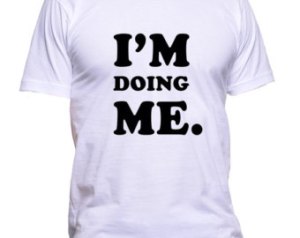
Photo from TShirts by Victoria on https://www.etsy.com/

    1. First off, learn to support, encourage and validate yourself! And then practice self-care, support, encouragement and validation of yourself daily. People that are seeking emotionally healthy friends and peers tend to be drawn to others that have similar attitudes.Keep in mind validation is not affirmation nor cheer leading. (Affirmation and cheer leading can be helpful. However, if we do not also validate ourselves, we may not believe our affirmations and cheer leading and affirmations may actually end up making us feel more anxious if we don’t acknowledge our feelings and thoughts first.)

      Validation is the acceptance of yourself as you are, it involves self talk or recognition that what you are feeling or thinking makes sense and is understandable and logical given your experience in the world.For example, a self validation statement would be, “I am nervous about giving this speech. I haven’t given many speeches before and doing something new can be anxiety provoking.”

      An invalidating self statement might be: “I shouldn’t be nervous about giving this speech. What a loser that I can’t even give a speech without being nervous. Get it together!” Affirmation would be: “I am awesome. I can give  a great speech.” Cheer leading would be “I can do it. C’mon, self, you got this!”

2. Practice gratitude, writing gratitude lists, looking for what you have and appreciating it helps you feel better. Writing gratitude lists and practicing thinking in a grateful mindset helps train your mind to focus on what is positive and working in your life versus training your mind to look for what you do not have or focusing on fears.

Focusing on gratitude is not the same as requiring yourself to always be positive nor is it denial of pain, fear or things that are perceived as negative.

Gratitude allows us to notice that while there may be sadness or loss or fears, there are also things in your life to be grateful for. Thinking of these thinks, counting our blessings and remembering that even when we lose something we still have other things to appreciate helps keep us stable and feeling motivated. And this type of attitude will attract supportive people to you


3. Work with a psychotherapist/counselor to help you learn to be more validating and to connect with other people if you have trouble on your own. Psychotherapists are trained to be validating and encouraging. Telling you to be validating and encouraging of yourself sounds easy, but for many people it is not! It takes retraining, especially if what you learned from people growing up was to be self-critical, judgemental or shaming.

4. Be a joiner! If you have access to any support group, attend meetings and get to know other people in the group. For some people, this means attending Alcoholics Anonymous meetings, or Alanon meetings or joining a support group for people with loved ones with Alzheimer’s Disorder. It can also mean checking out Meetups.com for people with simple similar interests like hiking, or reading, speaking French or folk dancing. If you belong to a church or religious group, get involved. A great way to meet positive supportive people is to volunteer with a charity that interests you.

E.K  Bernshaw has these tips as well in his post How To Attract Emotionally Healthy People.

Read Full Post »

By Sue Shekut, MA, Licensed Professional Counselor, Licensed Massage Therapist, Wellness Coach, Owner, Working Well Massage

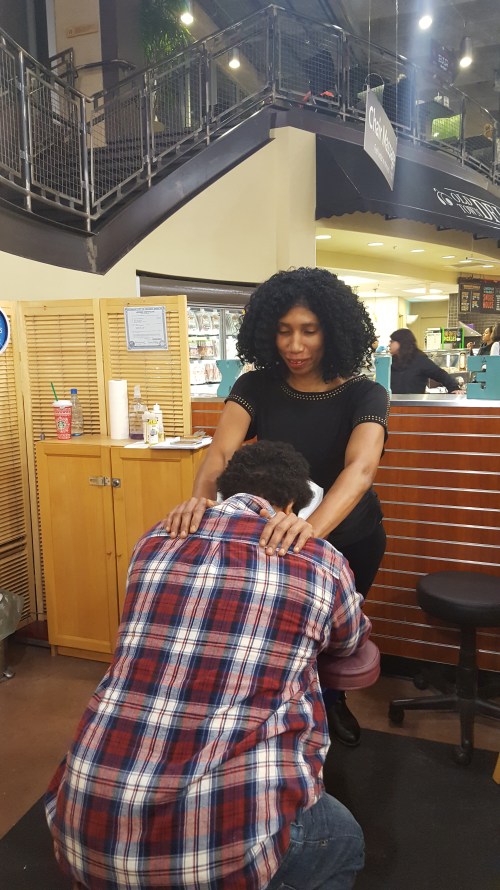
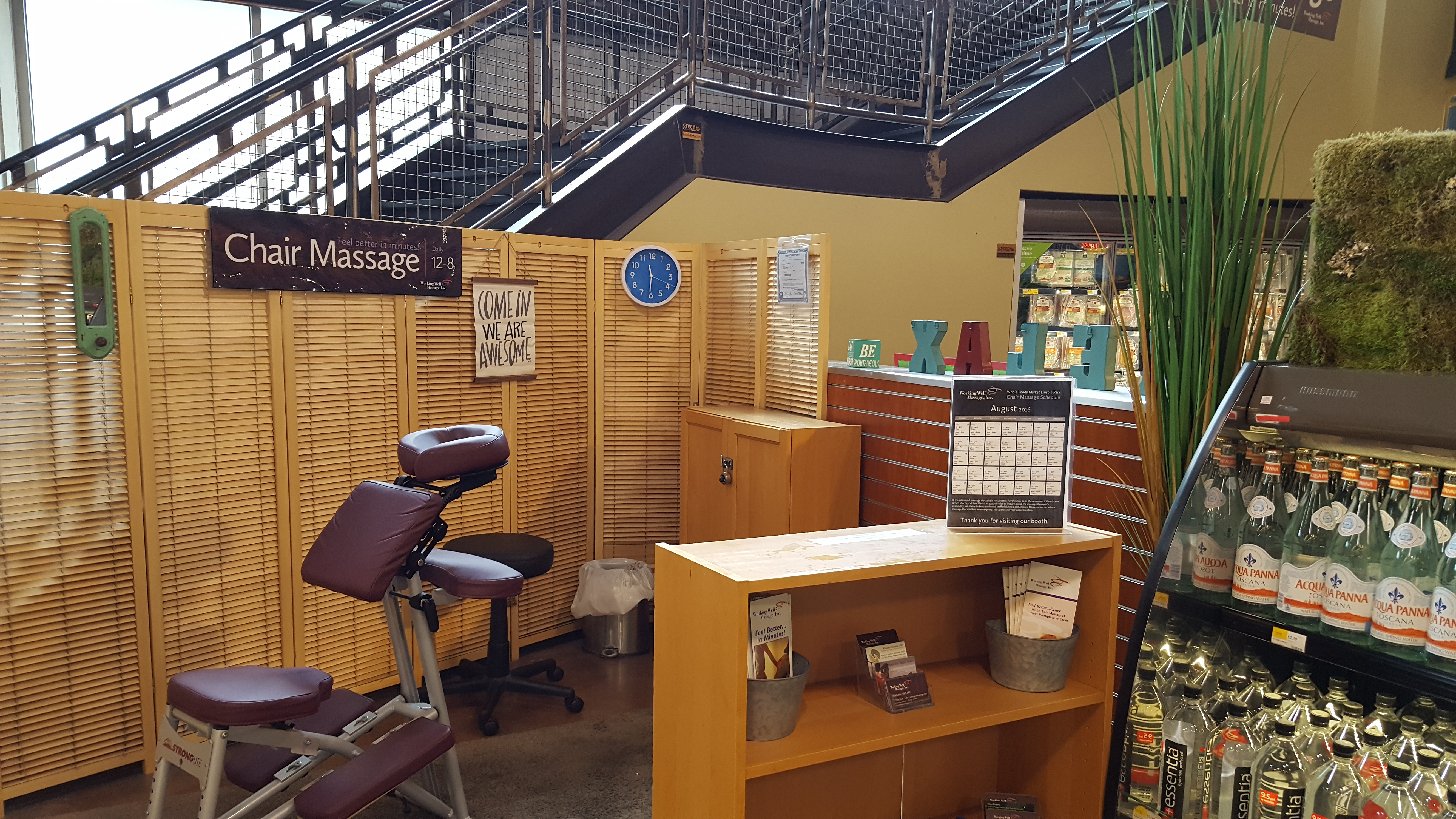
Now that WWM has closed our Gold Coast location, we want to remind Chicagoans that we are still open and serving chair massage clients in the Lincoln Park area in our WWM chair massage station! WWM is open daily from 12-8pm. That’s right, seven days a week (excluding holidays).

20160823_113041

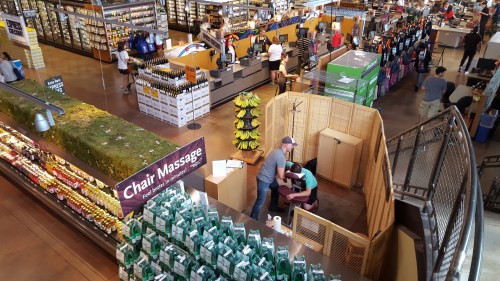
WWM Lincoln Park Chair massage station is located inside Whole Foods Market in Lincoln Park at 1550 N Kingsbury. Find us on the main floor right ext to Express check out line and in front of the in store restaurants.


WWM booth inside WFM Lincoln Park near Express checkout

WWM booth inside WFM Lincoln Park near Express checkout

WWM has been inside the giant Lincoln Park Whole Foods Market since the store was first opened in 2009.   We are grateful to Store Team Leader, Rich Howley for his support and welcome to his Lincoln Park store.

WWM Massage Therapists at WWM Lincoln Park

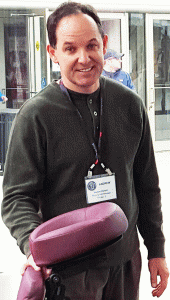
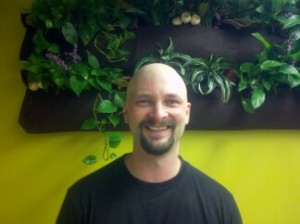
Many of our WWM Gold Coast massage therapist are still available at the WWM Lincoln Park chair massage station. See below for our usual weekly line up. And for the next few weeks, Najat will be on vacation and back Mid March. Until then Bernardo, David M., Andrew and Patty and David K will be subbing for Najat. And once she is back, Patty and David K will not have regular shifts the Lincoln Park WWM booth, but will be subbing from time to time.

WWM Lincoln Park (Usual) Massage Therapist Weekly Schedule

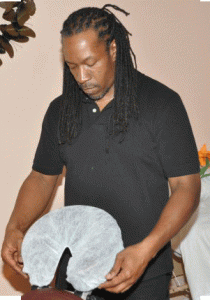
Mondays, 12-4pm, David M

David M

David M


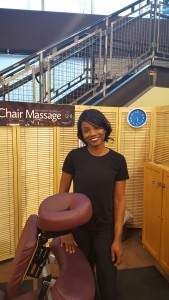
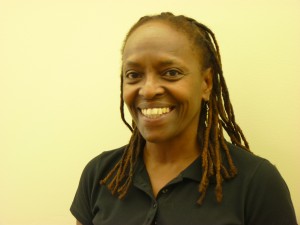
Mondays, 4-8pm, Najat

Najat

Najat


Tuesdays, 12-4pm, Jeanie (not pictured)


Tuesdays, 4-8pm, Starlette

Starlette

Starlette


Wednesdays, 12-4pm, Andrew

Andrew Petrikiv, LMT

Andrew


Wednesdays, 4-8pm, Najat

Najat

Najat


Thursdays, 12-4pm, David M

David M.

David M.


Thursdays, 4-8pm, Aaron

Aaron

Aaron


Friday’s 12-4pm, Najat

Najat

Najat


Fridays,  4-8pm, Trina

Trina

Trina


Saturdays, 12-4pm, Najat

Najat

Najat


Saturday, 4-8pm, Kimosha

Kimosha

Kimosha

Sundays, 12-4pm, Trina

Trina

Trina


Sundays, 4-8pm, Bernardo

Bernado

Bernado


Guest Appearances by Patty M and David K from time to time!

Patty

Patty


David K

David K.


Read Full Post »

By Sue Shekut, MA, Licensed Professional Counselor, Licensed Massage Therapist, Wellness Coach, Owner, Working Well Massage

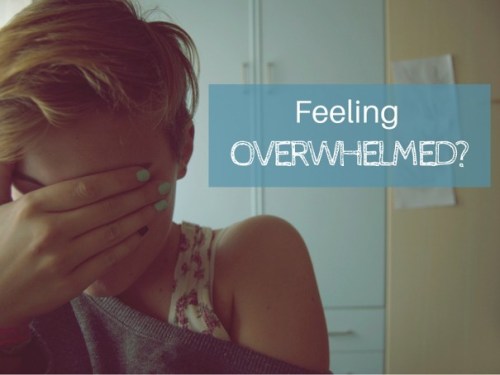
In my role as a massage therapist, I spend a lot of time trying to help people relax their nervous systems, allowing them to “de-stress” and feel their bodies relax, thus reducing muscle and mental tension. In my role as a psychotherapist, I do something similar, helping clients learn to manage emotional and psychological stress in a more functional way, to reduce symptoms of depression, anxiety and PTSD, along with reducing need for relying on addictive coping skills like substance use.

feeling-overwhelmed-e1457628014580

Photo from livebold&bloom.com

Working with clients that have social and communication deficits known as Autism Spectrum Disorder, or previously known as Asperger’s Disorder, requires a good understanding of the nervous system and how being in a highly activated nervous system state (known as flight or flight or Sympathetic Nervous System mode) tends to shut down Executive Functioning processes like problem solving, decision making, impulse control and working memory.ae_mainlogo_tagline-9-300x136

Asperger’s Experts, my new favorite website for learning about Asperger’s and Autistic traits, provides a wonderful video explaining how people with Asperger’s tend to process information and sensations and gives really great tips on how to work with children and adults with this disorder.

When humans are in fight or flight mode, the brain and body is trying to save the person from perceived harm. It’s not a good time to learn or listen to directions or face social anxiety fears. People with Asperger’s tend to be overwhelmed by sensory input and thus tend to be in sympathetic mode much of the time.  This makes it super difficult for them to learn social and communication skills unless they have taught how to handle the overload and self soothe or calm themselves down.

Danny Raede explains the Sensory Funnel here. My favorite quote is this, “Lack of social skills are a symptom of being too overwhelmed and in Defense Mode. And until you get somebody with Asperger’s out of defense mode, you won’t be able to teach him social skills. It’s like taking somebody in Iraq that’s involved in an active battle and saying, hey, do you want to learn how to knit? And while they may want to make sweaters, they have more important things on their mind. They’re just trying to stay alive.”

When parents work with children, when managers work with employees and when people in relationships  become emotionally overwhelmed, we can all experience a similar feeling of not being able to think clearly, control our emotions and make decisions. Learning how to manage our sensory overloads and self soothe are valuable skills for us all, and even more important for working with people with Asperger’s and Autistic traits!

Read Full Post »

By Sue Shekut, MA, Licensed Professional Counselor, Licensed Massage Therapist, Wellness Coach, Owner,Working Well Massage

Happy Thanksgiving to all our readers, clients, friends, families and to our staff!

Turkey Run State Park. Photo by Sue Shekut.

Turkey Run State Park. Photo by Sue Shekut.

Gratitude is in the name of today’s holiday: Thankfulness is defined by the dictionary as appreciation, gratitude.

According to scientific research, expressing gratitude is actually good for our health! in her article,
7 Scientifically Proven Benefits Of Gratitude That Will Motivate You To Give Thanks Year-Round
in Forbes magazine, Amy Morin, provides us with helpful ways that gratitude improves health.

• Gratitude helps us expand our social support network, important to reduce symptoms of depression, anxiety and give us friend to turn to when we need emotional support.

• Gratitude improves physical and psychological health. People that are thankful tend to take better care of themselves, feel happiness and a sense of well-being.

• Gratitude increases our ability to feel empathy and reduces our tendency to become aggressive.

• Gratitude improves our self-esteem and reduces our tendency to make social comparisons which can leave us feeling less than. When we look at what we have rather than what we don’t have, we tend to feel more satisfied and less envious of what we feel we lack.

• Gratitude improves our resilience helping us heal from trauma and making us more resistant to the negative effects of difficult circumstances in the future.

I am grateful to be able to provide hundreds if not thousands of massages for the past 16 years at Working Well Massage, grateful to have such wonderful clients and team members and relationships with partners such as Whole Foods Market and River North Wellness Center and grateful to be able to blog about it!

Read Full Post »

By Sue Shekut, MA, Licensed Professional Counselor, Licensed Massage Therapist, Wellness Coach, ACSM Personal Trainer

For some time, the research behind massage therapy has shown that massage can reduce symptoms of anxiety, depression and improve the ability to get good nights sleep.

In the Institute for Integrative Health Care, Leslie DeMatteo, LMT, MS,  wrote a good article that sums up the symptoms of anxiety and explains that the way massage therapy helps is to help you sleep more soundly and massage also reduces muscle pain.  For more details, read the article here!

Massage reduces anxiety!

Massage reduces anxiety!

Want the “official word” On anxiety and massage therapy? Read the American Massage Therapy Associations position statement with multiple research articles referenced here.

If you are in Chicago and want to reduce your anxiety,  stop by one of our chair massage locations inside Whole Foods and let us help you relax…in minutes!


7 days a week, we reduce anxiety and muscle pain at Whole Foods Lincoln Park and Whole Foods Gold Coast

7 days a week, we reduce anxiety and muscle pain at Whole Foods Lincoln Park and Whole Foods Gold Coast


Read Full Post »

By Sue Shekut, MA, Licensed Professional Counselor, Owner, Working Well Massage, Licensed Massage Therapist, Wellness Coach, ACSM Personal Trainer

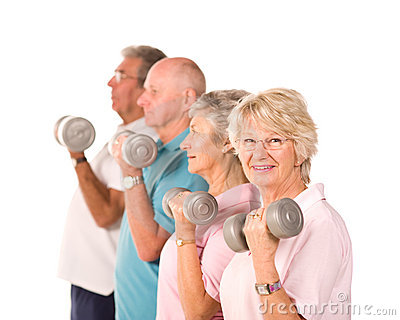
I’ve been lifting weights (also known as resistance training), since I was  a young woman. I am by no means a body builder and at some points in my life, I have lifted less and my body has paid the price (less energy, less muscle mass, feeling more sluggish and low energy). Overall,  I feel much better when I lift weights, even dumbbells, or especially, dumbbells because many weight machines are made for people who are taller than I am.

Weight training isn't just for young people

Weight training isn’t just for young people

Men’s Health posted an article about a study from Penn State College of Medicine that indicates that lifting weights can help us live longer. Dr. Jennifer Kraschnewsk and colleague’s study, Is strength training associated with mortality benefits? A 15 year cohort study of US older adults, found that adults 65 and older who reported that they participated in strength training twice each week had 46% lower odds of all-cause mortality than those who did not. The association between strength training and death remained after adjustment for past medical history and health behaviors.

Another study, “Mental health benefits of strength training in adults,” by O’Connor, Herring, and Carvalho  shows that resistance training also helps us maintain our cognitive abilities (ability to think clearly), longer as well as having other important mental health impacts such as reducing anxiety (American Journal of Lifestyle Medicine, 4(5), 377-396.).

I try to lift 2-3 time a week with dumbbells and bodyweight, nothing fancy, just the basic muscle groups.

What is your weight lifting routine?

Read Full Post »

By Sue Shekut, MA, Licensed Professional Counselor, Owner, Working Well Massage, Licensed Massage Therapist, Wellness Coach, ACSM Personal Trainer

Deep breathing from Anxiety Therapy Online

Deep breathing from Anxiety Therapy Online

The Wounded Warrior Project on Facebook. recently posted about another study on Post Traumatic Stress Disorder (PTSD) treatments for veterans.  This study looks at effects of meditation on PTSD in improving outcomes and helping vets become less dependent on medication. (It’s confusing I know, meditation and medication, but follow along!) The article, “Meditation may reduce PTSD, medication in soldiers in UPC.com,” by Stephen Feller, explains that Dwight Eisenhower Army Medical Center’s Traumatic Brain Injury Clinic and Augusta University researchers conducted a study mounted the study that taught active duty military personnel with concussions and PTSD to use transcendental meditation as part of their recovery. The study demonstrated that meditation techniques helped reduce the anxious, hyperactive state that is common with those suffering from PTSD symptoms.

According to Fellers article: “One month into the study, 83.7 percent of the meditation group had stabilized, decreased or stopped taking meditation, while 10.9 percent increased their medication dosage. Of the non-meditation group, 59.4 percent had stabilized, decreased or stopped using drugs, while 40.5 percent increased the amount of medication taken. Similar patterns were seen at two- and six-month follow-ups.” That’s good news for military and civilians with symptoms of PTSD.

How does TM help those with PTSD and concussions? Feller states that meditation helps people tune out distractions and feel an inner calm that helps reduce the amount of stress hormones in the brain while meditating.

Want to learn how to meditate via transcendental meditation? Go to the TM website here and learn more.

Read Full Post »

Older Posts »