Feeds:
Posts
Comments

Archive for December, 2009

Many Working Well Massage clients try to eat well and exercise. But they do love their chocolate!  Can you eat chocolate and still feel you are eating healthy? Can you satisfy your chocolate cravings and still keep your fat and sugar intake to a healthy amount?

To answer those questions, you first need to know a bit about chocolate.  According to Robert L. Wolke www.professorscience.com), professor emeritus of chemistry at the University of Pittsburgh and the author, most recently, of “What Einstein Told His Cook: Kitchen Science Explained”, “Milk chocolate contains so much milk and sugar that its percentage of true cacao may be as low as 10 percent, the minimum required by the FDA for calling it “chocolate” on the label. Hershey’s milk chocolate contains about 11 percent cacao. In contrast, a serious dark chocolate bar will contain anywhere from 65 percent to 85 percent cacao.”

“Good Morning America” contributor Dr. David Katz has been conducting a study at Yale University on the health effects of chocolate.

The Yale study, which is funded by Hershey, used ultrasound technology and sophisticated measurements to assess the effects of eating dark chocolate on 45 moderately overweight adults. The study also measured participants’ blood pressure before and two hours after eating two servings of dark chocolate. Sure enough, after consuming the dark chocolate, which is high in antioxidants, their blood pressure dropped. Dark chocolate also helps blood vessels dilate which allows blood to flow more freely.

But that does not mean everyone can consume as much dark chocolate as they want?

“Chocolate remains a concentrated source of calories and sugar and too much of those things will seriously offset any health benefit,” Katz said. “Milk chocolate doesn’t work because it’s high in saturated fatty acids that harm blood vessels and the overall health of your heart … So don’t go overboard, but switch to dark chocolate and you can really have your cake and eat it too.”

People should look for chocolate that has a cocoa content of 60 percent or higher, Katz said.

Katz said that “healthy” candy bars are example of “functional foods.” The manufacturers purposely added a healthy nutrient to the product. He said he expects more similar items in the future. read more from Dr. Katz about “healthy” chocolate bars here.

Health By Chocolate

Health By Chocolate is a new bar that makes health claims about it’s chocolate bars. According to their website,  Health by chocolate bars are low glycemic foods and contain only 2 teaspoons of sugar, and a 50 gram bar contains less than half the caffeine of a cup of coffee (15-40 mg versus 80-100mg). Created by Sally Malanga, founder of the natural beauty brand Ecco Bella, in her New Jersey townhouse in 2003, the bars have a proprietary blend of functional ingredients to address a specific need:

• Instant Bliss Beauty for healthy skin

Bliss bar

• Beautiful Bones for strong, healthy bones
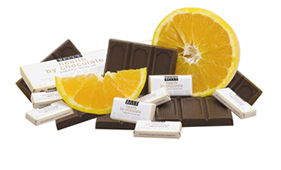
Bones bar

• Women’s Wonder bar to combat the effects of PMS and menopause
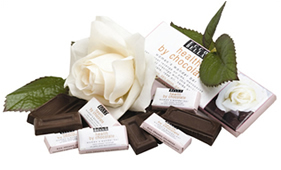
Woman's Wonder Bar

What’s So Healthy About Health By Chocolate Bars?

• Each of Beautiful Bones serving (2 squares 16.66gr.) contains 400 mg calcium (38% RDA), 22 mcg vitamin K blend with K2 (from natto, a fermented soybean- no official RDA but suggested RDA is 45mcg), 150iu vitamin D2 (from yeast), 150 iu vitamin D3 (from lanolin- 15% of RDA), 750 mg fructooligosaccharide fiber (from sugar cane fiber- 2% of RDA).

• Calcium in the Beautiful Bones Bar is produced from seaweed with its trace minerals intact, such as magnesium, iodine, boron, and selenium. The seaweed is harvested from the seabed off the west coast of Ireland from mineral rich Atlantic waters.

• Woman’s Wonder Bars includes a traditional herb, Chaste Tree Berry, which is considered safe and effective for relieving symptoms of both PMS and menopause. According to the German Commission E monograph, the ripened berry of the Chaste Tree was clinically proven to relieve PMS symptoms and reduce menopausal symptoms. Research shows that recommended dosages vary from 40 mg day to 400 mg day without side effects, except for a slight skin itching. It is not recommended for pregnant women.

• Whole soybean powder contains the isoflavones genistein and daidzein. According to the HealthByChocolate website, some studies show that isoflavones have the ability to mimic human estrogen, helping to reduce insomnia, loss of libido, night sweats and hot flashes. Isoflavones also have a positive effect on bone, breast and heart health.

• Cranberry Seed Oil has a blend of omega 3/6/9 essential fatty acids that are beneficial to skin, heart, brain and overall cellular health. Omega 3 essential fatty acids help relieve inflammation, a major factor in PMS cramping and headaches.

• FOS (fructooligosaccharide) is the fibrous part of sugar cane. FOS feeds the good bacteria in the digestive tract. When digestion is optimized, hormone levels are more balanced and calcium absorption increases by 50%!

Where Can You Buy Healthy By Chocolate Bars?

Whole Foods Market and a host of other retailers here.

Or Make Your Own Chocolate Bars!

By Xxheather2124 From Grouprecipies.com From Grouprecipies.com
Very Healthy Chocolate Bars Recipe
Ingredients

  • 12 tablespoons raw cacao powder (crushed cacao beans or nibs)
  • 6 tablespoons agave nectar
  • 6 tablespoons coconut oil
  • 2 tablespoons coconut milk (optional)
  • 3 tablespoons shredded coconut
  • Directions

    1. Blend everything in a food processor until very smooth.
    2. Pour into your chosen mold (ice cube trays work well).
    3. Freeze for 20-30 minutes, and then enjoy!

    Note: Neither Working Well Massage nor Working Well Resources has any affiliation with Health by Chocolate. We just want our clients to know about options that may be healthier than standard high fructose corn sugar sweetened milk chocolate bars!
    Read Full Post »

    Partner Yoga

    Every day, clients ask us how often to stretch, why the stretching they do does not combat their neck and back pain and what are the best ways to stretch. The truth is, it’s tough to remember to stretch and it’s even more difficult to stretch often enough to combat the muscle tension we place on ourselves when sitting at computers all day. It’s also a challenge to find time to stretch without sacrificing time with loved ones.

    So what are poor stressed out, tense muscled people to do? How about a few simple yoga poses?

    One of the reason I like yoga is that is gives you a set of pre-designed poses that stretch the majority of muscles in your body. Once you know poses like “Downward Facing Dog,” “Sun Saluations” or “Tree Pose” you can do them virtually anywhere you have space and time to stretch out and extend your limbs. Simple yoga poses don’t require props and you can do them in a hotel room, or at home, or in a spare conference room at work if it’s allowed.

    Even better yet, a great way to do yoga AND spend quality time with your partner or family, is to try Partner Yoga.

    What is Partner Yoga?

    The website, Partneryoga.com, defines partner yoga as a unique practice which combines powerful techniques and exercises from yoga, dance and martial arts. Partner Yoga use various movements and poses (asanas) to focus the mind and increase strength, stamina and flexibility. The physical poses are combined with potent breathing techniques (prananyams) which help release tension and promote the free flow of subtle energies (prana). All Partner Yoga exercises use the buddy system to dissolve tension and establish a natural state of harmony in body, mind, emotion, and spirit.

    Partner Yoga postures like the “Cat/Cow” and the “Downward Facing Dog” are a fun and creative ways to for kids to learn about their bodies and the importance of physical exercise. Friends can use Partner Yoga to help each other stay motivated and committed to their wellness plan. Practicing yoga with a partner is uplifting and inspiring, and helps raise both people to new heights. The movements and poses in Partner Yoga require 100% participation from two people. Best of all, Partner Yoga requires no special equipment and can be done in any open space (the living room, gym, or park).

    Benefits of Partner Yoga Poses

    Working through a yoga sequence with someone else extends a number of benefits:

    • It’s non-competitive fitness in which two or more people can engage.
    • It builds intimacy, especially between love partners.
    • A deeper level of trust develops between two people who explore yoga together.
    • Partners can assist one another.
    • It’s a fun activity to share with children.

    Where Can I Learn Partner Yoga Poses?

    Here are some books and DVD’s on Partner Yoga.
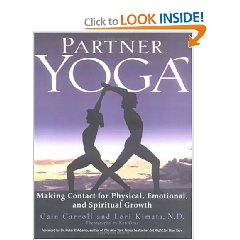
    Partner Yoga: Making Contact for Physical, Emotional, and Spiritual Growth on Amazon here

    Relaxation Fit Partner Yoga video  here from Divakar Yoga

    The Joy of Partner Yoga here

    Together: the Art of Partner Yoga here.

    Read Full Post »

    Does fitness have to be an all or nothing proposition? Experts say no.

    Gentle exercise from EverydayHealth.com

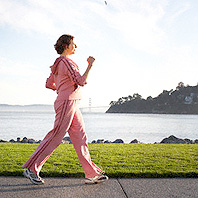
    Simply walking can have cardiovascular benefits. And you can walk a lot longer in your life than you may be able to run or kick box. Some take walking to the woods or hills and call it hiking. Others take walking to the streets for an “urban hike.” As a child, I walked everywhere my feet could take me–and my mother allowed! I could explore, see much more of my world, stop and smell the roses. As an adult I enjoy hiking in nature and walking around the city of Chicago. I see things I often miss when I am driving or biking. A good long walk clears my head, literally pumping fresh oxygen (via my blood) to my brain.

    The American College of Sports Medicine and American Heart Association recommend that adults under 65 get at least 30 minutes of moderately intense cardiovascular exercise 5 days a week to maintain health and reduce the risk for chronic disease. And it does not have to be a consecutive 30 minutes of exercise. Three 10 minute walks will do the trick. Or, you can do vigorously intense cardio 20 minutes a day, 3 days a week for the same result. (In either case, twice a week, you should add in eight to 10 strength-training exercises of eight to 12 repetitions of each exercise.)

    Moderate-intensity physical activity means working hard enough to raise your heart rate and break a sweat, yet still being able to carry on a conversation. (To lose weight or maintain weight loss, you likely need to add 60 to 90 minutes of physical activity.)

    According to , at About.com, a study in the Nov. 14, 2005 issue of the “Archives of Internal Medicine” confirms that walking builds aerobic fitness at both moderate and high intensity.

    Walk Longer or Walk Faster

    Improvements in aerobic fitness were seen in the study group for those who walked with high intensity, either with low frequency or high frequency. But similar benefits for aerobic fitness were also seen for those walking at moderate intensity and high frequency.

    “The findings demonstrate that significant improvements in cardiorespiratory fitness can be achieved and maintained over 24 months via exercise counseling with a prescription for walking 30 minutes per day, either at a moderate intensity five to seven days per week, or at a hard intensity three to four days per week,” Glen E. Duncan, Ph.D., R.C.E.P.S.M., of the University of Washington, Seattle, and colleagues concluded.
    Reference: (Arch Intern Med. 2005; 165: 2362-2369.)

    Walking Intensity vs. Frequency

    • Moderate Intensity Walking: Walking at 45-55% of maximum heart rate, an intensity at which you may be breathing a little harder than usual but able to keep up a full conversation.
    • High Intensity Walking: Walking at 65-75% of maximum heart rate. You are able to speak only in short sentences.
    • Low Frequency Walking: 3-4 times a week for 30 minutes a session.
    • High Frequency Walking: 5-7 times a week for 30 minutes a session.

    Walking Prescription for Aerobic Fitness

    The prescription for aerobic fitness gives you these choices:

    • High Intensity, Low Frequency: 30 minutes per day 3-4 days per week at 65-75% maximum heart rate.
    • Moderate Intensity, High Frequency: 30 minutes per day 5-7 days per week at 45-55% maximum heart rate.
    • High Intensity, High Frequency: 30 minutes per day 5-7 days per week at 65-75% maximum heart rate

    Read entire article at About.com here.

    How Do I Find My Target Heart Rate?

    It’s easy! Use these simple online calculators.

    Target Heart Rate Calculator from MayoClinic here.

    Target Heart Rate Calculator based on your fitness level from About.com here.

    Target Heart Rate Calculator for different intensity levels from Fitwatch.com here.

    Or follow the instructions below from WikiHow.com to calculate your target heart rate the old fashioned pen and pencil way!

    What’s this Karvonen Method of Calculating Target Heart Rate?

    1. Find your resting heart rate as soon as you wake up. You can do this by counting your pulse for one minute while still in bed. You may average your heart rate over three mornings to obtain your average resting heart rate (RHR). Add the three readings together, and divide that number by three to get the RHR. For example,(76 + 80 + 78) / 3= 78.
    2. Find your maximum heart rate and heart rate reserve.
      • Subtract your age from 220. This is your maximum heart rate (HRmax). For example, the HRmax for a 24-year-old would be220 – 24 = 196.
      • Subtract your RHR from your HRmax. This is your heart rate reserve (HRmaxRESERVE). For example,HRmaxRESERVE = 196 – 78 = 118
    3. Calculate the lower limit of your THR. Figure 60% of the HRmaxRESERVE (multiply by 0.6) and add your RHR to the answer. For example,(118 * 0.6) + 78 = 149.
    4. Calculate the upper limit of your THR. Figure 80% of the HRmaxRESERVE (multiply by 0.8) and add your RHR to the answer. For example,(118 * 0.8) + 78 = 172.
    5. Combine the values obtained in steps 3 and 4 and divide by the number 2. For example,(149 + 172) / 2 = 161 (You can get the same result by simply multiplying HRmaxRESERVE by 0.7 and adding to it RHR).

    Tips for Checking Your Heart Rate

    • When you take your reading for your resting heart rate, make sure to do so the morning after a day where you are rested, as trying to do this after a day of a hard workout can affect your results.
    • You should ensure during your workout that your heart rate falls within your target heart rate zone to maximize cardiovascular fitness.
    • A rule-of-thumb is that if you’re able to sing, you’re not working out hard enough. Conversely, if you’re not able to talk, you’re working out too hard.
    • One of the most common ways to take a pulse is to lightly touch the artery on the thumb-side of the wrist, using your index and middle fingers. This is called a radial pulse check.
    • You may also place two fingers below the jawline, along the trachea (windpipe) to feel for a pulse, again using your index and middle fingers. This is called a carotid pulse check.
    • When taking your pulse for ten seconds during a workout, stop exercising. Do not allow yourself to rest before taking your pulse, and immediately resume exercise after the ten seconds. Multiply by 6 and you’ll have your heart rate.
    • If you are serious about working out and becoming more cardiovascularly fit, you may want to consider purchasing a heart monitor for accurate readings during your workout sessions.
    Reblog this post [with Zemanta]

    Read Full Post »

    Fibromyalgia sufferers were once told their pain was all in their head. But in recent years, the medical community has found evidence that fibromyalgia is in fact a physiological disorder. However, that doesn’t mean that talk therapy has no place in treatment of fibromyalgia. In fact, cognitive behavioral therapy or CBT, has been found to be useful in addressing insomnia and some of the side effects of fibromyalgia symptoms.

    According to Dr. Dorothy McCoy from PsychNetUK:

    In a recent study, CBT offered an alternative approach that demonstrated clinically significant improvement within six weeks (Edlinger, 2001). In another study, on chronic fatigue syndrome, the researchers compared standard treatment with cognitive therapy and standard treatment without cognitive therapy. “Seventy-three percent of the cognitive group were spending less time in bed and functioning normally after a year” (WebMD Health). Only 27% of the other group experienced the same gains. Flemming (1997) suggests amplifying standard treatments’ efficacy by including bodywork and relaxation. According to the eminent wellness physician, Dr. Andrew Weil, guided imagery tapes are useful in reducing pain and speeding the healing process. Patients are relieved to discover they have a legitimate medical disorder and the pain is not imaginary.

    In a study on low back pain, researchers found that relaxation response training was effective in reducing pain severity. Twenty-eight of the patients also had fibromyalgia. Many of the study subjects reported reduced pain and a reduction in other symptoms, as well as “improved function and general health” (Millea, 2001). One panel of experts concluded that relaxation techniques were helpful in managing chronic pain. Furthermore, the techniques were valuable in managing the stress inherent in living with a chronic pain disorder. Yet anther study suggests that patients who believe they have little control over their symptoms report more severe and chronic fatigue. CBT is helping patients to change their inaccurate, self-defeating beliefs and regain a sense of control over their lives. A belief in one’s ability to manage one’s disorder frequently becomes a self-fulfilling prophecy.

    According to the University of Maryland Medical Center website:

    Studies show that fibromyalgia patients feel better when they deal with the consequences of their disorder on their lives. Cognitive-behavioral therapy (CBT) enhances a patient’s belief in their own abilities and helps them develop methods for dealing with stressful situations. CBT, also called cognitive therapy, is known to be an effective method for dealing with chronic pain from arthritic conditions. Evidence also suggests that cognitive-behavioral therapy can help some patients with fibromyalgia.

    Although the effects of CBT and other non-medication treatments for fibromyalgia do not always last over the long-term, they may help certain groups of people, particularly those with a high level of psychological stress.

    CBT may be particularly useful for addressing insomnia, one of the hallmark symptoms of fibromyalgia. In studies, patients who received CBT for insomnia woke up 50% less often at night, and had fewer symptoms of insomnia and improved mood.

    The Goals of CBT. The primary goals of CBT are to change any unclear or mistaken ideas and self-defeating behaviors. Using specific tasks and self-observation, patients learn to think of pain as something other than a negative factor that controls their life. Over time, the idea that they are helpless goes away and they learn that they can manage the pain.

    Cognitive therapy is particularly helpful for defining and setting limits, which is extremely important for these patients. Many fibromyalgia patients live their lives in extremes. They first become heroes or martyrs, pushing themselves too far until they collapse. This collapse reverses the way they view themselves, and they then think of themselves as complete failures, unable to cope with the simplest task. One important aim of cognitive therapy is to help such patients discover a middle route. Patients learn to prioritize their responsibilities and drop some of the less important tasks or delegate them to others. Learning these coping skills can eventually lead to a more manageable life. Patients learn to view themselves and others with a more flexible attitude.

    The Procedure. Cognitive therapy usually does not last long. It typically consists of 6 – 20 one-hour sessions. Patients also receive homework, which usually includes keeping a diary and trying tasks they have avoided in the past because of negative attitudes.

    A typical cognitive therapy program may involve the following measures:

    • Keep a Diary. Patients are usually asked to keep a diary, a key part of cognitive therapy. The diary serves as a general guide for setting limits and planning activities. Patients use the diary to track any stress factors, such as a job or a relationship that may be improving or worsening the pain.
    • Confront Negative or Discouraging Thoughts. Patients are taught to challenge and reverse negative beliefs. For example, “I’m not good enough to control this disease, so I’m a total failure” becomes the coping statement, “Where is the evidence that I can control this disease?”
    • Set Limits. Limits are designed to keep both mental and physical stress within manageable levels, so that patients do not become discouraged by getting in over their heads. For example, tasks are broken down into incremental steps, and patients focus on one step at a time.
    • Seek out Pleasurable Activities. Patients list a number of enjoyable low-energy activities that they can conveniently schedule.
    • Prioritize. Patients learn to drop some of the less critical tasks or delegate them to others.

    Patients should learn to accept that relapses occur, and that over-coping and accomplishing too much too soon can often cause a relapse. Patients should respect these relapses and back off. They should not consider them a sign of failure.

    Research also shows that patient education can be effective in treating fibromyalgia, especially when combined with CBT, exercise, and other therapies. Educational programs can take the form of group discussions, lectures, or printed materials, although there isn’t any clear evidence on which type of education works best.

    Support Organizations and Group Therapy

    Cognitive therapy may be expensive and not covered by insurance. Other effective approaches that are free or less costly include support groups or group psychotherapy. In one study, educational discussion groups were as effective, or even more so, than a cognitive therapy program. Such results are not typical in all centers. Therapeutic success varies widely depending on the skill of the therapist.

    Resources

    References

    Abeles M, Solitar BM, Pillinger MH, Abeles AM. Update on fibromyalgia therapy. Am J Med. 2008;121:555-561.

    Arnold LM, Goldenberg DL, Stanford SB, Lalonde JK, Sandhu HS, Keck PE, et al. Gabapentin in the treatment of fibromyalgia: a randomized, double-blind, placebo-controlled multicenter trial. Arthritis & Rheumatism. 2007;56:1336-1344.

    Geisser ME, Glass JM, Rajcevska LD, Clauw DJ, Williams DA, Kileny PR. A psychophysical study of auditory and pressure sensitivity in patients with fibromyalgia and healthy controls. J Pain. 2008;9:417-422.

    Guedj E, Cammilleri S, Niboyet J, Dupont P, Vidal E, Dropinski JP, Mundler O. Clinical correlate of brain SPECT perfusion abnormalities in fibromyalgia. J Nucl Med. 2008;49:1798-1803.

    Gusi N, Tomas-Carus P. Cost-utility of an 8-month aquatic training for women with fibromyalgia: a randomized controlled trial. Arthritis Res Ther. 2008;10:R24.

    Harris RE, Clauw DJ, Scott DJ, McLean SA, Gracely RH, Zubieta JK. Decreased central u-opioid receptor availability in fibromyalgia. J Neurosci. 2007;27:10000-10006.

    Lawrence RC, Felson DT, Helmick CG, Arnold LM, Choi H, Deyo RA, et al. Estimates of the prevalence of arthritis and other rheumatic conditions in the United States. Part II. Arthritis Rheum. 2008;58:26-35.

    Mannerkorpi K, Henriksson C. Non-pharmacological treatment of chronic widespread musculoskeletal pain. Best Pract Res Clin Rheumatol. 2007;21:513-534.

    Matsushita K, Masuda A, Tei C. Efficacy of Waon therapy for fibromyalgia. Intern Med. 2008;47:1473-1476.

    McCabe CS, Cohen H, Blake DR. Somaesthetic disturbances in fibromyalgia are exaggerated by sensory-motor conflict: implications for chronicity of the disease? Rheumatology. 2007;46:1587-1592.

    Rooks DS, Gautam S, Romeling M, Cross ML, Stratigakis D, Evans B, et al. Group exercise, education, and combination self-management in women with fibromyalgia. Arch Intern Med. 2007;167;2192-2200.

    Schweinhardt P. Fibromyalgia: a disorder of the brain? Neuroscientist. 2008;14:415-421.

    Targino RA, Imamura M, Kaziyama HH, Souza LP, Hsing WT, Furlan AD, et al. A randomized controlled trial of acupuncture added to usual treatment for fibromyalgia. J Rehabil Med. 2008;40:582-588.

    Van Koulil S, Effting M, Kraaimaat FW, van Lankveld W, van Helmond T, Cats H, et al. Cognitive-behavioural therapies and exercise programmes for patients with fibromyalgia; state of the art and future directions. Ann Rheum Dis. 2007;66:571-581.

    Verbunt JA, Pernot DH, Smeets RJ. Disability and quality of life in patients with fibromyalgia. Health Qual Life Outcomes. 2008;6:8.

    Read Full Post »

    « Newer Posts