Feeds:
Posts
Comments

Archive for September, 2009

By Sue Shekut, Licensed Massage Therapist, ACSM Personal Trainer, Certified Wellness Coach, Owner, Working Well Massage

Most office furniture is made for people of average height, say people from 5’ 5” to 6’ 2 “. For those of us that don’t fall within this height range (like me at 5’2” or a friend that is 6’-6”), finding a comfortable way to sit and work on your computer is a challenge. Luckily, there are a host of add on products we can use to modify our workstations to make them more comfortable and ergonomic.

Recently a client has been having pain in her neck and upper back due to sitting at a desk without a properly fit keyboard tray. She can’t raise her chair high enough to let her hands rest comfortably over the keyboard because the desk design won’t allow it. And the desk has a support bar along the bottom of the desktop that prevents her from installing a conventional, slide out keyboard tray.

We looked into various trays and offer those of you with similar limitations a few options to easily add a keyboard tray to your workstation.

Waterloo Premium Arm, Keyboard Tray & Mouse Tray
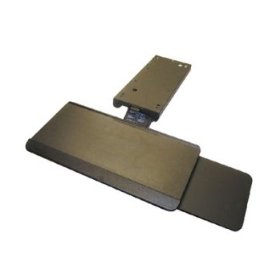
Waterloo Keyboard and Mouse Tray

The advantage of this tray is that you don’t need to install rails and casters along the bottom of the tray. You can simply install one arm which sits in the center of the tray. In the case of the desk with the bar along the front underside of the desk, it looks like this arm can fit just under the bar and then the opening between the stabilizer arm and the actual trial itself may give a=enough room to accommodate the desk support bar. This keyboard tray has 7 positive reviews on Amazon and reviewers found to easy to install. Retails for $126.30 on Amazon. View more at the link here.

Kensington SnapLock Keyboard Tray with SmartFit
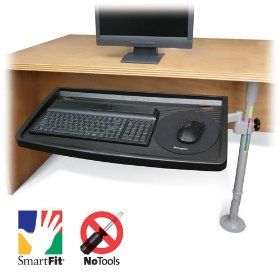
Kensington SnapLock Keyboard Tray

In this case, the tray is mounted on a metal pole that allows you to adjust the tray 6 inches in height, +/- 15 degrees in tilt and rotates 360 degrees. I did not find any customer reviews but the design gives those of you with desks without space for brackets and rails another potion for a keyboard tray. This tray extender retails for $117.83 at Amazon but is available via other online shopping services as well (for likely more). Link to this tray here.

3M Desktop Adjustable Keyboard Drawer

3M Adjustable Keyboard Monitor Stand and Drawer

A top of the desk option, the desktop design is height and tilt adjustable up to 3 1/4″ below desk level and wide platform keeps mouse and keyboard at same level for added comfort. Includes gel-filled wrist rest and full size mousing area. No installation required. Lifetime warranty included.

Pros: holds heavy monitors and installs without having to attach anything to the actual desk. 4 adjustment levels for the keyboard tray. The tray can also be inclined at any angle that is comfortable and locked into position or not.

Cons: if your monitor is too light or if you do not place the monitor in the center of the stand the keyboard will wobble when you type. If you place the monitor too far forward the whole assembly, plus monitor could fall into your lap. (Sounds like proper placement is essential in this case!)

Retails for $132 at Amazon (or you can pay a hefty $209.99 for the same product at ergoguys.com)

Amazon link

Ergoguys link. This let’s you pay more for the same product from a company with the Ergo name in it.

Fellowes Designer Suites Desk Ready Keyboard Drawer
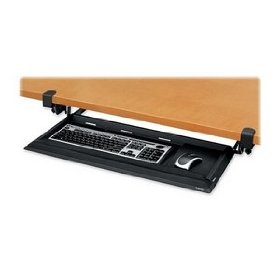
Fellowes Keyboard Drawer
According to Fellowes:
• Attaches to virtually any work surface without tools or complex instructions.
• The patented clamp easily attaches unit to desktop (5/8 1-5/8 W) without surface damage and adjusts tray to one of three height positions below desktop for personal comfort: 2-1/2, 3-1/8,and 3-3/4
• Tray adjustment tilts to 3, 6, or 9 degrees to suit personal preference, and separate tray and mouse platforms allow you to switch mouse position to right or left side of keyboard tray
• Sturdy, impact-resistant tray fits standard and ergonomic keyboards, and the ball-bearing glide tracks ensure smooth drawer movement
• Includes soothing memory foam wrist rest for keyboard tray and provides convenient cable management for keyboard and mouse cord
From users of the tray: The suspension mechanism causes it to need almost 34 inches side to side table top space to attach. The exterior width of the drawer itself is 28 inches. The mouse tray is a little small.

This tray retails for $76.52 at Amazon.

Amazon Link here.

Read Full Post »

By Sue Shekut, Licensed Massage Therapist, ACSM Personal Trainer, Certified Wellness Coach, Owner, Working Well Massage

By now, most people have heard the news that consuming High Fructose Corn Syrup (HFCS) may have adverse effects on your health. The documentary, King Of Corn, is a humerus and educational review of corn production and describes how much of the corn produced in the U.S. is refined into HFCS. The Corn Refiners Association lobby countered bad press about HFCS with the Sweet Surprise campaign, a series of ads saying “HFCS is not bad for you..in moderation.”

Not to be alarmist, but how bad is HFCS for us, really?

Let’s look at the recent research:

High-Fructose Diet Raises Blood Pressure in Middle-Aged Men
A diet high in foods with large amounts of fructose sugar such as sweetened soft drinks increased blood pressure in men, according to a study presented today (September 23, 2009) that also found that a drug for gout blocked the effect.

Men in the study who ate a high-fructose diet had their blood pressure rise about 5 percent after two weeks, while those who also were given a gout treatment increased less than 1 percent, study author Richard Johnson said. Eating great amounts of fructose without the treatment also raised the risk of developing metabolic syndrome, a group of risk factors associated with the development of heart disease and diabetes.

The study, which was funded by the National Institutes of Health, will be presented today (September 23, 2009) at the American Heart Association’s annual conference on high blood pressure in Chicago.

Fructose is one of several sugars in food and makes up about half of all the sugar molecules in table sugar and in high-fructose corn syrup, according to background information from the American Heart Association. The syrup often is used as a sweetener in packaged food products. Fructose is the only common sugar known to increase uric acid levels, the heart association said. Study info here

Study Finds High-Fructose Corn Syrup Contains Mercury
MONDAY, Jan. 26, 2009 (HealthDay News) — Almost half of tested samples of commercial high-fructose corn syrup (HFCS) contained mercury, which was also found in nearly a third of 55 popular brand-name food and beverage products where HFCS is the first- or second-highest labeled ingredient, according to two new U.S. studies.

In the first study, published in current issue of Environmental Health, researchers found detectable levels of mercury in nine of 20 samples of commercial HFCS.

And in the second study, the Institute for Agriculture and Trade Policy (IATP), a non-profit watchdog group, found that nearly one in three of 55 brand-name foods contained mercury. The chemical was found most commonly in HFCS-containing dairy products, dressings and condiments.

The use of mercury-contaminated caustic soda in the production of HFCS is common. The contamination occurs when mercury cells are used to produce caustic soda.

“The bad news is that nobody knows whether or not their soda or snack food contains HFCS made from ingredients like caustic soda contaminated with mercury. The good news is that mercury-free HFCS ingredients exist. Food companies just need a good push to only use those ingredients,” Wallinga said in his prepared statement. Washington Post Article on Mercury on HFCS products here

HFCS and Obesity
And finally, researchers from Pennington Biomedical Research Center, Louisiana State University, and the Department of Nutrition, University of North Carolina, analyzed food consumption patterns by using US Department of Agriculture food consumption tables from 1967 to 2000. The consumption of HFCS increased > 1000% between 1970 and 1990, far exceeding the changes in intake of any other food or food group.

HFCS now represents more than 40% of caloric sweeteners added to foods and beverages and is the sole caloric sweetener in soft drinks in the United States. The increased use of HFCS in the United States mirrors the rapid increase in obesity. The digestion, absorption, and metabolism of fructose differ from those of glucose. In addition, unlike glucose, fructose does not stimulate insulin secretion or enhance leptin production. Because insulin and leptin act as key afferent signals in the regulation of food intake and body weight, this suggests that dietary fructose may contribute to increased energy intake and weight gain. Furthermore, calorically sweetened beverages may enhance caloric overconsumption. Thus, the increase in consumption of HFCS has a temporal relation to the epidemic of obesity, and the overconsumption of HFCS in calorically sweetened beverages may play a role in the epidemic of obesity. Link to article in American Journal of Clinical Nutrition

More research needs to be and is being done. And, King of Corn afficionados aside, HFCS isn’t the only sugar that should be consumed in moderation.

Sugar Consumption Guidelines
According to the American Heart Association, no more than half of your daily discretionary calorie allowance come from added sugars. For most American women, this is no more than 100 calories per day and no more than 150 per day for men (or about 6 teaspoons a day for women and 9 teaspoons a day for men).

How much added sugars do most Americans consume?
A report from the 2001–04 NHANES (National Health and Nutrition Examination Survey) database showed that Americans get about 22.2 teaspoons of sugar a day or about 355 calories. This number has increased steadily over the past three decades. Teens and men consume the most added sugars.

A major contributor of added sugars to American diets are soft drinks and other sugar-sweetened beverages.

What foods and beverages are the main sources of added sugars in Americans’ diets?
Regular soft drinks; sugars and candy; cakes, cookies, pies; fruit drinks (fruitades and fruit punch); dairy desserts and milk products (ice cream, sweetened yogurt, and sweetened milk); and other grains (cinnamon toast and honey-nut waffles).

Regular soft drinks are the No. 1 source of added sugars in Americans’ diets. A 12-ounce can of regular soda contains an estimated 130 calories (or 8 teaspoons) of added sugars. People who consume lots of sugar-sweetened beverages eat too many sugar calories which can add up quickly and tend to gain weight. Carefully monitor the number of calories you get from sodas and other sources of added sugars.

More on the AHA’s standpoint on sugar consumption

Obesity, mercury poisoning and high blood pressure is serious stuff. But, let’s not get too stressed out about it. Pour a glass of nice cold water, kick back and watch the King of Corn filmmakers, Ian Cheney and Curt Ellis spoof about the Corn Refiners Association “HFCS is OK in moderation” ads.

Spoof: HFCS is like cigarettes..it’s OK in moderation

Spoof: DDT is OK, in moderation

Read Full Post »

By Sue Shekut, Licensed Massage Therapist, ACSM Personal Trainer, Certified Wellness Coach, Owner, Working Well Massage

By now, most of us have heard about the new recommended guidelines for adults under 65 to get at least 30 minutes a day of moderately intense cardio, five days a week. The American College of Sports Medicine (ACSM) and the American Heart Association (AHA) Guidelines here

However, many people have a hard time finding time to exercise after work with long commutes, family obligations and just maintaining the household. At work, people face deadlines, scores of emails, phone calls and piles of paperwork to address. One way for employers and employees to help keep health care costs down, reduce risks of illness, and help improve overall health and well being is to encourage employees to step up their steps!

According to Health Enhancement Systems’ report, Walking: The Health and Economic Impact, there’s no wellness investment that pays a higher dividend than a robust walking program. Here are just a few of the health-related findings specifically associated with walking:

• Protects against heart attack and stroke.
• Helps prevent weight gain.
• Reduces risk of diabetes.
• Lowers overall mortality.
• Decreases heart disease risk.
• Maintains a healthy BMI.
• Enhances fitness with little time or effort.

According to a Loughbrough University study, women who took three 10-minute brisk walks, 5 days a week, had nearly the same increases in fitness levels as women who walked continuously for 30 minutes. In fact, those who walked in briefer sessions lost more weight and inches around the waist than the 30-minute walkers! More here from Health Enhancement Systems

Why Walk?
• Walking is the only exercise where participation rates don’t decrease as
individuals reach middle age and older. One national survey found that
compared with any other group, men 65 and older had the highest percent
of regular walkers — 39.4%.14
• It’s the most popular physical activity in America. More than 56 million people
walk for fitness at least 100 days a year.15
• Walking is inexpensive and easy. All a person needs is a pair of comfortable,
supportive shoes.16
• It comes naturally and can be done in connection with other daily activities —
for example: walking to work, circling the mall or grocery aisles, walking
the dog, or pacing while on the phone.
• Walking is a low impact, safe form of exercise — even for those who are
obese or have arthritis.

How to Find Time to Walk at Work
Employers cannot mandate that employees walk at work. And we don’t encourage employees to shirk their work responsibilities to complete their walking goals. But many smokers take “smoke breaks” at work, leaving the office for 10-15 minutes to smoke a cigarette outdoors. Why shouldn’t the nonsmokers take advantage of a similar break in the work flow for a far healthier result!

And the lunch “hour” is also a great time to get coworkers together and take a brisk walk outside the office or at a nearby mall. Although some do not take a full hour for lunch, and others may want to split the lunch break up into 30 minutes of walking and then time to eat lunch, there are many ways you can fit in a walk a few times during the workweek lunch time.

• A simple plan would be to set up 3 ten-minute walk breaks inside the office building if there is enough space, or weather permitting outside the office.

• Alternatively, staff can set up 20-30 minute walk breaks at lunch time.

• And for those lucky few that take a train or bus or subway to work, try getting off a few blocks or even a half mile earlier than normal and then walk to your destination from there. it’s an easy way to add a few steps to your day and explore your own neighborhood.

Benefits of Walking at Work
Employers have found that allowing employees to take minibreaks leads to increased productivity and job satisfaction. According to Health Enhancement Solutions, walking, like other physical activity, employee productivity increases with physical activity. Findings include:
• Better concentration 1
• Enhanced memory and learning 2
• Improved ability to make complex decisions 1
• Increased physical stamina. 3, 4

Walking promotes an overall sense of wellness by helping people to:
• Control appetite and increase the body’s metabolism 5
• Improve mood and well-being 2, 4
• Reduce symptoms of depression and anxiety 2
• Relax, feel more energetic, and control stress 4, 6
• Sleep better. 7, 8

Programs to Encourage People to Walk at Work
• Employers can encourage or even provide low cost pedometers to help staff monitor the steps they take every day. Recomended Top Ten Pedometers. The Sportline 360 Fitness Pedometer is $22 pedometer that’s easier to use, lightweight and clips on a belt or waistline of trowsers Order here
• Employers or Employees can start a Walking Club at work.

Walking Club Tips
• Spread the word – use email, voicemail and posters to get people interested
• Make it fun and make it friendly. Start slowly so that none of your co-workers are too intimidated to continue.
• Set a Walking club schedule so that it become part of your regular daily routine. Even if some people cannot commit to every day, make sure at least 2 of you keep up the schedule to maintain momentum.
• Encourage your colleagues to take walking breaks instead of coffee breaks in order to get some fresh air– and avoid problems sleeping alter at night due to too much caffeine.
• Promote a noon-hour walking group.
• Create an indoor walking route in case of poor weather – go to a local mall if your workspace is not conducive to walking. Walk the stairwells if your office is a high rise or building with access to stairs.
• Track your walking groups progress on a graph or poster in a main foyer to inspire others to join.
• Hold a contest or challenge between departments.
• Host a heart healthy nutritious potluck before or after your walking groups noon-hour walk.
• Ask your colleagues when they would prefer to walk. Some people need a “pick me up” in the morning while others require one in the later afternoon.

Link to the Health Unit of Canada’s tips on organizing a walking group at work

Research Cited:

1 Loehr J, Schwartz T. The Power of Full Engagement; New York, NY, 2003.
2 US Department of Health and Human Services. Physical Activity Fundamental to Preventing
Disease Washington, DC: U.S. Government Printing Office, June 2002.
3 Murphy MH, Nevill AM, Murtagh EM, Holder RL. The Effect of Walking on Fitness, Fatness and
Resting Blood Pressure: A Meta-Analysis of Randomised, Controlled Trials. Preventive Medicine
2007;44(5):377-385.
4 Fentem PH. Benefits of Exercise in Health and Disease. British Medical Journal
1994;308(6939):1291-1295.

5 Cheng MH, Bushnell D, Cannon DT, Kern M. Appetite Regulation via Exercise Prior or
Subsequent to High-Fat Meal Consumption. Appetite 2009;52(1):193-198.
6 Puetz TW, Flowers SS, O’Connor PJ. A Randomized Controlled Trial of the Effect of Aerobic
Exercise Training on Feelings of Energy and Fatigue in Sedentary Young Adults With Persistent
Fatigue. Psychotherapy and Psychosomatics 2008;77(3):167-174.
7 Galantino ML, Cannon N, Hoelker T, Iannaco J, Quinn L. Potential Benefits of Walking and Yoga
on Perceived Levels of Cognitive Decline and Persistent Fatigue in Women With Breast Cancer.
Rehabilitation Oncology 2007;25(3):3-16.
8 King AC, Pruitt LA, Woo S, Castro CM, Ahn DK, Vitiello MV, Woodward SH, Bliwise DL. Effects of Moderate-Intensity Exercise on Polysomnographic and Subjective Sleep Quality in Older Adults With Mild to Moderate Sleep Complaints. The Journals of Gerontology 2008;63A(9):997-1004.

Read Full Post »

By Sue Shekut, Licensed Massage Therapist, ACSM Personal Trainer, Certified Wellness Coach, Owner, Working Well Massage

Fall is a time the kids go back to school, people start spending more time indoors and flu bugs from across the globe travel to “make new friends” (infect new hosts, meaning us).

Colds and flues can now travel from one country to another in just a few hours via a carrier on an airplane. But you don’t have to go a round the world to catch a cold. You can get a virus from anyone in your immediate vicinity, coworker, random person out in public that touches something you touch. It’s so great that we all have learned to share!

Most colds and flues are not serious or life threatening, but they can make you miss work, drag down your energy levels and overall disrupt your regular life schedule.

What can you do to prevent getting sick?

Immune System Defenses
To start with, keep your immune system functioning well with these simply tips:

Get enough physical activity aka exercise. A the very least get the recommended minimum of 30 minutes of activity 5 times a day (recommended by the American College of Sports Medicine) even in 3 sets of 10 minutes of walking or stair climbing.

Make sure you drink enough water. According to the Mayo Clinic, “Water is your body’s principal chemical component, making up, on average, 60 percent of your body weight. Every system in your body depends on water. For example, water flushes toxins out of vital organs, carries nutrients to your cells and provides a moist environment for ear, nose and throat tissues.”

How much water is enough?

The Institute of Medicine advises that men consume roughly 3 liters (about 13 cups) of total beverages a day and women consume 2.2 liters (about 9 cups) of total beverages a day.

Even apart from the above approaches, if you drink enough fluid so that you rarely feel thirsty and produce 1.5 liters (6.3 cups) or more of colorless or slightly yellow urine a day, your fluid intake is probably adequate. Link to Mayo Clinic’s Water Intake article here

Get your ZZZ’s-Sleep deprivation is a torture technique. Don’t torture yourself! Get the reccomended 7-9 hours by night. And on days you are feeling run down, take an actual nap even for 20 minutes. it lets your nervous system take a break from high stress hormones and let’s your body recharge. Link to health.com “How Much Sleep Do You Really Need”

Aside from your immune system, here are some tips from the Center for Disease Control to help prevent the spread of actual germs.

How Germs Spread

Illnesses like the flu (influenza) and colds are caused by viruses that infect the nose, throat, and lungs. The flu and colds usually spread from person to person when an infected person coughs or sneezes.

How to Help Stop the Spread of Germs

Take care to:

• Cover your mouth and nose when you sneeze or cough
• Clean your hands often
• Avoid touching your eyes, nose or mouth
• Stay home when you are sick and check with a health care provider when needed
• Practice other good health habits.

Cover your mouth and nose when you sneeze or cough

Cough or sneeze into a tissue and then throw it away. Cover your cough or sneeze if you do not have a tissue. Then, clean your hands, and do so every time you cough or sneeze.
Clean your hands often

When available, wash your hands — with soap and warm water — then rub your hands vigorously together and scrub all surfaces. Wash for 15 to 20 seconds. It is the soap combined with the scrubbing action that helps dislodge and remove germs.

When soap and water are not available, alcohol-based disposable hand wipes or gel sanitizers may be used. You can find them in most supermarkets and drugstores. If using a gel, rub the gel in your hands until they are dry. The gel doesn’t need water to work; the alcohol in the gel kills germs that cause colds and the flu. (Source: FDA/CFSAN Food Safety A to Z Reference Guide, September 2001: Handwashing.)

Avoid touching your eyes, nose, or mouth

Germs are often spread when a person touches something that is contaminated with germs and then touches their eyes, nose, or mouth. Germs can live for a long time (some can live for 2 hours or more) on surfaces like doorknobs, desks, and tables.

Stay home when you are sick and check with a health care provider when needed

When you are sick or have flu symptoms, stay home, get plenty of rest, and check with a health care provider as needed. Your employer may need a doctor’s note for an excused absence. Remember: Keeping your distance from others may protect them from getting sick.

Common symptoms of the flu include:

• fever (usually high)
• headache
• extreme tiredness
• cough
• sore throat
• runny or stuffy nose
• muscle aches, and
• nausea, vomiting, and diarrhea, (much more common among children than adults).

The CDC’s “Stopping the Spread of Germs at Work”

Read Full Post »

By Sue Shekut, Licensed Massage Therapist, ACSM Personal Trainer, Certified Wellness Coach, Owner, Working Well Massage

One of the most common problems we see with people that work on computers all day is sore neck and shoulders. Bending forward to see the laptop screen is a big headache (literally!) for students, sales people and anyone that uses a laptop on a frequent basis.

I’ve written Apple and some of the PC makers asking if they would create a laptop with an adjustable monitor that could be height adjustable and articulate to be more comfortable to users to no avail. Likely they have even bigger and better ideas. (I hope.)

For now, though, if you use a laptop frequently and can’t always connect to an external monitor and extended keyboard, there is a simple, inexpensive short term fix: the Portabook.

Sure, it’s sold via a cheesy infomercial. Sure the base model is made of plastic. But it’s durable plastic. And it works. (A metal version is available.) The Portabook is a laptop holder, a textbook or paper holder and it IS portable (and very lightweight.)

Watch the short video from the company here

I have two at home and I even take it with me when I plan on using my laptop away from home for extended periods. It fits right into my backpack along with the laptop! When I read textbooks or any 8.5 x 11 size papers, I also use the Portabook as a reading stand. It’s worth the $20 to save my neck and shoulders from pain and tension.

Note: Neither Working Well resources nor I have any affiliation or make any profits from Portabook. We just like the product!

Read Full Post »

By Sue Shekut, Licensed Massage Therapist, ACSM Personal Trainer, Certified Wellness Coach, Owner, Working Well Massage

Where can you get anything in a few minutes that makes you feel happier, more relaxed and less worried about your life these days? Better yet, where can get you something that makes you feel better, less stressed and reduces your physical pain …for only $5, $10 or even $20?

I admit, I am both blessed and cursed to have the secret to affordable, effective, mood altering relief from modern day stress. (And I don’t mean a morphine drip!) Blessed because I know where to find instant relaxation and pain relief all over the country. Cursed because I am a massage therapist AND business owner myself.  I have my own aches and pains to contend with. Like many of my clients, some days I work long hours…and then go home and work some more!  How do I do it without being in constant pain? How do I maintain a business, write this blog, exercise, manage two massage stations and a host of corporate wellness accounts and staff without melting down?

It’s simple really. I get regular chair massages at Whole Foods Market.

Now, you may say, of course she’s going to say that. She has a vested interest. She works there.  It’s true, I do run some of the Chicago chair massage stations.  But even if I didn’t, I would still be using the massage services at Whole Foods.  Why? Because Whole Foods Markets tends to attract good massage therapists and good massage therapy companies. (Note, I do get longer forms of bodywork and exercise for stress relief as well. But I am not able to schedule hour-long massage session as often as I can get chair massages!)

When I go to other parts of the U.S., I gravitate towards Whole Foods for three reasons:

  1. I have a lot of food allergies and I know I can consistently find healthy, tasty food I can eat there.
  2. I know I can often find a chair massage station where I can get instant neck shoulder and back tension relief.
  3. When I am traveling and want to get an actual table massage, I have no idea if a therapist I find off the internet will be any good. For $10 or so, I can “audition” a massage therapist at the Whole Foods chair station. If they are good, I may extend my chair massage to 30-40 minutes or book a table massage with them while I am in town. If I don’t like their style, I can leave after 10 minutes–without throwing away $80 on a one-hour massage I might not have enjoyed!

Especially when I fly, I need someone to knead my sore neck and shoulders (bad pun intended). This spring I was fortunate enough to visit California for a few days. One of my first stops after getting off the plane was to the Whole Foods Market in San Fransisco on 4th Street, to stock up on groceries for the road and visit the On the Spot massage station.

At home in Chicago, I know the massage therapists at Whole Foods Market Gold Coast and Lincoln Park are some of the best in the city. I did hand pick them and I am choosy so I know this for a fact! But even at other area Chicago stations, when I see a chair massage sign, I know relief from pain and stress is only minutes away.

I’ve been giving chair massages myself at various Chicago area Whole Foods Markets for the past 10 years. Prior to that I was a regular chair massage customer at the Lincoln Park store before I became a massage therapist. I believe in massage. I know the quality of Whole Foods products. And I know the quality of massage therapists that give massages at Whole Foods chair stations.

Although my company, Working Well Massage, is based out of Chicago, I’ve compiled a quick list of chair massage stations I found at Whole Foods Markets across the U.S. (and now LONDON!) for you. It’s by no means an exhaustive list, just what popped up when I ran a google search. Why should I be one of the lucky few in on the secret? (That’s me, saving you time and shoulder pain any way I can.)

So, if you want a quick way to relax and relieve some of your modern day tension, stop by the Whole Foods chair massage station in your local area. For just a few dollars, give yourself a break from the stress and muscle pain you build up working at computers and even reading this blog!

Note: If you do not have a chair massage station inside your local Whole Foods, ask Customer Service if they would set one up. Or if you know of a local massage therapist that might benefit from marketing their services to Whole Foods shoppers, tell them to ask the store if they can set up a chair station.

Chair Massage Stations inside Whole Foods Markets

Working Well Massage Chair Massage inside Whole Foods Market

Working Well Masage Gold Coast


Working Well Massage Chair Massage inside Whole Foods Market Lincoln Park, Chicago, Illinois

Working Well Massage Lincoln Park

Evanston, Whole Foods Stores in Illinois

Wheaton, Illinois

On the Spot Massage Stations in Berkeley, San Fransisco, Emeryville, Alamedea, all in Bay area of California

Glendale, California

Glendale, CA and Santa Clarita, CA

Winterpark, Florida

My Massage Corners are located inside Whole Foods Markets in Aventura, Coral Gables, Naples, Pinecrest, Plantation and Wellington, Florida.

Belmar, Colorado

Bodywork Bistro in Bolder and Superior, Colorado

Henderson, Nevada

Houston, Texas

Overland Park, Kansas

Framingham, MA

Wyoming

LONDON, ENGLAND , Kensington High Street

Read Full Post »

By Sue Shekut, Licensed Massage Therapist, ACSM Personal Trainer, Certified Wellness Coach, Owner, Working Well Massage

Some say knowledge is power. And knowing how your body works and which muscles help you perform an activity can help you avoid injury and maintain optimal fitness. If you want to know more about your own body and how your muscles work in different exercises, Human Kinetics is the place to go. It’s a health and fitness education company that publishes a variety of books with detailed muscle anatomy illustrations. Books by Human Kinetics show how your muscles work in weight training exercises and when you do specific exercises like stretching, yoga, cycling and swimming. Each book shows the primary muscles you use in a particular exercise in color which makes it much easier to pick out individual muscles you wish to target. We recommend several of these illustrated anatomy books for corporate wellness libraries and for your home!

You can buy these books from the Human Kinetics site directly or from Amazon (where you may be able to get copies of used books for a bit less).

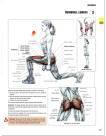
Example of Human Kinetic’s Strength Training Anatomy Dumbbell Lunge

Example of Human Kinetic's Strength Training Anatomy Dumbbell Lunge

Strength Training Anatomy-2nd Edition
By Frederic Delavier

Strength Training Anatomy

The detailed artwork in the Strength Training Anatomy book showcases the muscles used during each exercise and delineates how these muscles interact with surrounding joints and skeletal structures. Like having an X-ray for each exercise, the information gives you a multilateral view of strength training not seen in any other resource.

This book also contains new information on common strength training injuries and preventive measures to help you exercise safely. Chapters are devoted to each major muscle group, with 115 total exercises for arms, shoulders, chest, back, legs, buttocks, and abdomen.

Order from Human Kinetics here

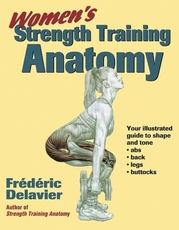
Women’s Strength Training Anatomy
By Frederic Delavier

Woman's Stretching Training Anatomy

With information on strengthening and toning the legs, buttocks, abs, and back, Women’s Strength Training Anatomy provides full-color, detailed anatomical illustrations of exercises for these hard-to-shape areas. Readers can see the muscles at work during each exercise, like an X ray of the body in motion.

Order from Human Kinetics here

Stretching Anatomy
By Arnold Nelson, Jouko Kokkonen

Stretching Anatomy

Each exercise in this book includes detailed instruction on how to stretch, when to stretch, primary and secondary muscle emphasis, and which muscles are activated for support. Stretching programs provide three levels of difficulty, including light stretching that can be used as a warm-up or to aid in recovery from soreness or injury. And summary movement tables show how to customize stretching programs to focus on key problem areas.

Order from Human Kinetics here

Cycling Anatomy
By Shannon Sovndal

Cycling Anatomy

Cycling Anatomy features 74 of the most effective cycling exercises, each with clear, step-by-step descriptions and full-color anatomical illustrations highlighting the primary muscles in action.

Cycling Anatomy goes beyond exercises by placing you on the bike and into the throes of competition. Illustrations of the active muscles involved in cornering, climbing, descending, and sprinting show you how the exercises are fundamentally linked to cycling performance.

Order from Human Kinetics here

Yoga Anatomy
By Leslie Kaminoff

Yoga Anatomy

With clear, expert instruction and full-color, detailed anatomical drawings, Yoga Anatomy depicts the most common asanasto provide a deeper understanding of the structures and principles underlying each movement and of yoga itself.

From breathing to standing poses, see how each muscle is used, how slight alterations of a pose can enhance or reduce effectiveness, and how the spine, breathing, and body position are all fundamentally linked.

Order from Human Kinetics here

Swimming Anatomy (available in October, 2009)
By Ian McLeod

Swimming Anatomy

See how to achieve stronger starts, more explosive turns, and faster times! Swimming Anatomy will show you how to improve your performance by increasing muscle strength and optimizing the efficiency of every stroke.

Swimming Anatomy includes 74 of the most effective swimming exercises, each with step-by-step descriptions and full-color anatomical illustrations highlighting the primary muscles in action.

Pre-order from Human Kinetics here

Read Full Post »

By Sue Shekut, Owner, Working Well Massage, Licensed Massage Therapist, Certified Wellness Coach, ACSM Personal Trainer

Pair a great upper body stretch with a few minutes of relaxation by using a yoga bolster to stretch every day. Let gravity do the work of opening your chest muscles. Meanwhile, give your back muscles a much needed break from holding you upright all day. AND give yourself an easy way to de-stress, take a few minutes to relax and unwind after a busy day.

Note: Always consult your doctor or health care provider before attempting any new exercises. This information is intended for educational purposes only and should not be construed as medical advice.

Gina Saka, a Chicago-based licensed massage therapist and yoga instructor, shows you how to perform the Yoga Bolster Stretch.

Why Stretch With the Yoga Bolster?
Working on a computer all day is tough on your back and neck muscles. Why is that? Forward leaning work causes us to tighten our pectoral and subscapularius muscles. As these muscles tighten, this can also lead to strain and pains in our upper back and neck muscles.

https://workingwellresources.blog/wp-content/uploads/2009/09/17975.jpg

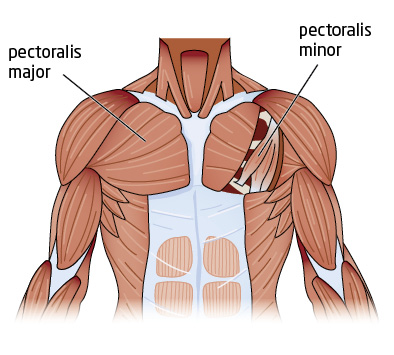
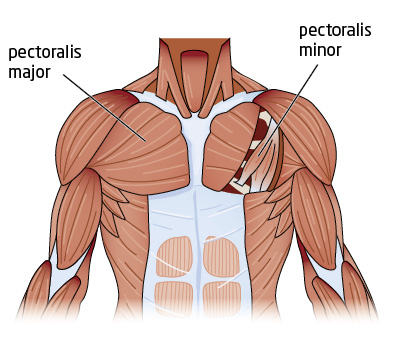
Pectoral Muscle Diagram from Demand Studios

Notice in the diagram that there are two pectoral muscles: Pec major and pec minor. When you use a keyboard or mouse, you contract these muscles–sometimes for hours. This can cause your shoulders to round. The corresponding muscles in your back and neck have to pull backwards to keep you from falling over. Over time these back and neck muscles can become weak or strained. Painful trigger points can develop. And soon, you have that “Oh my aching neck or shoulder pain” feeling. (Note: We will cover anatomy of pectoral and back muscles in depth in later posts. The more you know about your own body, the more you can keep yourself healthy! )

If you have a job that requires you to sit or lean forward for hours at a time, it’s tough to stretch enough to counteract the stress this puts on your upper back and neck muscles. Like brushing your teeth a few minutes each day (versus once a week for 2 hours), it’s far better to stretch a few minutes each day than just once a week or when you go to the gym!

So Where Do I get a Yoga Bolster?
As versatile as they are for stretching, yoga bolsters are not often available at your local department or even sporting goods store. However, it’s easy to order your yoga bolster from many venders online. You may use either a round or a rectangular bolster for this stretch and for many other relaxing yogic stretches.

Round bolsters should be at least 9″ by 25″.
Square bolsters should be at least 24″ by 12″ by 6″s.
If you are very tall (over 6′-2″), you may want a longer bolder, say 10″ by 29″.

Vendors that sell yoga bolsters at reasonable prices:

YogaAccessories (TM) Round Cotton Yoga Bolster

Yoga Direct Deluxe Round Yoga Bolster

YogaAccessories (TM) Rectangular Cotton Yoga Bolster

YogaAccessories (TM) Deluxe Rectangular Cotton Yoga Bolster

And if you MUST have an organic yoga bolster, try Organic Yoga Bolster – Cotton Round Cushion – Natural Cotton Fill A bit more expensive, but made of organic materials. (Just don’t eat them!)

And for Hemp bolsters, try Natural Fitness Hemp Yoga Bolster

Note: This is not an exhaustive list of all vendors of yoga bolsters. And we do not receive any advertising income from these product recommendations. Feel free to browse your favorite online search services to find the bolster that’s right for you!

Read Full Post »

Experts share tips about choosing a fitness professional who can put you on the road to better health.
By Annabelle Robertson
WebMD Feature
Reviewed by Louise Chang, MD

Laurie Heit couldn’t imagine working with a wellness coach. In fact, she didn’t even know what a wellness coach was — until one transformed her life.

A compulsive overeater, Heit had struggled with her weight since childhood. She went on diet after diet, and was finally ready to join Overeaters Anonymous when a friend told her about wellness coaching. She suggested Chere Bork, a registered dietitian and coach. Heit jumped at the chance.

After her first appointment, Heit was so impressed that she decided to do more. She has now had 12 telephone coaching sessions with Bork at a cost of $75 each. She insists they were worth every penny.

Although Heit has made significant improvements to her diet and lost weight, she says she’s gained something far more important. Through the coaching process, Heit discovered that losing weight wasn’t what she needed most. She longed to be at home with her family. So after debating the options, Heit quit her insurance job and became a full-time homemaker. She’s never been happier.

“My goal didn’t change, but how I got there did,” she explains. “The time and exploration of the right food plan helped me explore myself and my wants in life.”

Fitness Trends

According to a recent survey by the American College of Sports Medicine (ACSM), “educated and experienced fitness professionals” now constitute the most important fitness trend in the world, having jumped from third to first place since last year. “Personal trainers” rose from seventh to third place.

“We want to be well. We yearn to be in control and feel better. We want more energy,” says Margaret Moore, founder of Well Coaches, the only health and wellness coaching certification program endorsed by the ACSM. “But there is an enormous gap between wanting to be well and the everyday reality of living with the mental and physical health penalties of overeating, underexercising, and having too little down time.”

That gap is growing. The CDC reports that more than 66% of adult Americans are overweight or obese.

Doctors’ Views on Wellness Coaching

That’s one of the reasons why Moore and other wellness coaches have been working to increase awareness about the field among medical professionals. Moore readily admits, however, that although the idea is becoming increasingly popular with the public, it’s only beginning to catch on with doctors.

“Physician referral to coaches is still at an early stage,” she says. “We don’t have reimbursement, and it’s going to take years to fall into place. We see grass-roots, small-scale doctors coming to us. But most physicians just aren’t into it yet. It’s still very new.”

One doctor who has embraced the idea is Michael Lano, MD. Director of the Ridgeview Clinics, a group of primary care facilities in suburban Minneapolis, Lano refers several patients a month to Bork.

“I’m a family physician and I always tell my patients that it’s my job to help them live a long, healthy life,” he says. “But 98% is their part, and that’s what the life coach helps with — everything from diet and exercise to emotional well-being. It’s the same thing that we [doctors] deal with, but she deals with it from a lifestyle perspective.”

Lano says he sees significant improvements in patients who work with Bork. Most begin exercising and eating better. Many make other important changes as well, which tend to have a boomerang effect on their overall outlook and lifestyle, as they did with Heit.

Ideal Candidates for Wellness Coaching

However, not everyone is a good candidate for wellness coaching, says Lano. Some may be too old or sick to change. Others may simply be unmotivated. The ideal patient is someone who may not be doing anything bad, but they’re not doing the good things, either, he says. “They’re not eating well. They’re not exercising. They’re stressed. They’re stuck. They’re not making progress.”

Jim Harburger found himself in that situation. The 66-year-old clinical psychiatrist began to gain weight 32 years ago when he abandoned his heavy smoking habit. Gradually, his weight began to creep from 165 pounds to 220 pounds.

Much of the problem, Harburger says, was stress from his high pressure job as the director of a large behavioral health organization. But the trigger was the daily gift of sweets offered by his secretaries, which Harburger found irresistible.

“The metaphor was that I was being eaten alive by my job, but I was actually eating to handle the anxieties from my work,” he says.

Harburger joined a gym. But like so many others, he found it hard to get there and went only sporadically. Desperate, he finally decided to hire a personal trainer. The gym recommended Ellen Albertson, a staff member who was a registered dietitian, a licensed nutritionist, a certified personal trainer, and a licensed corporate wellness coach.

Albertson began each session with 20 minutes of walking, during which time she and Harburger would talk.

“One might think I could walk on my own, but what she was doing was listening to me about my life, learning about how I managed eating, the stressors in my life, and my relationship to my body,” he explains. “She became familiar, almost like a good therapist, with all aspects of my life. And slowly, she built a relationship that I started to value.”

Albertson also helped Harburger manage his cravings. A self-confessed sugar addict, he likened it to withdrawal from cocaine. “I felt my body shaking, I couldn’t think, and I was in total transition for almost a week,” he says. “Now I know that if I have a cookie, I need to separate myself from what I am eating or I will just keep eating.”

The result? Harburger, who visits the gym almost every day now, dropped 40 pounds over a three-year period.

Albertson says she sees it all the time. People come in expecting to be told what to do, but what actually works best for them is to slow down, think about their goals, and then determine the path themselves.

“People are out of touch with their bodies. When you listen to your body, you eat when you’re hungry, you stop when you’re full, and you enjoy food for its rightful place in your life,” she says.

Looking for the Right Wellness Coach

Michael Arloski, PhD, is the author of Wellness Coaching for Lasting Change, a training manual used by several coaching programs, works with dozens of corporate clients, training them on the finer points of coaching for long-term lifestyle changes.

“We need to move from ‘prescribe and treat,’ or what I like to call ‘education and implore’ — where we’re begging someone to change after we give them a lot of information — to a coaching model where we’re advocating for change and becoming an ally with that person,” he says.

To determine whether a coach is reputable, Moore suggests checking references and asking for testimonials. Look for people with degrees or certification from reputable organizations such as WellCoaches and then interview them extensively about their background.

Moore advises choosing a coach who makes you feel the most energized and confident. You should be inspired after a coaching session, with lots of “Aha!” moments, as well as motivated about your ability to make needed changes in your life.

Plan to pay between $50 and $150 a session, and expect to spend at least three months with a coach before seeing meaningful progress, which is typically defined as the creation of two or three healthy new habits. And don’t hesitate to end the relationship if something doesn’t feel right.

In addition to his dramatic weight loss, Harburger says the changes have had a positive effect on his career. Harburger’s wellness coaching has led him to return to private practice and reduce his workweek to 75%.

“I struggled with giving myself permission to do that, but it was miraculous. Before, I would never have initiated that. Now, I feel so unencumbered,” he says. “It’s like I’m on constant vacation.”

Link to article in WebMD .

Read Full Post »

In an article from Reader’s Digest, “Change the Way You React to Stress,” Robert Fried, Ph.D., director of the Stress and Biofeedback Clinic at the Albert Ellis Institute and a senior professor of psychology at Hunter College said, “When you’re stressed, you may be sitting on the outside but running on the inside. Deep breathing for stress reduction means you’re sitting on the outside and you’re reposing on the inside.”

Once you’ve learned to do deep breathing, says Dr. Fried, author of Breathe Well, Be Well, it takes less work to breathe, thus reducing the amount of work your body has to do and sending a message to your brain that you’re inactive. After a while your body gets the signal and your heart rate and oxygen consumption slow.

The Deep Breathing Technique

This exercise combines deep breathing with mental imagery to help you feel relaxed yet alert. The results are immediate, so you can pull out the technique any time you need to feel calmer and more in control. Dr. Fried has used it in treating everything from tension and anxiety to burnout syndrome, panic disorder, agoraphobia, depression, tension headache, and high blood pressure.

A few notes of caution (yes, even something as seemingly innocuous as deep breathing isn’t entirely risk-free — a testament to its power to effect change in the body). If you’re not used to deep breathing, your diaphragm muscle will need time to adjust and become toned, so start slowly. If you experience cramps while doing the exercise, stop. Also, deep breathing may cause a significant decrease in blood pressure, so if you suffer from low blood pressure or fainting, be cautious when trying it. Check with your doctor before doing this exercise if you have a condition in which you may need to hyperventilate, such as diabetes or kidney disease. (Under certain circumstances hyperventilation may be the body’s protection against diabetic acidosis.) And diabetics, take note: The sudden reduction in blood levels of certain stress hormones has been demonstrated to reduce the need for insulin and may cause your blood sugar to drop.

Day 1. First, seat yourself comfortably, with your back supported by the back of the chair. Loosen any tight-fitting clothing and place your hands on your knees. Let yourself relax. Now you’re ready to begin.

• Close your mouth and breathe through your nose only.

• Put one hand on your chest and the other on your stomach. As you inhale, hold your chest and don’t let it rise. Let the hand on your abdomen rise as the air fills your lungs.

• Exhale slowly, pulling your abdomen back as far as it will go without letting that raise your chest in the process. Spend a minute or so on this exercise. If you feel dizzy, you are working too hard. Stop and rest a little until the dizziness passes, then make the motions a little more subtle.

Day 2. Follow the same routine you followed yesterday, but practice the exercise for two to three minutes.

Day 3. Breathe for four minutes, and try the exercise without your hands. You should now be noticing that your inhale and exhale are approximately the same duration. There should be no pause before or after inhale or exhale — just one smooth motion. Your breathing rate may range between three and seven breaths per minute.

Day 4. Today you introduce imagery. Sit in your chair as before. Now:

• Close your eyes.

• Picture a very specific scene — the beach in July, a cool pine forest, swimming underwater. Try to put yourself in the scene — hear the sounds, feel the air (or water), smell the scents.

• As you focus on this scene, begin your deep breathing. Each time you inhale, imagine that you are breathing in the air of your scene, saying to yourself, “I feel awake, alert, and refreshed.” And as you breathe out, feel the tensionin your body flow out with your breath as you say to yourself, “I feel relaxed, warm, and comfortable.”

Do this for four breaths, then stop. After a few minutes of rest, repeat the exercise. Try the routine once in the morning and once in the evening. After about three weeks, Dr. Fried recommends that you do the exercise in rounds of three: Four or five breathing cycles and a few moments of rest, followed by a second round of four or five breathing cycles and a few moments of rest, and finally a third round of four or five breathing cycles.

Once you’ve mastered deep breathing, you can pull it out of your relaxation arsenal whenever life gets tense. Not only will it help slow your body down, but it may also, in effect, slow down time, providing those critical moments that are often the difference between exploding and maintaining your cool. As you breathe in and out, release the physical tension and then ask yourself the following questions:

• Is the way I’m reacting to this situation increasing my tension?

• Is this reaction logical and reasonable?

• Is this reaction realistic?

• Is there another way to view the situation?

The answers may enable you to “spin” the stressful situation from the negative to the positive, or at least to the neutral.

Deep Breathing Technique from Reader’s Digest article, “Change The Way You React To Stress:Deep Breathing Exercise”

Read Full Post »

Older Posts »